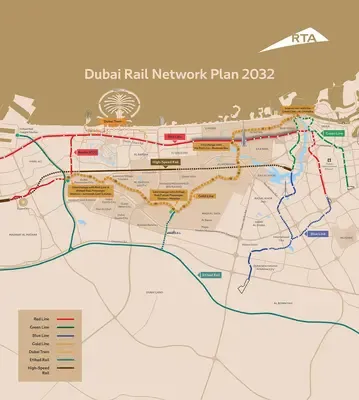
Dubai’s newly released Rail Network Plan 2032 map has revealed the full route of the upcoming Gold Line, showing a corridor that begins in the historic Al Ghubaiba area and runs across the city to terminate at Jumeirah Golf Estates. The line will pass through key residential and growth hubs across old Dubai, central districts and newer suburban communities.
The map also highlights major interchange points, including connections with the Green Line at Al Ghubaiba, with both the Red and Green Lines at BurJuman, and with the Red Line at Business Bay. A key feature is its integration with Etihad Rail at Jumeirah Golf Estates, where an interchange station is planned, positioning the Gold Line as a connector between Dubai’s Metro network and the wider national rail system. The map also points to a future Etihad Rail interchange in Meydan, indicating a second integration point along the route.
Here is the map shared by the Government of Dubai Media Office:
Further details from the route map show the line moving from Al Ghubaiba through Bur Dubai and Al Satwa in old Dubai, before linking with the Red Line at Business Bay. It then passes through Meydan, Al Barsha South and Jumeirah Village Triangle, continuing across fast-growing residential communities, Jumeirah Village Triangle and Dubai Production City, before ending at Jumeirah Golf Estates, with onward connectivity to Expo City.
The map also references a high-speed rail corridor running from Ras Al Khor towards areas beyond Expo City. No further details on this high-speed rail component have been disclosed at this stage.
The route details align with how the project has been positioned in official visuals as part of an integrated transport network. An accompanying project video described the Gold Line as “connecting with the Red and Green Lines of Dubai Metro” and “integrating with Etihad Rail”, while also referencing a future Etihad Rail station along the corridor. The line is designed to run 42km with 18 stations across 15 strategic locations, at a depth of up to 40 metres underground, and is expected to serve 1.5 million residents while supporting more than 55 major real estate developments.
By beyond 2040, the line is projected to carry 465,000 passengers daily, with cumulative economic returns over 20 years estimated at up to 430 per cent, according to project materials, which also describe it as the first fully integrated underground route in the emirate, with a tunnel network twice the length of the existing Dubai Metro tunnels.
The focus on integration comes amid efforts to link different modes of transport across the UAE. Etihad Rail has already announced a network of passenger stations across the country. Authorities have also emphasised that integrating metro, rail and other transport modes will be key to easing congestion, reducing emissions and supporting population growth as economic activity accelerates.
Proposed Dubai airport express line to connect DXB, DWC with 5 new metro stations New highway, trains, metro: How UAE daily commutes will change for residents-
Be sure to keep these things with you during the first round of elections and voting at night
-
From May 1, All Maharashtra Restaurants And Vendors Ordered To Declare Use Of Fake Paneer

-
UPI ID is not a payment! To avoid fraud, first understand the original-fake

-
Window AC vs Split AC: Which AC will be best for you in summer? understand the whole difference

-
WhatsApp Plus Premium features in testing