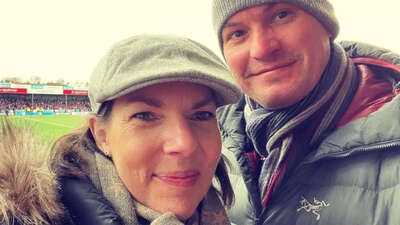
Imagine losing your partner to a rare disease, and instead of immersing yourself in grief, you make a vow to keep her alive in every possible way!
A story out of the UK has people talking, and it’s not hard to see why. Katy Miles was just 46 when she died from a rare cancer, and the thing that’s left her family and a lot of strangers so shaken is how it all started. One symptom — that’s it. Something that barely seemed worth worrying about at the time, but it turned out to be the only warning she got.
Her husband, Matt, has shared his grief and memories publicly, and what stands out isn’t just how much he loved her, but this quiet reminder: Sometimes, the scariest illnesses don’t come crashing in; they tiptoe so silently that you almost miss them.
Matt has now set his mind on a tribute. He’s taking on a series of tough challenges to raise money for the Sue Ryder hospice , the place that cared for Katy in her last weeks. For him, it’s about gratitude, and maybe about fighting back a little against a disease that showed up so quietly and took so much.
What happened to Katy Miles?People remember Katy as someone warm and full of life. Per The Mirror, she died in September 2024 at 46, after years of dealing with cancer. She first got her diagnosis at 38, but looking back, the only clue that anything was wrong happened in 2016, in a CrossFit class. Katy, a lifelong athlete, suddenly found she couldn’t control her bladder, a problem that didn’t seem urgent or even unusual for someone pushing themselves that hard in the gym.
Turns out, that was her only obvious warning sign before doctors told her she had low-grade serous ovarian carcinoma (LGSOC). LGSOC isn’t just rare; it’s the kind of disease that doctors only catch in a small number of patients. For Katy, the story was all too familiar: the problem is hard to spot, it hides, and by the time anybody figures it out, it can be serious.
Katy went through treatment, and for a while, things looked good. She was told the cancer was gone. But by 2024, it had spread, and her health went downhill fast. She entered hospice care, surrounded by close family and Matt, who hardly left her side.
Matt has made it his mission to honour Katy. He’s picked her police collar number, 1481, as his inspiration and is using it to shape everything he’s doing: a 1,481-mile row, 1,481 burpees, hiking 1,481 kilometres on the Camino de Santiago in Spain, and finally, running the London Marathon. It’s about love, but it’s also about making some noise for people and families facing rare diseases that don’t play by any of the usual rules.
Low-grade serous ovarian carcinoma: What is it?Katy’s battle isn’t just a personal story; it highlights something broader about rare diseases. They’re tough to spot, and they easily slip under the radar. Low-grade serous ovarian carcinoma is rare and tends to grow more slowly than other ovarian cancers. It usually affects younger women, often in their 40s and 50s, and makes up just a small percentage (2-10% of cases) of ovarian cancer cases. The problem? It resists standard chemo and keeps coming back, leaving doctors often scrambling to find what works.
The usual symptoms, from pelvic pain, bloating, to feeling tired, needing to pee more often, are so vague that they blend right into everyday life. That’s part of what makes this disease so insidious.
How Matt Miles is paying tribute to Katy MilesPer Express, Matt and Katy’s story started at work in 2009 and took off from there. Both police officers, both big on sports: rugby, skiing, you name it. Matt proposed on a ski trip, surprise tuxedo and all, and they married on May 10, 2013. Matt describes Katy as outgoing and infectious, the kind of person who could fill any silence in the room with a laugh.
In his words, "I'm quite shy and introverted. She was very extroverted, so she was very good at filling the gaps. She had a very infectious laugh and a huge, beaming smile. You'd never hear a bad word said about her."
Katy was the healthy, athletic type. She threw herself into CrossFit, which is where everything started to change. One day in 2016, mid-workout, she suddenly felt a desperate need to pee. She went to her GP, got a scan, and the doctors at first thought it was nothing serious, maybe just a cyst. But a biopsy told a different story, and in December 2016, she was told it was likely cancer.
Matt remembers every detail from that day: the clothes Katy wore, the shock when the news finally hit home, her legs giving out, both of them crying.
Per Matt, "I remember Katy had a yellow jumper on and blue jeans and we walked out into the corridor and went through a set of double doors. As soon as we went through those, she literally grabbed hold of me and her legs just buckled. Then she just burst into tears because she'd just been told that she had cancer."
The type wasn’t clear at first, but eventually they found out it was LGSOC, a rare and slow-growing disease. Katy had surgery, including a bowel resection and later a full hysterectomy and stoma bag, then rounds of brutal chemo. Afterward, she started to feel like herself again.
But the calm didn’t last. By 2019, scans revealed new tumours, and even though doctors said they weren’t a problem yet, the approach shifted. It wasn’t about beating the cancer anymore; it was about keeping Katy healthy for as long as possible. Treatments changed over time, and for a while, Katy kept up. But in 2024, the cancer moved into her bones and skin. The prognosis gave her about a year, but complications sped things up. She needed a nephrostomy (draining urine straight from her kidney), which she called the most painful thing she’d ever done, but she still faced it head-on.
Around this time, Sue Ryder Hospice became a lifeline, offering Katy and her family some welcome relief. By spring, Katy was tired. She told Matt she couldn’t keep going. She made the difficult decision to have her nephrostomies removed, and everyone, from doctors, nurses, to her family, felt the weight of that choice. But Katy was at peace with it; in those final weeks, she smiled again.
Katy’s last days were filled with the people she loved. When she died on September 24, 2024, Matt wanted to make sure her memory had a real impact. Starting on Katy's birthday on August 9, 2025, he set out on a series of challenges, all of them always tying it back to that her police collar number: 1481. Burpees, rowing, running, plunging into freezing water, trekking across Spain — all to thank the hospice and raise money for others in need.
He set his first target at £10,481 and has already beaten it, now aiming for £14,810. The London Marathon is the grand finale. He’ll close out the run with Katy’s patch on his shirt, a little wooden cross she carried. When things get tough, those reminders keep him going.
“Katy will be at the forefront of my mind,” Matt says. “She’s why I’m doing all this.”
-
Health at risk! 55% of young Indians have dropped health insurance in the last 3 years—act now before it’s too late to avoid regret.

-
Read messages without opening chats! WhatsApp launches a new AI feature to preview texts instantly without marking them as seen.

-
UP Board 12th Result 2026 Shorlty: UPMSP Class 12 Result At upmsp.edu.in, Steps To Check

-
Where Is Gurpa Hill? The Holy Site Linked To Lord Buddha’s Disciple’s Nirvana

-
37,000 Samsung Workers Stage Massive Rally Over Wages As AI Boom Fuels Record Profits, Warn Of 18-Day Strike