Global energy markets witnessed a cooling trend on Wednesday, April 22, as President Donald Trump moved to extend a delicate ceasefire with Iran just hours before its scheduled expiry. The decision has provided a temporary floor for the global economy, pulling Brent crude back from the psychological $100-per-barrel mark seen earlier this week.
Prices Soften on Peace Hopes
As of 11:19 AM IST, the benchmarks showed a reversal of Monday's 3% spike:
- Brent Crude: Down $1.06 (1.08%) at $97.42 per barrel.
- U.S. West Texas Intermediate (WTI): Dropped $1.14 (1.27%) to $88.53 per barrel.
The decline followed a White House statement confirming the extension was requested by Pakistan Prime Minister Shehbaz Sharif. President Trump noted the move was necessary due to a "deeply divided" political landscape in Tehran, giving Iranian authorities more time to submit a cohesive peace proposal.
Hormuz Blockade
The physical flow of oil remains severely restricted. The Strait of Hormuz, which carries roughly 20% of global oil demand, is still under a U.S. naval blockade.
- Real-time tracking shows only 3 ships successfully transited the waterway in the last 24 hours.
- The U.S. Department of Defense confirmed the boarding of the "stateless" tanker MT Tifani on April 21, alleging it was involved in smuggling sanctioned crude.
Inventory and OPEC+ Factors
The market is now bracing for volatility as the U.S. Energy Information Administration (EIA) prepares to release inventory data. Preliminary figures from the American Petroleum Institute (API) suggest a 4.5 million barrel decline in U.S. crude stocks, which could cap any further downward movement in prices.
Meanwhile, OPEC+ members, led by Saudi Arabia and Russia, are set to meet on May 3. The group had previously agreed to return 206,000 barrels per day to the market starting in April to temper price spikes. However, analysts at Goldman Sachs warn that an "$18-per-barrel geopolitical risk premium" remains embedded in current prices as long as the Hormuz crisis persists.
While today’s news is bearish for prices, the "Scenario 1" escalation remains a threat. Citi analysts have warned that if diplomatic efforts in Pakistan falter and the blockade extends through May, WTI could break above $115, targeting a second-quarter average of $110 per barrel. For now, the "Trump Extension" has bought the market time, but the underlying supply shock is far from over.
-
New Regulations for Online Gaming Introduced by Indian Government

-
Dubai: 5 weekend spots with free pool access, beach days and dining deals

-
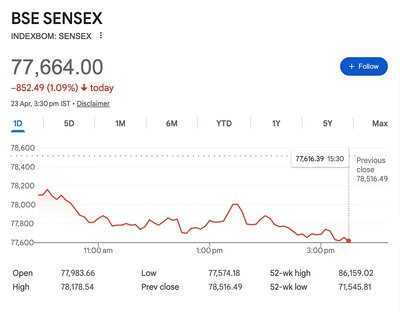
Late Sell-Off Shakes Dalal Street, Sensex Crashes 852 Pts While Nifty Drops 205 Points Below Key 24,200 Level Amid Banking & IT Weakness
-
Understanding Chanakya's Wisdom: The Choice Between Wealth and Women

-
Jet2 new check-in desk message for passengers flying to European holiday location