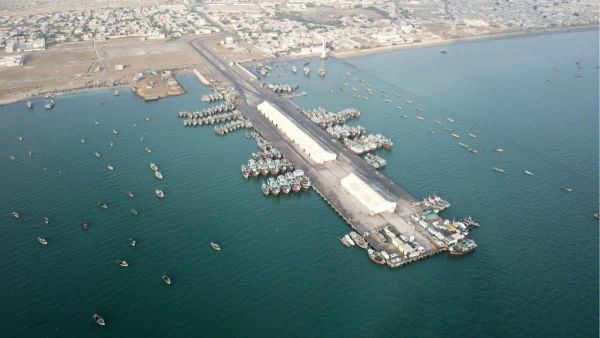
Gwadar Port is facing twin threats from two directions simultaneously, and neither shows signs of easing. From the northeast, active armed conflict between Pakistan and Afghanistan, triggered when Islamabad launched cross-border military operations in late February — continues to block the land corridors that are supposed to give Gwadar its economic purpose. From the southwest, a maritime attack on April 12 confirmed what security planners had long feared: that the sea lanes around the port are no longer beyond the reach of Baloch insurgents.
Three Pakistan Coast Guard personnel were killed near Jiwani — a coastal town approximately 84 kilometres from Gwadar port — when gunmen opened fire on their patrol vessel in the Arabian Sea. The attackers, who approached by speedboat, escaped. Pakistani authorities confirmed the deaths; the BLA claimed responsibility and announced the simultaneous formation of a dedicated naval wing, the Hammal Maritime Defence Force. No credible official or wire service source has confirmed that the vessel sank — that detail, which has circulated in some reporting, is unverified and should not be treated as established fact. What is confirmed is that it was the first known instance of a Pakistan Coast Guard patrol boat being directly targeted at sea by Baloch insurgents.
The attack landed barely a week after Chinese-mediated talks between Pakistan and Afghanistan concluded in Urumqi. Those negotiations, held April 1–7, represented a genuine diplomatic effort. The discussions ended without a formal agreement to halt hostilities, though Beijing maintained cautious optimism, stating that both sides had agreed to explore a comprehensive solution to their differences. The outcome was announced by China's Foreign Ministry on April 8. It was not a total failure — both delegations committed to non-escalation — but it fell well short of what the security situation requires. It was also not China's first attempt at mediation; previous rounds of talks in Doha, Istanbul, and Riyadh had also failed to produce lasting agreements.
China had powerful reasons to want the talks to succeed that went well beyond goodwill. CPEC — the corridor of roads, pipelines, ports, and industrial zones linking western China to the Arabian Sea — is one of Beijing's most consequential infrastructure investments. Gwadar is its outlet to the ocean.
Afghanistan, whether cooperative or obstructive, is a critical variable in whether land-based connectivity across the region ever materialises. What China could not invest in was the trust between the two delegations, and trust was the one thing the talks required.
Pakistan came to Urumqi with demands that were, in their own terms, entirely reasonable: that the Taliban government take concrete, measurable action against TTP militants based in Afghanistan responsible for attacks killing Pakistani soldiers and civilians. Operation Ghazab lil-Haq, launched on February 26, 2026, was Pakistan's large-scale military response after it concluded it had no other option — cross-border airstrikes and ground operations targeting Taliban positions in multiple Afghan provinces. The Taliban condemned the operation as an act of aggression and arrived in Urumqi with its own list of grievances.
Kabul's position was internally coherent: it will not subordinate its sovereignty to Pakistani security priorities, and the TTP issue, in its framing, is a matter for bilateral discussion under conditions of mutual respect. Adding complexity, a UN experts report found that Pakistan had yet to publish credible evidence that TTP attacks within its territory were directly controlled or directed by Afghan authorities — undermining the legal and political basis of Pakistan's demands in international forums.
Between these positions, the Chinese mediators had limited room. Talks involved mid-level officials rather than senior decision-makers, which constrained from the outset what could realistically be agreed.
The maritime attack compounds the commercial problem Gwadar already faced. The port has been described, repeatedly and enthusiastically, as Pakistan's economic game-changer — a deepwater facility capable of handling large cargo vessels, positioned to service Chinese trade routes and become a regional hub. The reality has been less dramatic. Traffic through Gwadar remains thin relative to its capacity. Chinese investors have continued to flag security concerns. The surrounding city is underdeveloped even by Pakistani standards — lacking reliable electricity and clean water while billions flow into port infrastructure.
The BLA's shift to maritime operations did not emerge from nowhere. The group had already established a drone unit, the QAHR, which carried out aerial attacks including strikes targeting Gwadar Port itself. The Hammal Maritime Defence Force is therefore not a pivot from land to sea — it is the addition of a third operational domain to a group that has been systematically expanding its capabilities. In announcing the naval wing, the BLA warned that its military scope is "no longer limited only to the mountains and cities" and that it has "achieved the full capability to target the enemy in the deep seas, including its naval installations and assets." That is a statement of intent, not just of capability.
Insurers who cover vessels operating in the region will note the April 12 attack. Premiums will adjust. Shipping companies will reassess routes. Port operators, already dealing with sluggish volumes, will find the commercial pitch harder to make. A port whose land approaches are threatened by insurgency, whose diplomatic hinterland is consumed by active armed conflict, and whose sea lanes are now explicitly declared a target — that port faces a compounding problem that no single policy lever can resolve.
Pakistan's government and military face a situation without obvious exits. Counterinsurgency on land is already stretching resources. Protecting maritime approaches requires a different capability set — vessels, coastal surveillance, and intelligence networks oriented toward sea-borne threat detection — that the Coast Guard is not currently configured for. Diplomatic efforts with Afghanistan remain deadlocked, and the Urumqi process has shown that even sustained Chinese pressure cannot bridge the gap of mutual distrust.
And somewhere in Beijing, the calculus is being revised. The investment is too large to walk away from. The strategic logic of Gwadar is too important to abandon. But with each new front the BLA opens, and each round of talks that fails to hold, the gap between what Gwadar was promised to be and what it is actually becoming grows harder to ignore.
About the Author
Ashu Mann is an Associate Fellow at the Centre for Land Warfare Studies. He was awarded the Vice Chief of the Army Staff Commendation card on Army Day 2025. His research focuses include the India-China territorial dispute, great power rivalry, and Chinese foreign policy.
-
Now your car will also ask for alcohol! The car will run on alcohol and not petrol-diesel? ‘E85’ masterplan prepared

-
Political Storm Over Pappu Yadav’s Remarks on Women; BJP Demands Apology, Women’s Commission Seeks Explanation

-
LSG vs RR match prediction: Who will win Lucknow Super Giants vs Rajasthan Royals IPL 2026 match 32?

-
Abhishek Sharma fires back at his critics with a 47-ball century and walks into Kohli’s T20 record books

-
Panacea home remedy for stomach gas, “All the gas will come out in a jiffy, bloated stomach will go away” – News Himachali News Himachali