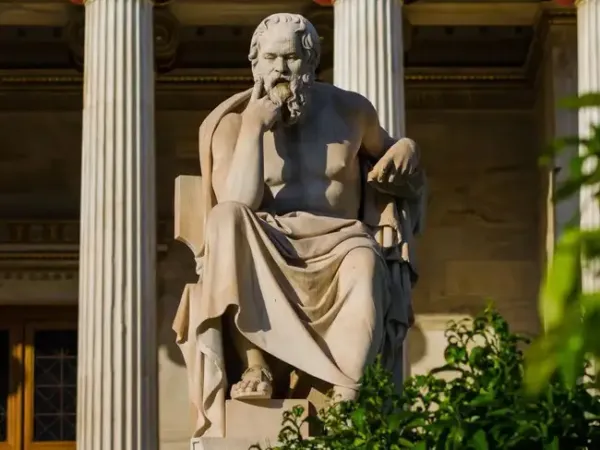
The foundational bedrock of Western intellectual tradition was largely laid by an Athenian iconoclast called Socrates, who pivoted philosophical inquiry away from the cosmos and toward the human soul. This thinker revolutionised the field by prioritising the exploration of virtue, personal integrity, and social duty. Curiously, he never committed a single syllable to parchment; instead, his presence and principles were immortalised through the conflicting narratives of his disciples, primarily Plato and Xenophon. This reliance on secondary perspectives creates a complex historiographical riddle known as the Socratic problem, where researchers must struggle to distinguish the flesh-and-blood man from the idealised protagonist depicted in ancient dialogues.
One of the quotes by Socrates that offers a deeper insight into human psychology and behaviour is this: ‘I cannot teach anybody anything. I can only make them think. To find yourself, think for yourself.’
Quote of the day by Socrates: Power of intellectual awakening
The statement by Socrates highlights the true role of a guide or mentor. It suggests that genuine education is not about shoving facts into a passive mind but rather about sparking a flame of curiosity. A teacher acts more like a mirror than a bucket. They do not give you new eyes; they simply help you clear your vision so you can view the world accurately. This approach moves away from the old style of learning where people just memorise data to pass tests. Instead, it focuses on the internal process of logic. By asking deep questions, a guide forces a person to look at their own beliefs and find the gaps in their reasoning.
In today's fast world, this concept is more vital than ever. We are often buried under a mountain of data and quick answers from the internet. Real wisdom comes when we stop just accepting what we are told and start asking why things are the way they are. In modern jobs, the most valued people are not those who know every rule, but those who can solve new problems by using their own brains. This shift from being a sponge to being a thinker is what allows society to grow and change for the better.
Socrates quote of the day: Focus on personal sovereignty
Socrates’ message also focuses on the journey of discovering one's true identity through independent logic. It argues that you can never truly know who you are if your thoughts are just copies of what your parents, friends, or leaders say. To reach a state of self-knowledge, a person must be brave enough to separate their own values from the noise of the crowd. This requires a high level of mental strength. It is much easier to follow a path that someone else built than to cut your own trail through the woods. However, only the latter leads to a life that feels honest and meaningful.
In our current age of social media, the pressure to fit in is constant. Algorithms try to tell us what to like, what to wear, and how to feel about every topic. If we do not actively choose to evaluate these influences, we become ghosts of other people's ideas. By practising the habit of solo reflection, we reclaim our power. We move from being a small part of a herd to being a unique individual with a clear purpose. Finding your own voice in a loud world is the ultimate act of freedom and the only way to build a life that is truly yours.
More about Socrates
Socrates, born in 470 BCE within the Alopece suburb, was the child of a sculptor named Sophroniscus and a midwife, Phaenarete. His household enjoyed a respectable standing, which granted him a childhood free from the burdens of extreme poverty. Throughout his life, Socrates was married to two different women, with Xanthippe being the most famous of his three sons. Though legends often paint his home life as stormy, it remained a central pillar of his existence.
Beyond his intellectual pursuits, Socrates acted as a loyal patriot, taking up arms during the Peloponnesian conflict. He eventually became a staple of Athenian street life, captivating the local youth with his rebellious logic. Rejecting the pursuit of gold or bodily ease, the philosopher famously embraced a rugged lifestyle, walking without shoes and wearing tattered robes. This rejection of material status was a physical manifestation of his teaching that the soul’s excellence outweighs any physical riches.
By 399 BCE, legal accusations of religious defiance and misleading the younger generation led to Socrates’ death sentence. Despite having a clear path to flee into exile, he stood firm, honouring the legal system that had raised him. He passed away with tranquil dignity after consuming a poisonous draught. His final breath cemented his reputation as the ultimate martyr for truth and an eternal beacon of ethical bravery.
One of the quotes by Socrates that offers a deeper insight into human psychology and behaviour is this: ‘I cannot teach anybody anything. I can only make them think. To find yourself, think for yourself.’
Quote of the day by Socrates: Power of intellectual awakening
The statement by Socrates highlights the true role of a guide or mentor. It suggests that genuine education is not about shoving facts into a passive mind but rather about sparking a flame of curiosity. A teacher acts more like a mirror than a bucket. They do not give you new eyes; they simply help you clear your vision so you can view the world accurately. This approach moves away from the old style of learning where people just memorise data to pass tests. Instead, it focuses on the internal process of logic. By asking deep questions, a guide forces a person to look at their own beliefs and find the gaps in their reasoning.
In today's fast world, this concept is more vital than ever. We are often buried under a mountain of data and quick answers from the internet. Real wisdom comes when we stop just accepting what we are told and start asking why things are the way they are. In modern jobs, the most valued people are not those who know every rule, but those who can solve new problems by using their own brains. This shift from being a sponge to being a thinker is what allows society to grow and change for the better.
Socrates quote of the day: Focus on personal sovereignty
Socrates’ message also focuses on the journey of discovering one's true identity through independent logic. It argues that you can never truly know who you are if your thoughts are just copies of what your parents, friends, or leaders say. To reach a state of self-knowledge, a person must be brave enough to separate their own values from the noise of the crowd. This requires a high level of mental strength. It is much easier to follow a path that someone else built than to cut your own trail through the woods. However, only the latter leads to a life that feels honest and meaningful.
In our current age of social media, the pressure to fit in is constant. Algorithms try to tell us what to like, what to wear, and how to feel about every topic. If we do not actively choose to evaluate these influences, we become ghosts of other people's ideas. By practising the habit of solo reflection, we reclaim our power. We move from being a small part of a herd to being a unique individual with a clear purpose. Finding your own voice in a loud world is the ultimate act of freedom and the only way to build a life that is truly yours.
More about Socrates
Socrates, born in 470 BCE within the Alopece suburb, was the child of a sculptor named Sophroniscus and a midwife, Phaenarete. His household enjoyed a respectable standing, which granted him a childhood free from the burdens of extreme poverty. Throughout his life, Socrates was married to two different women, with Xanthippe being the most famous of his three sons. Though legends often paint his home life as stormy, it remained a central pillar of his existence.
Beyond his intellectual pursuits, Socrates acted as a loyal patriot, taking up arms during the Peloponnesian conflict. He eventually became a staple of Athenian street life, captivating the local youth with his rebellious logic. Rejecting the pursuit of gold or bodily ease, the philosopher famously embraced a rugged lifestyle, walking without shoes and wearing tattered robes. This rejection of material status was a physical manifestation of his teaching that the soul’s excellence outweighs any physical riches.
By 399 BCE, legal accusations of religious defiance and misleading the younger generation led to Socrates’ death sentence. Despite having a clear path to flee into exile, he stood firm, honouring the legal system that had raised him. He passed away with tranquil dignity after consuming a poisonous draught. His final breath cemented his reputation as the ultimate martyr for truth and an eternal beacon of ethical bravery.