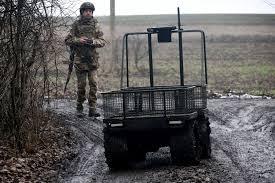
Ukraine is moving fast to expand its use of ground robots in war. The country’s Ministry of Defense plans to contract 25,000 robotic systems in the first half of 2026. That goal would double the total number bought during all of 2025. The initiative is indicative of the general trend towards automation in warfare.
The news was conveyed on April 18 by Ukraine’s Defense Minister Mykhailo Fedorov. According to him, it is the result of consultations with local producers of unmanned ground vehicles.
Such robots serve to provide logistic support, evacuation, and combat aid. Now the ministry intends to entrust robots with all of the frontline logistics. “Our plan is that 100% of frontline logistics should be done using robotic systems,” Fedorov stated.
The scope of application of robots has increased greatly. Ukrainian troops conducted more than 9,000 missions involving ground robots in March. Over the first quarter of 2026, the number of such missions exceeded 21,500.
These were mainly logistic tasks including providing supplies, carrying out medical evacuation, and assisting combat formations. Statistics prove that robots have stopped being just a means of experimentation. It is a routine practice now.
Ukraine’s Strategic Pivot to Long-Term Procurement and Combat Robotics
Ukraine’s Defense Procurement Agency has made 19 purchases worth 11 billion Ukrainian hryvnia.The ministry is also changing how it plans purchases. It now aims to give companies contracts for the next year in advance.
This approach helps firms plan production and manage supply chains. It also reduces delays during periods of high demand.
The government has taken steps to speed up deliveries. It allows contract changes when prices shift. It also aligns funding schedules with production timelines. At the same time, it plans to increase annual procurement volumes. These steps aim to remove bottlenecks and keep equipment flowing to the front.
A new competence center for ground robotic systems is also in development. This center will work with the Armed Forces and the General Staff. It will coordinate how robots are deployed in the field. It will also serve as a hub for manufacturers. The goal is to connect developers, soldiers, and planners in one system.
The growth of this sector has been rapid. Since the start of Russia’s full-scale invasion, more than 280 companies have entered the field. These firms have produced over 550 active robotic solutions. Many focus on low-cost systems that can scale fast. The state-backed defense tech cluster Brave1 has issued 175 grants to support development. These grants help startups and engineers bring new ideas into service.
Ukraine is not only building logistics robots. It is also expanding into other areas. These include engineering systems for mining and demining, combat robots, and loitering ground platforms. The military is also testing automated turrets designed to counter aerial threats. These turrets can track and engage drones without direct human control.
The Strategy of Ukraine for Scalable, Unmanned Warfare
Fedorov stressed the need for systems that are both cheap and effective. The aim is to produce tools that can be deployed in large numbers. This approach reflects the nature of the war, where scale often matters as much as precision. By focusing on cost and speed, Ukraine hopes to maintain an edge.
There are signs that these systems are already changing how battles unfold. Ukraine reported a case where unmanned systems alone captured a Russian position.
According to President Volodymyr Zelenskyy, drones and ground robots forced Russian troops to surrender. No infantry took part in the operation. There were no Ukrainian losses. This case shows what coordinated robotic systems can achieve.
The push toward robotics also helps reduce risk for soldiers. Tasks like supply runs and casualty evacuation often expose troops to fire.
Robots can take on these roles in dangerous areas. This shift may lower casualties over time. It also enables soldiers to concentrate on activities that involve human discretion.
However, there are still issues to consider. For instance, manufacturers need to meet the rising demand. The systems have to function in adverse environments such as mud, low temperatures, and electronic warfare. Moreover, communication links can get interrupted in the presence of heavy interference. Lastly, the armed forces need to train their divisions on utilizing these resources during actual warfare scenarios.
The strategy adopted by Ukraine indicates an evident direction. The robots will be instrumental in the conduct of warfare in the modern era. Through the massive utilization of these robots, the nation intends to revolutionize its frontline activities.
-
Nalgonda man arrested for obscene comments against actress Anasuya Bharadwaj

-
We can’t have fishing inquiry, says SC on allegation of addition of voters in WB

-
Bengal polls a battle of poverty, exploitation for Murshidabad beedi workers

-
Rahul Gandhi claims PM Modi went to Israel complying with Trump’s diktat

-
Noida woman faces rape threats for defending Muslim couple