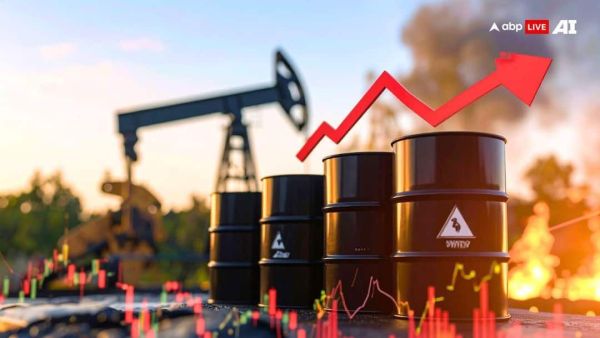
Global crude oil prices moved sharply higher on Monday, edging closer to the $100 per barrel mark, as renewed tensions in West Asia disrupted fragile ceasefire expectations and reignited concerns over energy supply.
The rebound in oil prices comes amid fresh developments involving Iran and the United States, particularly around the Strait of Hormuz, a critical artery for global oil trade.
Oil Prices Surge On Renewed Supply Fears
International benchmark Brent crude rose as much as 7.18 per cent to touch an intraday high of $96.87 per barrel. Meanwhile, US West Texas Intermediate (WTI) crude climbed 8.76 per cent to $91.20 per barrel, reported IANS.
On the domestic front, crude oil futures on the Multi Commodity Exchange (MCX) were trading at Rs 8,289, up 6.72 per cent from the previous close. The sharp rise reflects growing market anxiety over potential disruptions to oil shipments, particularly through key maritime routes in the Gulf region.
Strait Of Hormuz Back In Focus
The latest spike in oil prices follows Iran’s announcement that it is tightening control over the Strait of Hormuz, warning mariners that the route had been closed again.
The Strait of Hormuz is one of the world’s most vital energy corridors, handling a significant share of global crude oil and liquefied natural gas shipments. Any disruption to this route has immediate implications for global supply chains and pricing.
The renewed restrictions have raised concerns among traders that supply bottlenecks could intensify if tensions continue to escalate.
Ceasefire Under Pressure
The fragile ceasefire between the United States and Iran appears increasingly uncertain, with both sides exchanging strong statements.
Iran said its actions were a response to what it described as a continued US blockade of its ports, calling it a violation of the ceasefire terms. Supreme Leader Mojtaba Khamenei stated that the country’s navy is prepared to inflict “new bitter defeats” on its adversaries, signalling a hardening stance.
On the other hand, US President Donald Trump said Tehran could not “blackmail” the United States by attempting to shut the waterway.
Rising Military Tensions
Tensions escalated further after the United States reportedly seized an Iranian cargo ship that attempted to breach its blockade.
The move prompted a warning of retaliation from Tehran, adding to fears that the situation could spiral beyond control.
These developments have cast doubt over whether the ceasefire, originally expected to hold for at least two days, can be sustained.
Markets React With Volatility
Financial markets reflected the heightened uncertainty, with Indian benchmark indices trading in negative territory despite early gains.
The Sensex and Nifty experienced volatility as investor sentiment turned cautious amid rising geopolitical risks and oil price pressures.
Higher crude oil prices typically raise concerns about inflation, fiscal balances and corporate profitability, particularly in oil-importing economies like India.
Global Markets Show Mixed Signals
While Indian markets struggled, Asian markets showed relatively stable performance.
Japan’s Nikkei, Hong Kong’s Hang Seng and South Korea’s KOSPI posted gains of up to 1 per cent, indicating selective optimism in the region.
In the United States, markets had closed on a positive note in the previous session, with the S&P 500 rising 1.2 per cent and the Nasdaq gaining 1.52 per cent.
Why Oil Prices Matter For India
India remains highly dependent on imported crude oil, making it vulnerable to global price fluctuations. A sustained rise in oil prices can increase input costs across sectors, push up inflation and widen the current account deficit.
It can also impact fuel prices domestically, although policy interventions may sometimes delay or cushion the immediate effects on consumers. The trajectory of oil prices will largely depend on how the situation in West Asia evolves in the coming days.
-
Zerodha’s Nithin Kamath shares a parenting reality, reveals what screens are doing to kids, and it’s scary: Watch

-
Samsung SDI signs first EV battery supply deal with Mercedes-Benz

-
A humanoid robot sprints past the human half-marathon world record in Beijing race

-
Green card holder held at US airport over Iran-linked arms trafficking charges

-
Gujarati travellers cut back on travel plans amid geopolitical uncertainty, expected market volatility