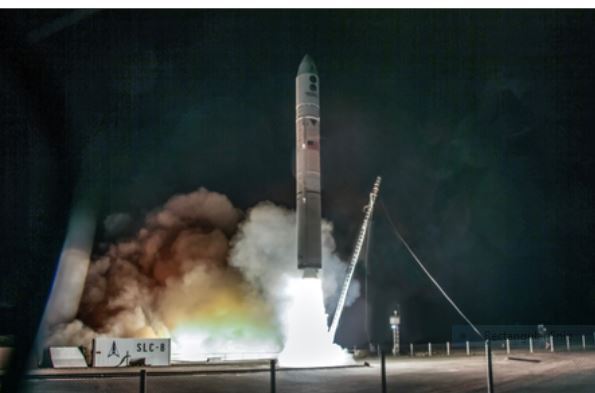
New Delhi, 19 April. US space agency NASA has recently launched a small but important satellite, which is studying natural and man-made radio waves emanating from the Earth. This mission will help scientists better understand the space environment around Earth and accurately forecast space weather. This CubeSat, named CANVAS (Climatology of Anthropogenic and Natural VAF Wave Activity in Space), was launched on April 7, 2026, using a Minotaur IV rocket from Vandenberg Space Force Base in California.
It was part of the US Defense Department’s Space Test Program S29A (STP-S29A) mission. At the same time, its launch arrangements were made under NASA’s CubeSat Launch Initiative (CLI). Canvas is a 4U CubeSat developed by the University of Colorado, Boulder. Its main function is to measure very low frequency (VLF) radio waves from low Earth orbit. These waves are generated by lightning strikes and transmitters located on the ground.
It measures how much of these waves pass through Earth’s ionosphere (the upper electrically charged part of the atmosphere) and reach the magnetosphere. VLF waves can slightly alter the path of high-energy electrons trapped in space. Due to this, sometimes these electrons escape from the radiation belts and enter the atmosphere. Canvas will strengthen space weather models by understanding the effects of these waves. This will improve the security of spacecraft, satellites and infrastructure on Earth.
The two main instruments Canvas will use during the mission are a tri-axis search coil magnetometer and a bi-axis AC electric field sensor. With their help it will detect the strength and direction of VLF waves. By comparing lightning events with data from the worldwide electricity network, it will study the climate of how these waves travel through the ionosphere.
Let us tell you, NASA had selected Canvas under CLI in the year 2021. This low-cost mission provides students, teachers and researchers with practical experience in designing, developing and building space hardware. NASA’s Launch Services Program is making a key contribution to running this initiative. Canvas is also part of the Elana 55 launch grouping. Canvas will continuously collect data over the next year. This data will prove important in understanding the flow of energy from Earth to space.
-
Man gives lift to elderly woman, takes off with gold chain in Telangana

-
Trump says Iran ‘must never have nuclear weapon’, dismisses critics as ‘fake’

-
Caste certificate row: AIMIM’s Sahar Shaikh, her father deny irregularities

-
The Rebel Kid – Apoorva Mukhija gets cancelled again, here’s why

-
Iran President Flags ‘Deep Mistrust’ Towards US As Talks In Islamabad Remain Uncertain