Fifteen years ago a 1,300-km trip between Beijing and Shanghai took over 10 hours by conventional train. Today high-speed rail has shortened the trip to just over four hours, making travel between the two megacities convenient and accessible.
China’s railroad transformation began from a relatively modest baseline.
The railroad system used to be constrained by outdated infrastructure, which kept average train speeds in 1993, for instance, at a mere 48 km/h, Xinhua News Agency reported.
The slow services steadily lost out to air and road transport.
The turning point came in August 2008, when the country’s first high-speed rail line linking Beijing and Tianjin opened just ahead of the Olympic Games.
The Beijing – Shanghai high-speed rail line then began service in June 2011. By the end of December 2025, the Xi’an – Yan’an line in Shaanxi Province became operational, pushing China’s high-speed rail network beyond 50,000 km in total or around 70% of the global network, CNN reported.
|
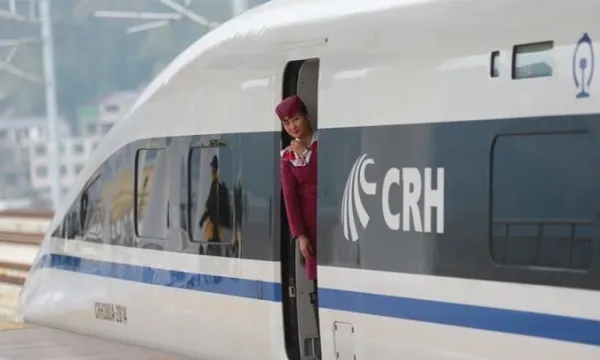
A staff looks out from a high-speed railway train linking Shanghai and Kunming, of Yunnan Province, China, on Dec. 28, 2016. Photo via Reuters |
Unlike legacy systems such as Japan’s Shinkansen or Germany’s ICE, which evolved over decades, China built its high-speed rail network in less than 20 years.
Its newest trains now routinely run at speeds of up to 350 km/h, extending the limits of large-scale rail efficiency.
During the 2026 Spring Festival travel period, the network carried a record 538 million passengers, with nearly 13,000 trains running daily at peak capacity, China Daily reported.
New lines such as Guangzhou – Zhanjiang and Baotou – Yinchuan have further expanded reach and capacity.
For tourism, the impact has been profound.
High-speed rail compresses geographic space, making long-distance travel feasible within a single day. Trips that once required overnight journeys can now be completed in a few hours, enabling short-haul, high-frequency travel.
Previously travelers from eastern megacities like Shanghai or Hangzhou had to spend two or three days traveling 2,000 km by road to reach Ningxia in China’s northwest. Thanks to the high-speed rail network connecting via hubs like Xuzhou and Xi’an, passengers can now depart from Shanghai in the morning and arrive in Ningxia for dinner after about 10 hours of travel.
This improved connectivity has transformed remote areas into weekend getaways for urban dwellers.
Improved connectivity is also redistributing tourism flows.
Secondary and inland cities are seeing increased visitor numbers, supported by easier access and rising demand for local experiences.
The Baotou – Yinchuan line has, for example, reduced travel time across the northern desert and grasslands from over six hours to just 2.5, turning previously isolated areas into accessible destinations.
By 2024 high-speed rail served 97% of Chinese cities with populations above 500,000 and had transported more than 22.9 billion passengers cumulatively.
Tour operators are shifting away from long bus itineraries toward rail-based itineraries, often integrating high-speed trains with local transport.
Digital platforms are also capitalizing on this shift.
According to Trip.com, bookings combining air and rail travel rose 35% in 2025, driven by seamless connections between major airports and high-speed rail stations in cities like Beijing and Shanghai.
This integration allows international travelers to move efficiently beyond gateway cities into the country’s interior.
Looking beyond domestic borders, China is extending its rail ambitions through regional projects under the Belt and Road Initiative.
The Laos-China railway, linking Kunming with Vientiane, is one such.
Running over 1,000 km, the line became operational in 2021 and is expected to serve more than 30 million passengers by 2025. It has dramatically reduced travel time, cutting the journey from the Chinese border town of Boten to Vientiane to just three or four hours from more than a full day by road previously.
The next phase of expansion is focused on Thailand and Malaysia to forming a continuous network that links major economic hubs and cultural destinations across the region.
Analysts point out that direct rail connectivity between China and Southeast Asia could reshape international travel patterns by reducing reliance on air travel and bringing cross-border travel closer to the convenience of domestic trips.
-
Pulkit Samrat Creates History, Stuns Fans With Live Boxing At Glory Trailer Launch

-
'I Felt A Bit Sorry For Him': German Influencer LizLaz Sympathises With Virat Kohli After Backlash Over Like On Instagram Post Goes Viral

-
Shubhankar Sharma Ends Eight-Year-Long Title-Drought With Convincing Eight-Shot Victory At Boulders Classic 2026

-
'Son Falsely Implicated, We Are Well-Educated': Father Of Accused Tausif Attar Breaks Silence After Skullcap, Namaz Coercion Allegations Rock TCS Nashik

-
IPU CET 2026 Exam Schedule Released; Tests To Be Held From April 25 To May 23