
The govt has introduced the new tax regime which has fewer deductions to save income tax. However, according to a Redditor, you can still save if you plan properly.
In a post that’s now gaining traction, the user claimed their income stayed constant at Rs 48 lakh CTC, but their tax outgo dropped significantly after making a few strategic adjustments at the start of the financial year.
The biggest chunk of savings—around Rs 80,000—came from something most employees overlook: salary restructuring. By working with HR to include components like food coupons, phone reimbursements, and Leave Travel Allowance (LTA), the user reduced taxable income without changing actual earnings. The post notes that many employees simply accept default salary structures without exploring such options.
Another Rs 45,000 was saved through employer contribution to the National Pension System (NPS). Unlike many deductions, this falls outside the ?1.5 lakh limit under Section 80C, and remains available even under the new tax regime—something the user says is widely misunderstood.
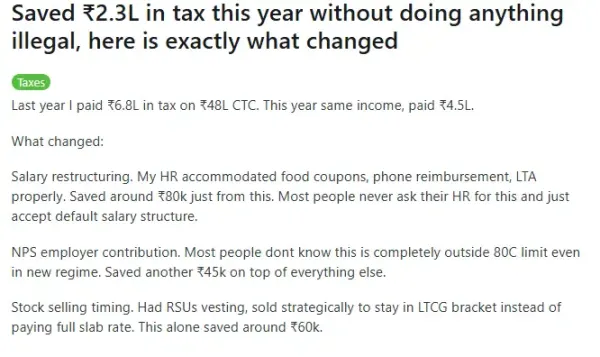
Timing also played a role. The user reported saving about ?60,000 by carefully planning the sale of RSUs (Restricted Stock Units). By selling within the long-term capital gains (LTCG) framework instead of letting it fall under higher slab taxation, they managed to significantly cut their tax liability.
Finally, the user emphasized the importance of choosing the right tax regime—old vs new—not based on assumptions but on actual calculations tailored to individual deductions. In this case, switching regimes accounted for the remaining savings.
‘Not complicated, just planned early’
The post highlights a broader issue: many taxpayers rush into last-minute investments like ELSS in March, rather than planning at the beginning of the year. According to the user, none of these steps involved loopholes or aggressive tax avoidance—just awareness and timing.
What stands out is the closing remark: the user claims their chartered accountant never suggested these strategies, prompting them to consult a tax advisory firm instead of relying solely on a filing agent.
The takeaway feels less like a hack and more like a quiet nudge—most of the savings came not from earning more, but from understanding the system a little better, a little earlier.
In a post that’s now gaining traction, the user claimed their income stayed constant at Rs 48 lakh CTC, but their tax outgo dropped significantly after making a few strategic adjustments at the start of the financial year.
The biggest chunk of savings—around Rs 80,000—came from something most employees overlook: salary restructuring. By working with HR to include components like food coupons, phone reimbursements, and Leave Travel Allowance (LTA), the user reduced taxable income without changing actual earnings. The post notes that many employees simply accept default salary structures without exploring such options.
Another Rs 45,000 was saved through employer contribution to the National Pension System (NPS). Unlike many deductions, this falls outside the ?1.5 lakh limit under Section 80C, and remains available even under the new tax regime—something the user says is widely misunderstood.
Timing also played a role. The user reported saving about ?60,000 by carefully planning the sale of RSUs (Restricted Stock Units). By selling within the long-term capital gains (LTCG) framework instead of letting it fall under higher slab taxation, they managed to significantly cut their tax liability.
Finally, the user emphasized the importance of choosing the right tax regime—old vs new—not based on assumptions but on actual calculations tailored to individual deductions. In this case, switching regimes accounted for the remaining savings.
‘Not complicated, just planned early’
The post highlights a broader issue: many taxpayers rush into last-minute investments like ELSS in March, rather than planning at the beginning of the year. According to the user, none of these steps involved loopholes or aggressive tax avoidance—just awareness and timing.
What stands out is the closing remark: the user claims their chartered accountant never suggested these strategies, prompting them to consult a tax advisory firm instead of relying solely on a filing agent.
The takeaway feels less like a hack and more like a quiet nudge—most of the savings came not from earning more, but from understanding the system a little better, a little earlier.