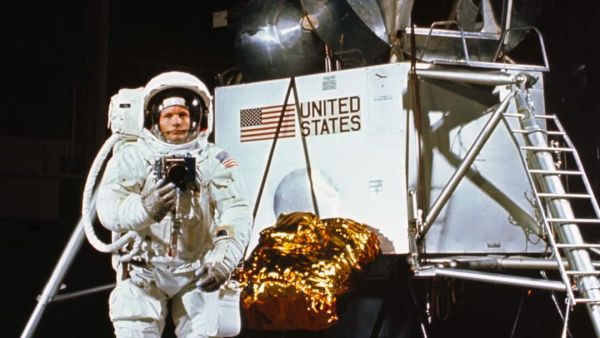
The Apollo 11 mission in July 1969 remains one of the most significant moments in human history. Neil Armstrong and Buzz Aldrin spent over 21 hours on the Moon’s surface, carrying out scientific experiments, taking photographs, and collecting lunar samples to bring back to Earth. While the mission is widely remembered for the first Moon landing, some details from that journey only surfaced years later.
Why NASA Left Things Behind On The Moon
Due to strict weight limitations, NASA required astronauts to leave several items on the Moon before returning. This helped make space for the lunar material they collected.
One such item was a small storage bag informally known as the 'McDivitt Purse.' The name came from Apollo 9 commander James McDivitt, who had earlier suggested the need for a compact bag to temporarily hold loose items in space. Astronauts later nicknamed it a 'purse' because of its design and closure style.
The bag was originally intended to remain on the lunar surface.
A Surprising Discovery In A Closet
More than four decades later, in 2012, Neil Armstrong’s wife, Carol, made an unexpected discovery while going through a closet. Inside, she found the small bag, clearly filled with items that looked like they belonged to a spacecraft.
Recognizing its potential significance, she contacted the Smithsonian National Air and Space Museum, where she had already discussed donating other Armstrong artifacts.
For curator Allan Needell, the moment was extraordinary. As he later noted, it’s hard to imagine a more exciting find for someone responsible for preserving space history.
Confirming The Bag’s Journey To The Moon
Experts began carefully examining the bag and its contents. It didn’t take long to confirm what they suspected, the McDivitt Purse had indeed travelled to the Moon.
Originally slated to be discarded, something changed during the mission. NASA transcripts reveal the shift in real time. At one point, Armstrong described the bag to command module pilot Michael Collins as a collection of 'trash', miscellaneous Lunar Module parts and odds and ends that wouldn’t stay contained. Instead of leaving it behind, the crew brought it back.
What Was Inside The Bag?
The bag contained several pieces of equipment, including a tether designed as a safety tool for astronauts. Although it was not used for its intended purpose, it served a different function during the mission.
Armstrong used the tether to support his legs while resting inside the Lunar Module. Due to limited space, he could not lie down comfortably, and the tether helped him adjust his position.
He later described the difficulty of resting in the module, citing noise and temperature conditions as challenges.
A Camera That Recorded Key Moments
Also found inside the bag was a 16mm Data Acquisition Camera. This camera had been mounted on the Lunar Module and recorded important events, including the module’s separation and the Moon landing.
Like the bag, the camera had originally been expected to remain on the Moon due to weight considerations, but it was returned to Earth instead.
A Rare Piece Of Space History
By the time the items were examined in 2015, it appeared that their existence had not been widely known. There was no indication that Armstrong had spoken about keeping them after the mission.
The discovery of the bag and its contents has since provided additional insight into the Apollo 11 mission, highlighting lesser-known aspects of how astronauts managed equipment and space constraints during their time on the Moon.
-
Bengal Elections: Tension Flares In Durgapur As BJP Protests Arrests; Clashes With TMC Workers

-
Punjab Govt Withdraws Raghav Chadha’s Security; Centre May Grant Z-Category Cover

-
Mumbai’s First Non-AC Automatic Door Trains Ready For Trials, Focus On Passenger Safety

-
Amee Kamani Powered Into The Women's Semifinals Of Asian Heyball Championships

-
Fire Breaks Out At BYD Hub; Quick Response Averts Casualties, Probe Clears EV Safety Concerns