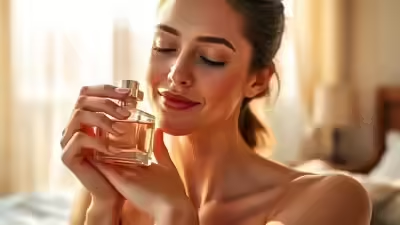
Applying fragrance to pulse points utilizes body heat for a consistent scent release, and choosing higher oil concentrations like Eau de Parfum further enhances lasting power.
In an interesting research paper from Cosmetics, named Nanoemulsions as a Form of Perfumery Productsthe connection between the structure of a liquid and its stability on a surface is explored. It turns out that when the perfume is placed in a high-lipid or high-moisture environment, the process of its evaporation significantly slows down. That’s why perfumers advise applying perfumes over unscented lotions because of their lipid composition that retains perfume molecules.Hydration first serves as a defence mechanism. It will ensure that the perfume remains on top of your skin without penetrating it and drying out; it will prolong its use without requiring another dose.
Heat and the proper application site for perfumesOnce you have hydrated your skin, it is time to apply the fragrance carefully. Instead of simply spraying the fragrance onto your neck and clothes, the proper technique involves applying the fragrance to your pulse points, where the blood flow comes close to the skin’s surface. Your wrists, elbows, and knees would be ideal sites for applying fragrances.The relationship between body heat and scent is deeper than most realise.
A comprehensive review published in Building and Environment journal discusses how the human body interacts with aromatic compounds based on temperature and environment. The study indicates that the heat produced by our bodies can actually trigger a more consistent release of scent molecules. By targeting pulse points, you are utilising your own body temperature to “pump” the fragrance out in a steady, slow stream rather than one big burst that fades quickly.The environment is extremely important too. If you spray your scent in a dry room or in an air-conditioned space, you will quickly find yourself without any fragrance. This can be compensated for by applying the product to your pulse points and giving your hair or clothing made of natural materials a little spritz.Choosing the right concentration for your applicationMoreover, spare a second to carefully examine the bottle’s label.
The differences between Eau de Cologne, Eau de Toilette, and Eau de Parfum are often overlooked. However, they are more than just fancy French terms: each of them refers to the amount of oil used in the creation of the fragrance. Specifically, Eau de Cologne normally has only two to five per cent = oil in its composition.For those who would like a smell that will last all throughout the day after a tiresome job, one would be wise to choose a Parfum or an Eau de Parfum, which contains far more oils and little alcohol content. Alcohol is responsible for carrying away the scent in the air via evaporation, and less alcohol implies that there will be more retention of the scent by your skin.
-
Food Review: Step Inside This Mumbai Restaurant Ummrao Saaj Where Umrao Jaan Still Inspires Cocktails & Cuisine

-
'I Always Try To Contribute Wherever I Can,' Says Rasikh Salam Dar As RCB Return Home To Face LSG

-
IPL 2026: Why Are CSK & KKR Players Wearing Black Armbands?

-
Dhurandhar Franchise Crosses ₹3000 Crore Mark Worldwide; Becomes First Indian Film Series To Achieve This Feat

-
Pakistan Hospital Under Scanner After 331 Children Contract HIV From Syringe Reuse