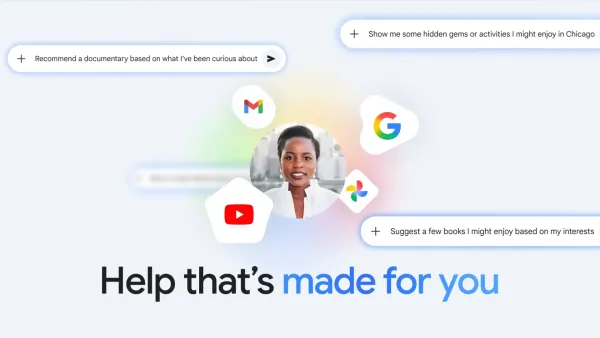
Google rolled out the Personal Intelligence feature to Gemini users in India on Tuesday, four months after its beta launch in the US. With Personal Intelligence, Google aims to make its artificial intelligence (AI) assistant Gemini more personalised for users by using the latter’s information across apps like Gmail, Google Photos, YouTube, and Search.
Last month, Google rolled out the Personal Intelligence experience to all users in the US across AI Mode in Search, Gemini on Chrome, and the Gemini app.
Eligible users will either get an invite on the Gemini home screen, or they may enable the feature manually in the AI assistant app’s Settings. Users will simply have to enable the Personal Intelligence feature and choose Connected Apps (such as Gmail and Photos). Once enabled, it works across web, Android, and iOS, and is available with all models in the Gemini model picker.
The Personal Intelligence enables Gemini to reason better across multiple sources and synthesise information from emails, photos, and online activity to deliver more tailored and context-aware responses. This reduces the need to manually search across platforms and enables a more seamless, integrated experience.
The experience is currently being rolled out to personal Google accounts of eligible Google AI Plus, Pro, and Ultra subscribers. Access to free users will be extended later.
Does it not raise privacy concerns?
While this may raise privacy concerns among users, the tech giant lets them choose which apps to link to power the Intelligence, to ensure a secure feature experience. By default, app connections are turned off, allowing users to enable or disable these connections at any time.
Google claims that Gemini only accesses data to respond to specific queries, and users can see or request explanations for how their information was used.
“Gemini doesn’t train directly on your Gmail inbox or Google Photos library. We train on limited info, like specific prompts in Gemini and the model’s responses, to improve functionality over time,” Google India wrote in a blog post.
Users will also get controls to manage personalisation, to regenerate responses without personal context, or to use temporary chats for non-personalised interactions.
Yet, the tech giant has warned that users may encounter occasional inaccuracies or ‘over-personalisation,’ where unrelated data is incorrectly linked. Users can flag and give feedback on such responses.
Last month, Google rolled out the Personal Intelligence experience to all users in the US across AI Mode in Search, Gemini on Chrome, and the Gemini app.
Eligible users will either get an invite on the Gemini home screen, or they may enable the feature manually in the AI assistant app’s Settings. Users will simply have to enable the Personal Intelligence feature and choose Connected Apps (such as Gmail and Photos). Once enabled, it works across web, Android, and iOS, and is available with all models in the Gemini model picker.
The Personal Intelligence enables Gemini to reason better across multiple sources and synthesise information from emails, photos, and online activity to deliver more tailored and context-aware responses. This reduces the need to manually search across platforms and enables a more seamless, integrated experience.
The experience is currently being rolled out to personal Google accounts of eligible Google AI Plus, Pro, and Ultra subscribers. Access to free users will be extended later.
Does it not raise privacy concerns?
While this may raise privacy concerns among users, the tech giant lets them choose which apps to link to power the Intelligence, to ensure a secure feature experience. By default, app connections are turned off, allowing users to enable or disable these connections at any time.
Google claims that Gemini only accesses data to respond to specific queries, and users can see or request explanations for how their information was used.
“Gemini doesn’t train directly on your Gmail inbox or Google Photos library. We train on limited info, like specific prompts in Gemini and the model’s responses, to improve functionality over time,” Google India wrote in a blog post.
Users will also get controls to manage personalisation, to regenerate responses without personal context, or to use temporary chats for non-personalised interactions.
Yet, the tech giant has warned that users may encounter occasional inaccuracies or ‘over-personalisation,’ where unrelated data is incorrectly linked. Users can flag and give feedback on such responses.