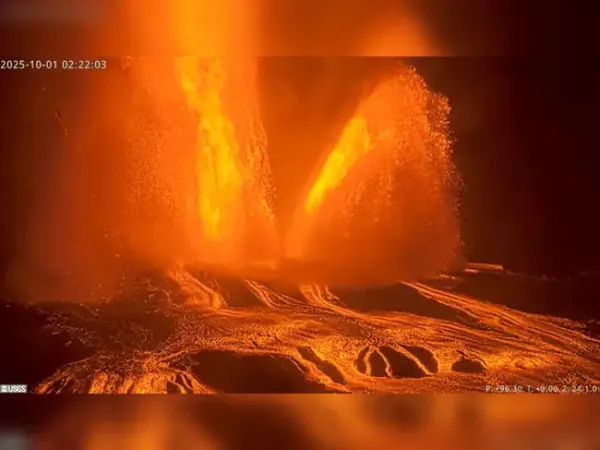
Volcanoes are often associated with destruction, ash clouds, large explosions, and tremendous sound. However, the relationship between volcanic eruptions and climate change, particularly regarding the cooling of the planet, is more complex than many assume. While explosive eruptions can reduce global temperatures, they can also contribute to warming under certain conditions. Therefore can volcanoes really trigger a “volcanic winter,” or is the impact more nuanced? Here’s what science suggests.
During major explosive eruptions, huge amounts of volcanic gas, aerosol droplets, and ash are injected into the stratosphere. While ash falls out relatively quickly, usually within days to weeks, it has little long-term climate impact. The real influence comes from gases, particularly sulfur dioxide and carbon dioxide, explains The United States Geological Survey (USGS).
Sulfur dioxide can lead to global cooling, whereas volcanic carbon dioxide, a greenhouse gas, has the potential to promote warming. This dual effect complicates volcanic eruptions more in their climate consequences than commonly believed.
The most significant climate impact occurs when sulfur dioxide converts into sulfuric acid in the stratosphere. This process forms fine sulfate aerosols that reflect sunlight back into space. By reducing the amount of solar radiation reaching Earth’s surface, these aerosols cool the lower atmosphere, also known as the troposphere, where almost all weather events occur.
This reflective effect is why volcanic eruptions are often linked to temporary global cooling, but the magnitude of that cooling has long been debated.
About 74,000 years ago, the Lake Toba supervolcano in Indonesia erupted with a force estimated to be 1,000 times stronger than the 1980 eruption of Mount St. Helens. Scientists have long wondered whether such an event triggered dramatic global cooling, sometimes referred to as a “volcanic winter.”
Previous studies suggested temperature drops ranging from 3.6 to 14 degrees Fahrenheit (2 to 8 degrees Celsius), which are a possible threat to humanity and ecosystems.
A 2024 study published in the Journal of Climate by researchers from NASA’s Goddard Institute for Space Studies and Columbia University used advanced computer modeling to simulate super-eruptions like Toba. Their findings suggest the cooling effect may be far smaller than previously estimated.
The study concluded that post-eruption cooling would likely not exceed 2.7 degrees Fahrenheit (1.5 degrees Celsius), even for the most powerful eruptions.
“The relatively modest temperature changes we found most compatible with the evidence could explain why no single super-eruption has produced firm evidence of global-scale catastrophe for humans or ecosystems,” said lead author Zachary McGraw.
While volcanoes can indeed cool the planet, the effect may be temporary and less dramatic than earlier theories suggested. Modern research indicates that even massive eruptions are unlikely to trigger long-term global catastrophe.
How volcanic eruptions influence climate
During major explosive eruptions, huge amounts of volcanic gas, aerosol droplets, and ash are injected into the stratosphere. While ash falls out relatively quickly, usually within days to weeks, it has little long-term climate impact. The real influence comes from gases, particularly sulfur dioxide and carbon dioxide, explains The United States Geological Survey (USGS).
Sulfur dioxide can lead to global cooling, whereas volcanic carbon dioxide, a greenhouse gas, has the potential to promote warming. This dual effect complicates volcanic eruptions more in their climate consequences than commonly believed.
How volcano can cool the planet
The most significant climate impact occurs when sulfur dioxide converts into sulfuric acid in the stratosphere. This process forms fine sulfate aerosols that reflect sunlight back into space. By reducing the amount of solar radiation reaching Earth’s surface, these aerosols cool the lower atmosphere, also known as the troposphere, where almost all weather events occur.
This reflective effect is why volcanic eruptions are often linked to temporary global cooling, but the magnitude of that cooling has long been debated.
The case of the ancient Toba super-eruption
About 74,000 years ago, the Lake Toba supervolcano in Indonesia erupted with a force estimated to be 1,000 times stronger than the 1980 eruption of Mount St. Helens. Scientists have long wondered whether such an event triggered dramatic global cooling, sometimes referred to as a “volcanic winter.”
Previous studies suggested temperature drops ranging from 3.6 to 14 degrees Fahrenheit (2 to 8 degrees Celsius), which are a possible threat to humanity and ecosystems.
New research challenges the “volcanic winter” idea
A 2024 study published in the Journal of Climate by researchers from NASA’s Goddard Institute for Space Studies and Columbia University used advanced computer modeling to simulate super-eruptions like Toba. Their findings suggest the cooling effect may be far smaller than previously estimated.
The study concluded that post-eruption cooling would likely not exceed 2.7 degrees Fahrenheit (1.5 degrees Celsius), even for the most powerful eruptions.
“The relatively modest temperature changes we found most compatible with the evidence could explain why no single super-eruption has produced firm evidence of global-scale catastrophe for humans or ecosystems,” said lead author Zachary McGraw.
The takeaway
While volcanoes can indeed cool the planet, the effect may be temporary and less dramatic than earlier theories suggested. Modern research indicates that even massive eruptions are unlikely to trigger long-term global catastrophe.