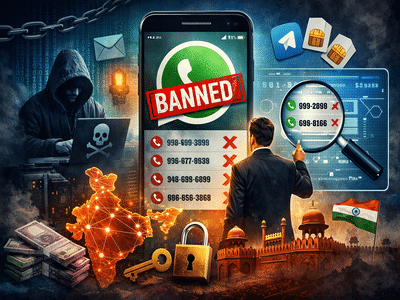
India is witnessing a sharp rise in cyber fraud linked to messaging platforms, prompting authorities to seek stronger intervention from WhatsApp. With nearly 10 million Indian accounts being blocked every month for suspicious activities, the government is now urging the platform to share key data related to these banned numbers to curb online scams more effectively.
Millions of Accounts Blocked Every Month Raise AlarmAccording to recent disclosures, WhatsApp is suspending close to 9.8 million Indian accounts monthly due to involvement in fraudulent activities, spam, or policy violations. This massive figure highlights the scale at which Indian mobile numbers are being misused for cybercrime.
India remains the largest market for WhatsApp, with hundreds of millions of users relying on the platform for daily communication. However, the increasing misuse of the app for scams—ranging from phishing to impersonation—has raised serious concerns within government circles. Officials believe that simply banning accounts is not enough to tackle the problem at its root.
Fraudsters Shift to Other Platforms After BanOne of the biggest challenges authorities face is the mobility of cybercriminals. Once banned on WhatsApp, many fraudsters quickly migrate to other platforms like Telegram and continue their activities without interruption.
Experts point out that these scams often involve OTP-based verification systems. Once an account is created and verified, fraudsters can operate without needing continuous access to the original SIM card, making it harder to trace them. These operations are often conducted both within India and from overseas networks, complicating enforcement further.
WhatsApp at the Center of Digital Fraud CasesGovernment officials estimate that nearly 95% of digital arrest scams and identity-based fraud cases are currently being executed through WhatsApp. In such schemes, scammers impersonate law enforcement officers or officials, using fear tactics to extort money from victims.
These incidents have led to growing concerns about the misuse of Indian telecom resources. Authorities emphasize the need to strike a balance between user convenience and national security. To effectively trace fraudsters, officials want access to basic information such as when a SIM card was issued and whether the associated KYC (Know Your Customer) details are genuine.
Government Steps Up Action Against Fraudulent AccountsThe Indian government has already been actively directing platforms to take down accounts involved in illegal activities. As per data from the Department of Telecommunications, around 2.9 million WhatsApp profiles and groups were blocked by November this year following government instructions.
In such cases, authorities have access to the details of the numbers being blocked. However, when WhatsApp independently removes accounts as part of its internal monitoring and enforcement, it only releases aggregate numbers in its monthly transparency reports. Specific details about the banned numbers are not shared.
Officials argue that without access to these numbers, it becomes difficult to verify whether they are linked to genuine users or fraudulent identities. Importantly, the government maintains that it is not seeking personal messages or private data—only the phone numbers to aid investigations.
Why the Government Wants More TransparencyA former official explained that transparency reports were initially designed to improve accountability among digital platforms. However, with cybercrime evolving rapidly, authorities now believe additional data-sharing is necessary to strengthen enforcement mechanisms.
WhatsApp, on its part, has highlighted that it operates on end-to-end encryption, which ensures user privacy. The platform states that its decisions to ban accounts are based on behavioral patterns rather than content monitoring. Sharing user data, even limited information like phone numbers, could raise both technical and legal challenges.
Despite these concerns, Indian officials argue that selective data-sharing in high-risk cases is essential for public safety. They believe that without coordinated efforts between tech platforms and regulators, cybercriminals will continue exploiting loopholes across multiple apps.
What Lies AheadAs cyber fraud cases continue to rise, the Indian government is expected to introduce stricter regulations and compliance requirements for digital platforms. The ongoing discussions with WhatsApp signal a broader push toward accountability and stronger safeguards in the digital ecosystem.
The outcome of these talks could shape how global tech companies operate in India, especially when it comes to balancing user privacy with national security concerns. For now, authorities remain focused on closing the gaps that allow fraudsters to operate freely across platforms.
-
IPL 2026: Intention of taking Vaibhav Suryavanshi to Sunrisers Hyderabad… Ishan Kishan’s heartfelt words came out on his tongue

-
Not only turmeric milk but water is also beneficial for health, know the right way to consume it’ – News Himachali News Himachali

-
Salary increased in Haryana from April 1! Now wages will not be less than ₹ 15,221

-
Amarnath Yatra 2026: Even before the start of Amarnath Yatra, Baba Barfani appeared in full size, see first picture.

-
Singapore Plans Up to 40,000 PR Approvals Yearly: Who Can Apply in 2026