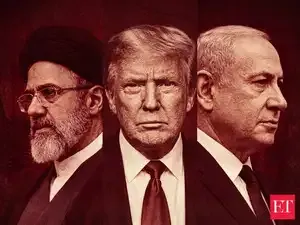
US President Donald Trump is considering resuming limited military strikes on Iran alongside a naval blockade of the Strait of Hormuz, as his administration looks for ways to break a stalemate in negotiations, The Wall Street Journal reported, citing officials and people familiar with the matter.
The options were under review on Sunday, hours after US-Iran talks in Pakistan collapsed. While a broader bombing campaign remains on the table, officials told WSJ it is seen as less likely due to risks of further destabilising the region and Trump’s reluctance to be drawn into a prolonged conflict.
You may follow our live coverage of the West Asia war here
Trump has also explored the possibility of a temporary blockade while pressing allies to assume a longer-term role in escorting commercial vessels through the strategic waterway.
Despite the breakdown, Trump has hinted he remains open to diplomacy. Speaking on Fox News, he warned of potential strikes on critical Iranian infrastructure while expressing reluctance. “I would hate to do it, but it’s their water, their desalination plants, their electric-generating plants, which are very easy to hit,” he said.
Iranian officials struck a more measured tone. Reza Amiri Moghadam, a senior member of Tehran’s delegation, described the Islamabad talks as the start of a process that could evolve into a “sustainable framework” if trust improves.
Also read: US military says it will blockade Iranian ports starting Monday after ceasefire talks ended without agreement
Blockade seen as pressure tool, but risks mount
According to report, some analysts and former officials view the blockade as the most viable option currently available. Matthew Kroenig, a former Pentagon official, said the strategy could significantly increase pressure on Tehran by targeting its oil exports, which account for a substantial share of government revenue.
“We’ve seen this blockade strategy essentially work on Venezuela,” Kroenig told the publication, adding that it could force Iran into difficult choices.
However, the approach carries significant risks. US officials warned that naval forces operating in the narrow strait could face missile or drone attacks with minimal warning. Iran has historically resisted economic pressure, remaining defiant despite years of sanctions and recent US and Israeli strikes, the report noted.
Trump is also facing competing pressures at home and abroad. Allies have pushed for decisive action as disruptions in the strait — which carries roughly a fifth of global oil supply — rattle energy markets. Domestically, rising fuel prices and war fatigue among voters pose political challenges ahead of midterm elections.
Economic concerns are increasingly shaping the debate. Steve Moore was quoted as saying that securing the strait is critical to preventing broader economic fallout, warning that failure to act could tip the global economy toward recession.
At the same time, some former officials see room for diplomacy. Fred Fleitz told WSJ Iran’s engagement in the Pakistan talks suggests a deal remains possible, backing Trump’s assessment that Tehran’s position may be weakening.
Still, US officials and analysts cautioned that every option carries trade-offs — with escalation risking deeper military and economic costs, and restraint potentially allowing Iran to retain leverage over both its nuclear ambitions and control of the strait, as per the WSJ report.
The options were under review on Sunday, hours after US-Iran talks in Pakistan collapsed. While a broader bombing campaign remains on the table, officials told WSJ it is seen as less likely due to risks of further destabilising the region and Trump’s reluctance to be drawn into a prolonged conflict.
You may follow our live coverage of the West Asia war here
Trump has also explored the possibility of a temporary blockade while pressing allies to assume a longer-term role in escorting commercial vessels through the strategic waterway.
Talks collapse, red lines harden
The negotiations in Pakistan, led by Vice President JD Vance, broke down after Iran refused to abandon its nuclear programme. US officials have since laid out strict conditions for any future deal, including reopening the Strait of Hormuz without tolls, ending uranium enrichment, dismantling nuclear facilities, surrendering highly enriched uranium, and halting support for regional proxy groups such as Hezbollah and Yemen’s Houthi rebels.Despite the breakdown, Trump has hinted he remains open to diplomacy. Speaking on Fox News, he warned of potential strikes on critical Iranian infrastructure while expressing reluctance. “I would hate to do it, but it’s their water, their desalination plants, their electric-generating plants, which are very easy to hit,” he said.
Iranian officials struck a more measured tone. Reza Amiri Moghadam, a senior member of Tehran’s delegation, described the Islamabad talks as the start of a process that could evolve into a “sustainable framework” if trust improves.
Also read: US military says it will blockade Iranian ports starting Monday after ceasefire talks ended without agreement
Blockade seen as pressure tool, but risks mount
According to report, some analysts and former officials view the blockade as the most viable option currently available. Matthew Kroenig, a former Pentagon official, said the strategy could significantly increase pressure on Tehran by targeting its oil exports, which account for a substantial share of government revenue.
“We’ve seen this blockade strategy essentially work on Venezuela,” Kroenig told the publication, adding that it could force Iran into difficult choices.
However, the approach carries significant risks. US officials warned that naval forces operating in the narrow strait could face missile or drone attacks with minimal warning. Iran has historically resisted economic pressure, remaining defiant despite years of sanctions and recent US and Israeli strikes, the report noted.
Trump is also facing competing pressures at home and abroad. Allies have pushed for decisive action as disruptions in the strait — which carries roughly a fifth of global oil supply — rattle energy markets. Domestically, rising fuel prices and war fatigue among voters pose political challenges ahead of midterm elections.
Economic concerns are increasingly shaping the debate. Steve Moore was quoted as saying that securing the strait is critical to preventing broader economic fallout, warning that failure to act could tip the global economy toward recession.
At the same time, some former officials see room for diplomacy. Fred Fleitz told WSJ Iran’s engagement in the Pakistan talks suggests a deal remains possible, backing Trump’s assessment that Tehran’s position may be weakening.
Still, US officials and analysts cautioned that every option carries trade-offs — with escalation risking deeper military and economic costs, and restraint potentially allowing Iran to retain leverage over both its nuclear ambitions and control of the strait, as per the WSJ report.