Somewhere between Devprayag and Rudraprayag, our driver’s nose began to bleed.
The sun was harsh in a way I did not expect from the mountains. We were stuck in a long line of vehicles inching towards Rudraprayag, and I got out to look for jaggery. In north Maharashtra, where I come from, jaggery is what people reach for in the heat, for sunstroke, for a body overwhelmed by summer. I found some in a small kirana shop by the roadside. The woman at the store handed me a piece wrapped in newspaper. Then she said something I have not stopped thinking about.
“This heat,” she said, wiping her forehead. “This is new to our land.”
New to their land.
 That sentence has stayed with me because it seemed to hold more than the heat of that afternoon. It held a mountain world changing in ways its people could feel in their bodies before anyone named it data. It held the unease of arriving at a sacred geography in the language of emergency.
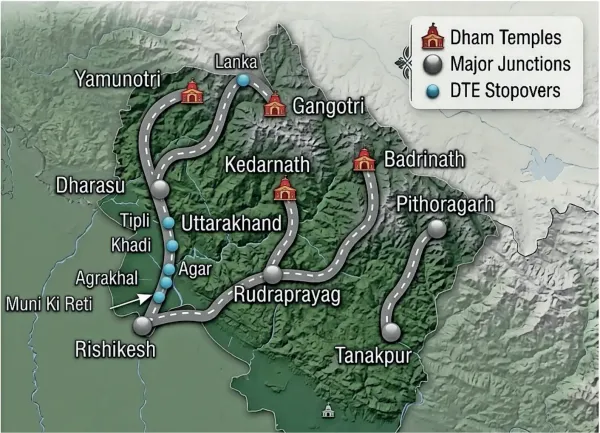
I was travelling with my parents through the country of the prayags, where rivers meet and are transformed. At Devprayag, the Alaknanda and the Bhagirathi come together as the Ganga which then begins her journey. At Rudraprayag, the Mandakini joins the Alaknanda. These are not just confluences. In the Indian imagination, these are crossings. Places where one thing meets another and both are altered.
 A prayag is not only a meeting of waters. It belongs to an older Indian understanding of the tirtha—a crossing place, a ford, a passage. The dictionary meaning is almost too beautiful for modern life: a place where one crosses over. That is how pilgrimage once lived in the Indian mind. Not as an itinerary or as consumption. As crossing.
That older meaning matters in the Himalayas. A journey to Badrinath or Kedarnath was never simply about arrival. It was the difficulty of the road, the surrender of comfort, the discipline of moving at the mountain’s pace, that formed the pilgrimage as much as the shrine itself. In Wanderings in the Himalayas , Swami Tapovanji Maharaj remembers this world of foot travel, halting places, rivers, silence and ascent. An older encyclopaedia entry on Badrinath notes ordinary annual pilgrim numbers of 7,000 to 10,000, rising to about 50,000 in special years. Whatever else the old world was, it was not organised around mass throughput. Even for much of the 20th century, a Himalayan yatra still carried some memory of renunciation. One did not go up there to conquer distance. One went to be made smaller by it.
This cannot be laid at the door of 1991 alone. The older Indian relationship between pilgrimage, wealth and the earth had already been fraying— through colonial extraction, industrial development and the gradual habit of treating rivers, mountains and forests as resources to be used rather than presences to be honoured. The post-liberalisation decades quickened that shift. They widened aspiration, mobility and access, and brought dignity and opportunity to millions. But it also helped make speed, scale and money the default measures of value. In the Himalaya, that economic change has since met another one: the remaking of pilgrimage through infrastructure and spectacle. The result is a sacred landscape carrying the pressures of both market and state at the very moment India is entering a harsher age of heat.
India has seen its warmest year on record in 2024, and a study by the Council on Energy, Environment and Water (CEEW) shows that more than half itsdistricts, home to three-fourths of its people, now face high to very high heat risk. The Himalaya matters here not only as pilgrimage country, but as part of the Hindu Kush Himalaya—the world’s Third Pole—whose ice and snow help sustain nearly 2 billion people. The 2026 Glacier Outlook of the International Centre for Integrated Mountain Development (ICIMOD) says ice loss there has doubled since 2000. In India alone, at least 639 million people live in the Ganga and Brahmaputra basins that stand downstream of that change.
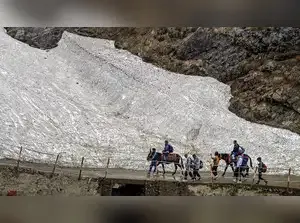
This is visible in the mountains before it becomes visible in data: the widened roads, the earth movers standing where deodars should have been, the rubble slipping down cut slopes, the queues of cars, the sense that the mountain must now adapt itself to our convenience. On the road that day, as we waited in a heat that felt wrong for the place, it struck me that the Himalaya was being asked to perform a very modern task. It was being made efficient.
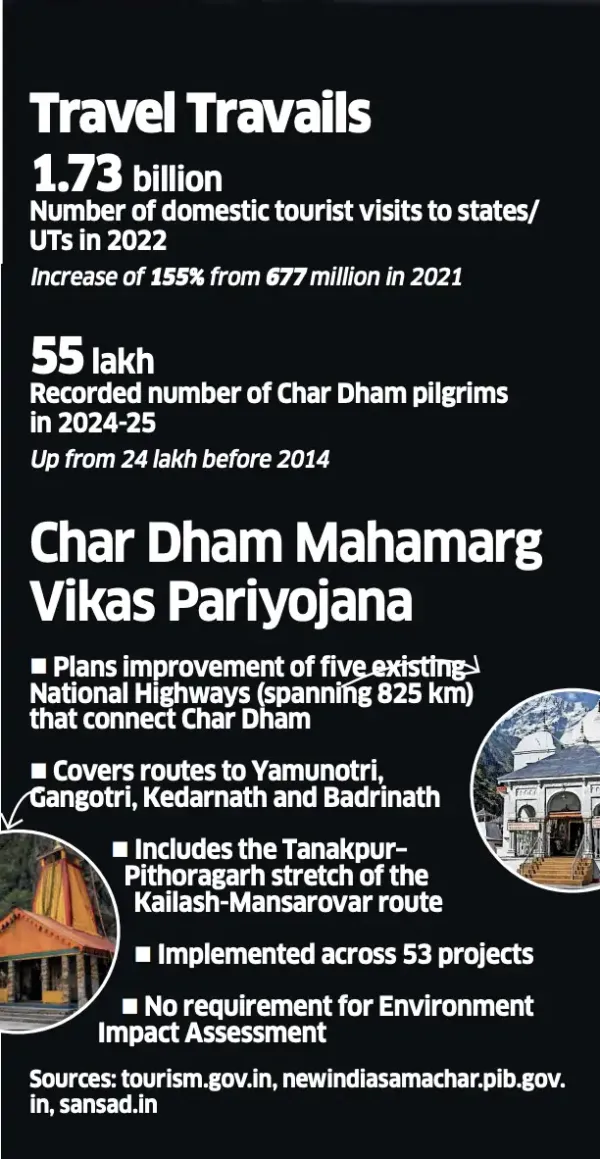
The numbers tell the story from another angle. India’s overall domestic tourist visits rose from 66.7 million in 1991 to 1.73 billion in 2022, according to the Union tourism ministry. In Uttarakhand, before 2014, the record Char Dham footfall was 24 lakh pilgrims; by 2023, it had crossed 54 lakh. This growth has brought livelihoods, mobility and access. It has also brought scale on a mountain that is not built for scale.
This April, as Kedarnath and Badrinath reopen for the 2026 season and registrations for the Char Dham Yatra gather pace, the Himalaya will once again be asked to bear the weight of our faith, our longing and our numbers.
Climate change is not only a failure of technology or policy. It is also a failure of thought: a forgetting of karma, of the truth that what we do to the earth returns to us. Traditions in this subcontinent long understood that action carries consequence, that the earth is not inert matter but presence, and that wealth is meant to keep life in balance, not drive endless accumulation. That understanding did not vanish when India liberalised its economy in the aftermath of a balance of payments crisis. It had been eroding for a long time.
But the last three and a half decades made individual aspiration the water we swim in. It made material success the default language of worth. Not all of this was bad. Millions rose out of poverty. A generation acquired dignity and choice. Much good came with that opening. But so did a deep moral contraction. And now the ecological bill has come due. And the woman in the kirana shop—who had lived in those hills all her life and was now seeing heat she had never seen before—was its accountant.
This is why pilgrimage matters as a way into economics. Because it shows how our idea of value has changed. As India integrated more deeply with current global economic values shaped by market-oriented reforms— access, speed and scale began to acquire a moral force of their own. A yatra became easier, but the mountain also began to be remade around that ease. Climate change is part of that story. So is karma, if one understands karma simply as consequence.
After the 2013 Uttarakhand disaster, the fragility of the region was plain. Yet in a 2023 Rajya Sabha reply, the government said the Char Dham project had been divided into 53 stretches of under 100 km each and therefore required no environmental impact assessment. That is the language of our times: a mountain broken into manageable pieces.
And this is not only an Indian question. At the time of writing, the US-Israeli war on Iran has effectively choked the Strait of Hormuz, disrupted one of the world’s most important oil routes, and pushed crude close to $120 a barrel. West Asia burns, oil surges, markets tremble and once again the world is reminded that war, energy and economic order are still tied to one another by old appetites for power. In such a world, climate cannot be discussed as an environmental side issue. It is already inside geopolitics, inside inflation, inside everyday life.
Which is why I keep returning to Bhudevi.
This doesn’t mean India should retreat into piety or pretend the modern world can be walked back into the past. Nor that roads are evil and poverty virtuous. That would be foolish, and untrue to the complexity of this country. What India needs is not a retreat from growth, but a deeper idea of it: an economy that does not reward greed. Can it restore a moral order in which artha has dignity, but not dominance? Can it remember that abundance is not the same as excess?
That is why the woman in that kirana shop stays with me. New to their land. In that one sentence were climate, economy, memory and grief. Heat arriving where it did not once arrive in that way. Remedies travelling where seasons have shifted. A sacred landscape learning the language of stress.
The old Indian word for a sacred place was a crossing place. We are standing in one now.
And so I want to end not with warning, but with Sant Dnyaneshwar. In the Pasayadan, he prays: May the darkness of wrongdoing disappear; may the world behold the sun of its own swadharma. There is great tenderness in that line. It does not ask for triumph. It asks for right order. For alignment.
For a world in which beings are not forced out of their nature by the appetites of others.
Can India look within now, not in retreat but in seriousness? Can it build a climate-resilient economy that does not mistake greed for growth? Can it become modern without becoming severed from the old knowledge that action ripens, that the earth is alive to injury, that wealth without balance becomes violence by another name?
At the prayags, the rivers still know how to meet without conquest. The question is whether we do.
Archana Chaudhary is a Delhi-based writer covering climate, economics and geopolitics, with a focus on India and emerging economies. Views are personal.
The sun was harsh in a way I did not expect from the mountains. We were stuck in a long line of vehicles inching towards Rudraprayag, and I got out to look for jaggery. In north Maharashtra, where I come from, jaggery is what people reach for in the heat, for sunstroke, for a body overwhelmed by summer. I found some in a small kirana shop by the roadside. The woman at the store handed me a piece wrapped in newspaper. Then she said something I have not stopped thinking about.
“This heat,” she said, wiping her forehead. “This is new to our land.”
New to their land.
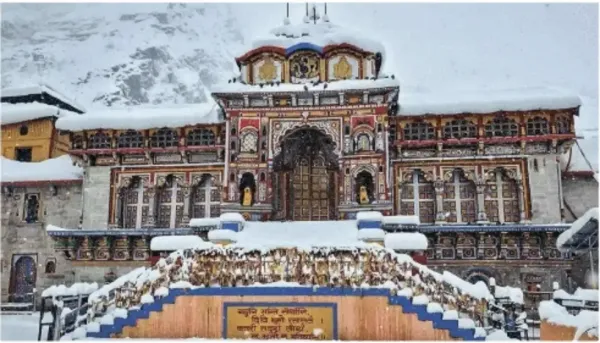
Badrinath Dham in Chamoli and Kedarnath Temple in Rudraprayag (below), Uttarakhand IANS/PTI
I was travelling with my parents through the country of the prayags, where rivers meet and are transformed. At Devprayag, the Alaknanda and the Bhagirathi come together as the Ganga which then begins her journey. At Rudraprayag, the Mandakini joins the Alaknanda. These are not just confluences. In the Indian imagination, these are crossings. Places where one thing meets another and both are altered.
That older meaning matters in the Himalayas. A journey to Badrinath or Kedarnath was never simply about arrival. It was the difficulty of the road, the surrender of comfort, the discipline of moving at the mountain’s pace, that formed the pilgrimage as much as the shrine itself. In Wanderings in the Himalayas , Swami Tapovanji Maharaj remembers this world of foot travel, halting places, rivers, silence and ascent. An older encyclopaedia entry on Badrinath notes ordinary annual pilgrim numbers of 7,000 to 10,000, rising to about 50,000 in special years. Whatever else the old world was, it was not organised around mass throughput. Even for much of the 20th century, a Himalayan yatra still carried some memory of renunciation. One did not go up there to conquer distance. One went to be made smaller by it.
The economics of pilgrimage
What has changed is not only the economics of pilgrimage, but the larger political economy now shaping it. Sacred journeys are now being reshaped by wider highways, redeveloped temple precincts, helicopter services and ropeways — part of a larger push to make faith faster, larger, more visible and more accessible.This cannot be laid at the door of 1991 alone. The older Indian relationship between pilgrimage, wealth and the earth had already been fraying— through colonial extraction, industrial development and the gradual habit of treating rivers, mountains and forests as resources to be used rather than presences to be honoured. The post-liberalisation decades quickened that shift. They widened aspiration, mobility and access, and brought dignity and opportunity to millions. But it also helped make speed, scale and money the default measures of value. In the Himalaya, that economic change has since met another one: the remaking of pilgrimage through infrastructure and spectacle. The result is a sacred landscape carrying the pressures of both market and state at the very moment India is entering a harsher age of heat.
India has seen its warmest year on record in 2024, and a study by the Council on Energy, Environment and Water (CEEW) shows that more than half itsdistricts, home to three-fourths of its people, now face high to very high heat risk. The Himalaya matters here not only as pilgrimage country, but as part of the Hindu Kush Himalaya—the world’s Third Pole—whose ice and snow help sustain nearly 2 billion people. The 2026 Glacier Outlook of the International Centre for Integrated Mountain Development (ICIMOD) says ice loss there has doubled since 2000. In India alone, at least 639 million people live in the Ganga and Brahmaputra basins that stand downstream of that change.
This is visible in the mountains before it becomes visible in data: the widened roads, the earth movers standing where deodars should have been, the rubble slipping down cut slopes, the queues of cars, the sense that the mountain must now adapt itself to our convenience. On the road that day, as we waited in a heat that felt wrong for the place, it struck me that the Himalaya was being asked to perform a very modern task. It was being made efficient.
The numbers tell the story from another angle. India’s overall domestic tourist visits rose from 66.7 million in 1991 to 1.73 billion in 2022, according to the Union tourism ministry. In Uttarakhand, before 2014, the record Char Dham footfall was 24 lakh pilgrims; by 2023, it had crossed 54 lakh. This growth has brought livelihoods, mobility and access. It has also brought scale on a mountain that is not built for scale.
This April, as Kedarnath and Badrinath reopen for the 2026 season and registrations for the Char Dham Yatra gather pace, the Himalaya will once again be asked to bear the weight of our faith, our longing and our numbers.
Climate change is not only a failure of technology or policy. It is also a failure of thought: a forgetting of karma, of the truth that what we do to the earth returns to us. Traditions in this subcontinent long understood that action carries consequence, that the earth is not inert matter but presence, and that wealth is meant to keep life in balance, not drive endless accumulation. That understanding did not vanish when India liberalised its economy in the aftermath of a balance of payments crisis. It had been eroding for a long time.
But the last three and a half decades made individual aspiration the water we swim in. It made material success the default language of worth. Not all of this was bad. Millions rose out of poverty. A generation acquired dignity and choice. Much good came with that opening. But so did a deep moral contraction. And now the ecological bill has come due. And the woman in the kirana shop—who had lived in those hills all her life and was now seeing heat she had never seen before—was its accountant.
This is why pilgrimage matters as a way into economics. Because it shows how our idea of value has changed. As India integrated more deeply with current global economic values shaped by market-oriented reforms— access, speed and scale began to acquire a moral force of their own. A yatra became easier, but the mountain also began to be remade around that ease. Climate change is part of that story. So is karma, if one understands karma simply as consequence.
After the 2013 Uttarakhand disaster, the fragility of the region was plain. Yet in a 2023 Rajya Sabha reply, the government said the Char Dham project had been divided into 53 stretches of under 100 km each and therefore required no environmental impact assessment. That is the language of our times: a mountain broken into manageable pieces.
And this is not only an Indian question. At the time of writing, the US-Israeli war on Iran has effectively choked the Strait of Hormuz, disrupted one of the world’s most important oil routes, and pushed crude close to $120 a barrel. West Asia burns, oil surges, markets tremble and once again the world is reminded that war, energy and economic order are still tied to one another by old appetites for power. In such a world, climate cannot be discussed as an environmental side issue. It is already inside geopolitics, inside inflation, inside everyday life.
Which is why I keep returning to Bhudevi.
Need to look within
In the Bhagavata Purana, when the earth is overburdened by arrogant rulers and violence, she approaches Brahma in distress, taking the form of a cow, tears in her eyes. It is one of those old stories that becomes newly legible in troubled times. Not because it offers policy. It does not. But because it remembers something modern economics forgets with astonishing ease: that the Earth can be made to suffer; that burden accumulates; that adharma is not only private vice but public disorder.This doesn’t mean India should retreat into piety or pretend the modern world can be walked back into the past. Nor that roads are evil and poverty virtuous. That would be foolish, and untrue to the complexity of this country. What India needs is not a retreat from growth, but a deeper idea of it: an economy that does not reward greed. Can it restore a moral order in which artha has dignity, but not dominance? Can it remember that abundance is not the same as excess?
That is why the woman in that kirana shop stays with me. New to their land. In that one sentence were climate, economy, memory and grief. Heat arriving where it did not once arrive in that way. Remedies travelling where seasons have shifted. A sacred landscape learning the language of stress.
The old Indian word for a sacred place was a crossing place. We are standing in one now.
And so I want to end not with warning, but with Sant Dnyaneshwar. In the Pasayadan, he prays: May the darkness of wrongdoing disappear; may the world behold the sun of its own swadharma. There is great tenderness in that line. It does not ask for triumph. It asks for right order. For alignment.
For a world in which beings are not forced out of their nature by the appetites of others.
Can India look within now, not in retreat but in seriousness? Can it build a climate-resilient economy that does not mistake greed for growth? Can it become modern without becoming severed from the old knowledge that action ripens, that the earth is alive to injury, that wealth without balance becomes violence by another name?
At the prayags, the rivers still know how to meet without conquest. The question is whether we do.
Archana Chaudhary is a Delhi-based writer covering climate, economics and geopolitics, with a focus on India and emerging economies. Views are personal.