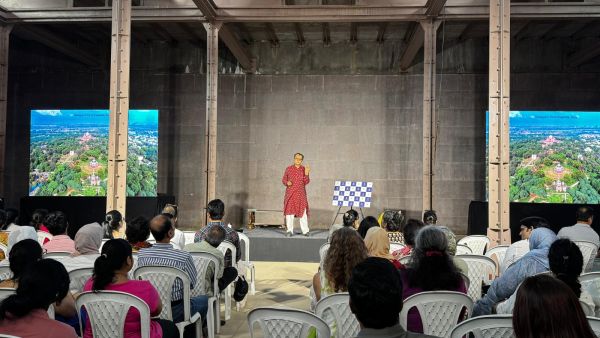
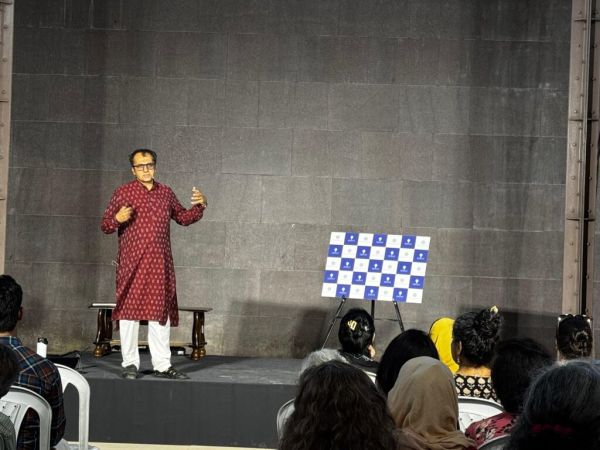
Hyderabad: It was a fitting setting when about 150 people gathered in an interpretation centre at the Qutb Shahi Tombs complex in Hyderabad’s Deccan Park, which isn’t open yet, stuck in litigation and half-built. This, undoubtedly, made it the right place for Ritish Nanda, the chief executive officer (CEO) of the Aga Khan Trust for Culture (AKTC), to speak about the years spent working on monuments that were, over time, buried in neglect. On Saturday evening, April 11, he explained what it takes to dig them back out.
At a talk organised by Sangat, a Hyderabad-based cultural initiative, Nanda spoke on the topic “Interpreting Heritage: From Humayun’s Tomb to the Qutb Shahi Tombs,” where he drew the organisation’s restoration efforts in Delhi and Hyderabad, moving between the 16th century and the present and the larger question of why any of it matters.
Why restoration is a breeze in Hyderabad
Nanda, while speaking about AKTC’s landmark restoration of Humayun’s Tomb in Delhi, said he likes coming to Hyderabad because of what doesn’t happen here. “There are no unnecessary obstacles, no one trying to block the conservation effort,” he said. The Telangana government had given the trust both support and room to carry out the restoration of the Qutb Shahi complex, he added.

The scale of the AKTC’s project at the Qutb Shahi Heritage Park is massive, with the complex having 86 monuments, four of which are as large as Humayun’s Tomb in Delhi. This, he said, was not what many people know about.
What was found under the 20th-century cement
Speaking about the condition of Sultan Quli Qutb ul-Mulk’s tomb when the AKTC first began work on it, Nanda said the surface had been covered in 20th-century cement. “Because it had been mixed with sand, it was possible to remove it without damaging the original structure underneath. What emerged was Persian and Iranian decorative patterns that had gone missing for years,” he said, showing such photographs in his presentation.
The gardens at the Qutb Shahi complex presented a different kind of challenge. Original plans had to be revised eight times as excavation revealed new information about the site’s layout. The team also had to remove millions of litre of water in the baolis (stepwells) during the restoration.
The restoration, he said, now results in 22 to 23 million litres collected in the stepwells annually, which is used to water the gardens and for horticulture of the complex. An endowment trust has been created to ensure that cleanliness, horticulture and upkeep continue beyond the project’s completion, he added.
The Qutb Shahi Interpretation Centre, once the litigation resolves, will eventually house two replicas of the tombs’ finials – the decorative, pointed ornament placed at the tomb on top. He also shared details about the project, which will house not just the lost elements of the Qutb Shahi complex but also a cultural meeting place, a restaurant and others, much like how it is at Humayun’s Tomb in Delhi.
Economics of care
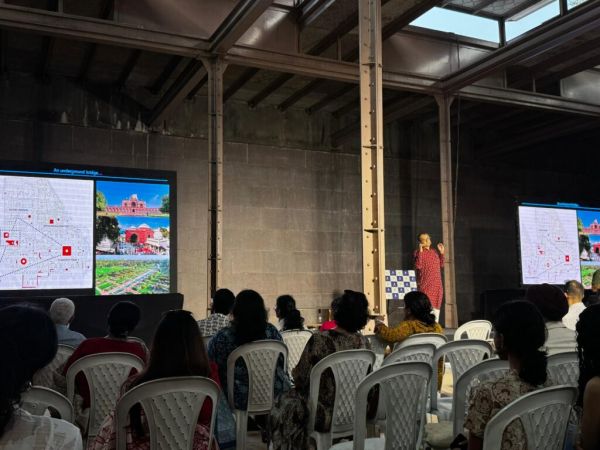
Nanda spoke at some length about Humayun’s Tomb in Delhi, where the AKTC completed a major restoration project. Visitor numbers increased afterwards “by 100 per cent,” he said, citing it as evidence that good conservation work pays off.
He said conservation creates employment. Restored monuments attract more visitors and those visitors spend money well beyond the site itself. “Heritage work is not just a cultural obligation, it is an economic one,” he said, answering one of the audience’s questions.
‘Humayun is underestimated’
He also pushed back against the popular view of Humayun. “People think Humayun was not much,” Nanda said. “What most people don’t know is that Humayun covered 34,000 kilometres in his lifetime,” he pointed out.
The tomb Akbar built for him was considered an architectural statement of India, a synthesis of Islamic tomb design and Hindu chhatri elements. The finial at the top is gold, not brass, as is commonly assumed, he added. The design itself was partly inspired by Humayun’s concept of a floating palace.
Nanda also spoke at length about the Hazrat Nizamuddin Dargah near Humayun’s Tomb and its cultural significance. Qawwali originated from the dargah, something most people didn’t know.
These are precisely the details that get lost without proper interpretation centres, Nanda noted.
Community involvement
“In India, we need to make a concerted effort to restore what we have,” Nanda said.
On community involvement, he said that when locals, who have lived around monuments for generations, have worked on a site for years or have seen it get restored to something beautiful, they develop a sense of ownership and pride over it.
“That is the most reliable form of long-term maintenance,” he said.
-
To eliminate the deficiency of hemoglobin, consume iron rich foods in the diet, the blood will increase rapidly

-
Is Social Media Making You Lonely? Know the scary truth between online chatting and declining social skills!

-
Brian Johnson’s new perspective on exercise

-
Ladli Behna Yojana: CM will release the 35th installment today, then Rs 1500 will come into the account, 1.25 crore dear sisters will get the benefit.

-
To get happiness from children, do these special measures on Sunday, happiness will spread in the house.