“Imagine the uproar when Uber’s cars start arriving without drivers,” prominent futurist and New York Times bestselling author Martin Ford wrote in his book, Rise of the Robots: Technology and the Threat of a Jobless Future.
It’s no longer a sci-fi climax. The time appears close when the planet will give in to the autonomy of humanoids, dwarfing their one-time human masters.
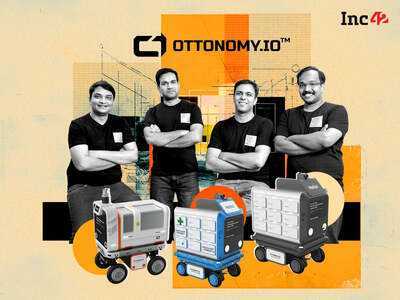
Until then, why not make the best use of robotic autonomy? That’s precisely where Ottonomy zeroed in on – the computational autonomy, and not the political autonomy – when the startup was rolled out to manufacture robots for hyperlocal indoor and outdoor delivery needs along with context.
“AI-first and autonomous robots are leading the market today. While segments like healthcare, logistics, manufacturing have seen deeper robotics penetration, hyperlocal delivery remains partially explored,” Ritukar Vijay shared with Inc42.
Vijay is one of the four founders who bet on ‘context’ to build their brainchild. Ottonomy uses Contextual AI for its robots. Instead of relying heavily on data-intensive perception models, these robots use pre-trained models to understand environments — whether it’s a hospital corridor, a mall, or a public sidewalk.
“The robots understand the context in what environment they are running and plan their way accordingly. The entire operation is autonomous. Full autonomy is what shapes our fundamental approach,” Vijay said.
Based in the US, the deeptech venture manufactures everything from scratch in India, working entirely with homegrown founders. About 40% of the supply chain is domestic, while critical components like LiDAR sensors and semiconductors are imported.
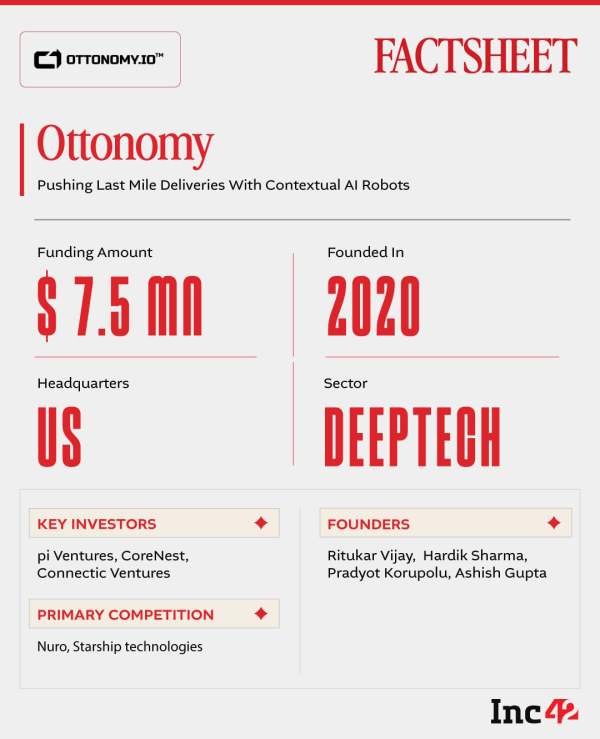
Made in India, the Ottonomy robots run with rivals like Nuro, Starship Technologies, and Serve Robotics, on the global turf. Along the six-year journey so far, Ottonomy has mopped up $7.8 Mn from investors like pi Ventures, CoreNest, Connectic Ventures, and ADR Ventures.
From Guest House To Global MarketsOttonomy’s founding quadrilateral, comprising Ritukar Vijay, Hardik Sharma, Pradyot Korupolu, and Ashish Gupta, tracked the rise of robotics since George Devol invented the first digitally operated and programmable robot in 1954. The last three decades have seen the industry go through a large-scale transformation.
The 1990s saw computer-controlled robotic arms become standard with early machine vision systems and basic sensors, mainly offering automotive manufacturing solutions like painting, welding, and electronic assembly. The next decade stood witness to an intelligence shift in robots with the penetration of AI and machine learning, serving warehouses and logistics without any fixed arms. Collaborative robots (cobots) came in early last decade, paving the way for humanoids to step out of the labs and work with humans in a real-world environment.
“There were many robots operating in warehouses, manufacturing, and autonomous vehicle segments, but hyperlocal delivery and logistics remained largely untapped,” Vijay said. “Back in 2020, only a few delivery robotics companies were focussed on food delivery. Their scope was limited by the size and capabilities of the robots, as most relied on GPS and similar tools for localisation,”
While Vijay’s 13 years spent in the robotics industry helped the software engineer work on an idea, teaming up with college mate Sharma and former colleagues Korupolu and Gupta, helped thrash out the blueprint for Ottonomy when the Covid pandemic hit the world.
With large swathes of the world going under lockdowns, they began making their first robot at a guest house in India. A test run was done in the basement, and the first pilots were booked with ecommerce companies.
Their first business came from the US. The Ottonomony robots were tasked to serve food and beverages at the Cincinnati International Airport. “Our first customer was interestingly an airport. We must not forget, one of the most impacted industries during Covid was travel,” he said.
Multiple pilots followed with companies like Walmart and other airports, but Vijay realised that the unit economics did not fit the food delivery segment. Ottonomy expanded its focus to healthcare and warehouses.
Ottonomy’s integrated hardware-software stack is designed for seamless indoor-outdoor logistics.
The startup operates with two primary robot SKUs – Autobot 2.0 and Autobot 3.0. While the underlying technology remains consistent across variants, the differentiation lies in form factor and deployment environment. Autobot 3.0, for instance, is designed with a narrower build to navigate tighter spaces like hospital elevators, and Autobot 2.0 caters more to industrial environments.
Instead of building multiple robots for different use cases, the company customises compartment modules mounted on top of the robots. With 6–8 compartment configurations, these bots can be adapted for multi-order last-mile deliveries (up to 8–10 deliveries in a single trip), secure medical transport (blood samples, chemo kits, vaccines), warehouse and industrial material movement, and high-value payload delivery.
According to Vijay, one of the biggest differentiators in Ottonomy robots is context. On the intelligence front, Ottonomy has taken a differentiated route with what it calls ‘contextual AI’ that differentiates and describes the surroundings. Once the context is identified, a reinforcement learning pipeline governs the behaviour. This decides how the robot should move, yield, prioritise, or optimise routes in real-time. For instance, the system learns whether to avoid a wheelchair or yield right-of-way, based on feedback loops and operational efficiency metrics.
“It could be a hospital, sidewalk, a shopping mall, a warehouse, a loading bay, or just anything. So, the robots understand the context in what environment they are running and what will plan their paths accordingly. And the entire operation is autonomous.That’s what our fundamental approach is like being fully autonomous for any of our departments right now,” Vijay told Inc42.
Another interesting fact is that the Ottonomy robots are designed to operate in varying weather conditions – be it winter or rain – the efficiency remains intact.
“We recently had a deployment in Finland where the temperature was minus-18 degrees Celsius. It was a chemical company moving goods from one building to another. We were running through snow till the point that robots are not occluded with snow. The robots work absolutely fine. It can take different weather conditions, from cold, rain, and even heat.”
Ottonomony also runs Ottumn.ai, a fleet management and orchestration platform. It works not only with robots but also drones, arms, smart mailboxes, elevators, access doors and more. It allows enterprises to onboard different robots, integrate their APIs, and coordinate how they work together, instead of working in silos.
Protecting Data, Paving The Road AheadInstead of selling robots directly, the startup operates on a Robots-as-a-Service (RaaS) model. Enterprises can take robots on lease through subscription, which is around $999 each robot per month for 1-5-year contracts.
Before signing a contract, the customer opts for a paid pilot, which lasts 1-3 months. After that, it converts into long-term contracts. The option is available in the US, UK, Europe, Australia, and India. While the US remained Ottonomy’s largest market, it failed to garner business on its home turf in the early years.
While Ottonomy has been signed up for a pilot at the Hyderabad airport, the company recently partnered with homegrown drone delivery startup Skye Air Mobility and drone logistics company Arrive AI to facilitate last-mile delivery solutions in India.
Ottonomy also earns revenue from the subscription it receives from Ottumn.ai. The fees start from $100 to $800 per month per system. The company is aiming at a revenue of $4.5 Mn for this year, marking a 4.5-fold jump from 2025.
Around 60% of the projected topline has already been secured from signed contracts. The company plans to penetrate deeper in the US market and expand its Ottumn.ai platform.
Ottonomy has 29 patents filed and 24 granted, covering various aspects of robotics, autonomy, and system design.
“Our autobots are zooming in on one critical white space – the indoor-outdoor logistics. There is hardly any player doing end-to-end indoor-outdoor. We are picking up the blood samples from level two at a healthcare facility, taking the elevator, coming down on the ground floor, and reaching for the access door. It travels half a mile outdoors and then delivers the samples to three labs. Now, since we are indoor-outdoor integrated with elevators, doors and working in different weather conditions, we were able to give the highest ROI compared to anyone,” Vijay said.
Ottonomy works in another critical area – data privacy. The company, according to the founder, does not store sensor or environmental data from customer locations. Instead, it relies on behavioural learning derived from robot performance, in compliance with the data protection laws laid out for companies doing business in India.
As the company works on building its customer base in India, it is bullish on enterprise deployment, starting from airports. While Ottonomy runs a fleet of 50 robots, it claims to have orders for 500 more. The company plans to deploy 200 robots this year, and the rest will be placed in 2027.
The post How Ottonomy Robots Are Mapping Last-Mile Delivery With Contextual AI appeared first on Inc42 Media.
-
PPF vs SIP: Which is the Better Investment Option? Find Out Which Will Yield the Highest Returns Over 10 Years

-
Absent from Duty Without Notice! Yet SBI Employee Sought Pension; Supreme Court Delivers a Stern Rebuke

-
Watch: Marco Jansen Pulls Off 'Catch Of Tournament' To Dismiss Ishan Kishan

-
Pakistani Fighters in Saudi Arabia? Why Shehbaz Took This Step Amid US-Iran Talks

-
'It’s A Marathon, You’re Not Going...': Dinesh Karthik Praises RCB's Fighting Spirit Despite Loss To Rajasthan Royals In Guwahati