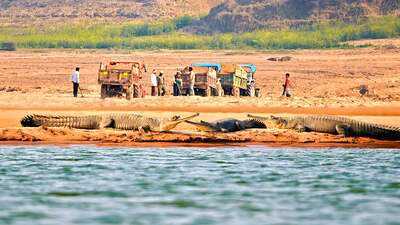
The National Board for Wildlife (NBWL) has sanctioned more than 1,500 projects in the past 10 years, with a 280 per cent surge in approvals in 2023-24 alone. Most of these projects are located inside or in close proximity of wildlife sanctuaries and national parks, leading to the diversion of more than two lakh hectares of forest for non-forest use.
The creeping acquisition of India’s forest wealth for sundry ‘development’ activities is so commonplace it doesn’t shock anyone. Nor does it make screaming media headlines. So, when the Rajasthan government denotified 732 hectares of the National Chambal Gharial Sanctuary (NCGS) in late December 2025, there was no outrage. But on 2 April, the Supreme Court intervened and put a stay on the denotification.
The Chambal sanctuary is India’s only tri-state (Rajasthan, Uttar Pradesh and Madhya Pradesh) riverine sanctuary spanning some 600 km of the Chambal river, offering refuge to nearly 75 per cent of the global gharial population.
The gharial (Gavialis gangeticus) is rated ‘Critically Endangered’ by the International Union for Conservation of Nature (IUCN). It relies on the solid sandbanks, clean water and steady river flows of this region, its natural habitat, to breed and survive. The December denotification put this fragile ecosystem at grave risk. It was endorsed by the Union government and approved by the NBWL, which is headed by the prime minister.
While the Rajasthan government argues the move will not dismantle the gharial habitat, conservationists point out that it is vulnerable to rampant sand mining and increased human intrusion. The presence of solid sandbanks is critical for the gharials to nest, and any disturbance to this riverine environment threatens their survival.
At a recent event on the Chambal riverfront in Kota, Lok Sabha speaker Om Birla proudly announced that long-held demands for a Chambal river cruise would finally be fulfilled, dismissing ecological concerns as secondary to ‘development’ and people’s demands.
Kranti Jain, president of the Kota Vyapar Mahasangh, also welcomed the denotification, saying it would help regularise homes of one lakh people who had settled illegally inside the sanctuary limits.
However, Babulal Jajoo, state coordinator of People for Animals, who has filed over 115 PILs, attributes the denotification to the influence of the sand mafia. More than a thousand truckloads of sand is mined daily in the affected areas, he says, on the watch of the police.
While ordering a stay on the denotification on 2 April, Justices Vikram Nath and Sandeep Mehta had some choice words for the sand mafia — the “modern dacoits” of the Chambal. “The state government has thrown in the towel. It is an extremely sad state of affairs if the state government says we cannot defend our natural resources,” Justice Mehta said.
Videos documenting the destruction were described by the judge as ‘terrifying’. “One can see the animals moving around as earthmovers dig out the sand,” he said. “Look at the number of sub-divisional magistrates, police and forest officers killed by the mining mafia… But the state has forgotten that there is a law called preventive detention.”
Environmentalist Vijay Varney says, “Till the 1970s, gharials used to be found from Dholpur right up to Morena, but now there is no space left for them. Unless the sand mining lobby is restrained, gharials and other river fauna will become extinct. The villagers fighting for this cause are impoverished farmers who cannot afford expensive litigation.”
The tragedy unfolding in the Chambal mirrors a nationwide trend. Wildlife sanctuaries and other protected areas are being denotified in great haste, supposedly to create vital infrastructure.
Varanasi, the prime minister’s Lok Sabha constituency, witnessed the controversial relocation of the Turtle Wildlife Sanctuary (TWS) — India’s first freshwater turtle sanctuary established in 1989 — to facilitate an inland waterways project as part of the Ganga Action Plan. The relocation project is doomed as sand mining is rampant in the Bhadohi-Mirzapur region as well, devastating the local riverine ecosystem.
Milk or ‘poison’ in the river: Religious extremism and assault on ecologyNowhere are protected zones truly sacrosanct. Buffer zones around tiger reserves and national parks have shrunk, leaving little room for wildlife. Environmentalist Reenu Paul says, “Reserved forests are no longer no-go areas.”
A Supreme Court decision in February 2021 allowed a road to pass through Rajaji National Park. The planned Haridwar bypass road threatens to cut through the Shivalik elephant corridor, requiring the felling of over 700 trees.
The Maharashtra State Board for Wildlife, chaired by chief minister Devendra Fadnavis, has similarly okayed iron ore mining in the Tadoba-Andhari Tiger Reserve corridor — home to over 60 tigers — despite warnings about irreparable environmental damage and poor economic returns.
Among the most egregious denotification actions is the transfer of 11.44 sq. km of Galathea Bay wildlife sanctuary — the largest nesting ground of the endangered giant leatherback turtles — in Greater Nicobar Island for a Rs 72,000 crore transshipment port project.
Retired Indian Forest Service officer Prakriti Srivastava warns: “Everything is up for sale. The more forests are diverted, the larger your vote bank becomes. The bureaucrats clearing these projects are blind to the permanent damage they cause.”
Protected areas across India are under threat. The list is long and growing: Dampa Tiger Reserve in Mizoram, Pakke Tiger Reserve’s buffer zone in Arunachal Pradesh, Melghat Tiger Reserve in Maharashtra, Mollem National Park (Goa), Girnar Wildlife Sanctuary (Gujarat), Eturnagaram Wildlife Sanctuary (Telangana)…
Land in or near protected areas and their buffer zones is being made over to mining and/or infra-structure companies with practically no concern for wildlife and the preservation of their ecosystems.
A review of the minutes of the NBWL’s standing committee meetings reveals an unsettling pattern: approvals rarely demonstrate any benefits to wildlife. ‘Development’ inside protected areas is illegal under the Wildlife Protection Act. Yet, the National Board for Wildlife is demonstrating no real concern for the areas it is mandated to protect, functioning instead as a clearing house rubber-stamping projects the government wants okayed.
-
Yuvraj Singh Names Former India Captain As Favourite Batting Partner

-
DDLJ Gets Oscars Academy Shoutout Among Top Travel Romance Films; Kajol Reacts

-
Kerala Minister V Sivankutty To Seek EC Approval To Conduct SSLC Exams In Gulf Amid West Asia Conflict; Decision On Marks Yet To Be Taken
-
NTA Opens Correction Window For GAT-B, BET 2026 Applications Till April 13 At exams.nta.nic.in/gat-bet; Check Editable Fields, Key Details Here
-
Dilwale Dulhania Le Jayenge Features In The Academy’s Social Media Post, Kajol Reacts