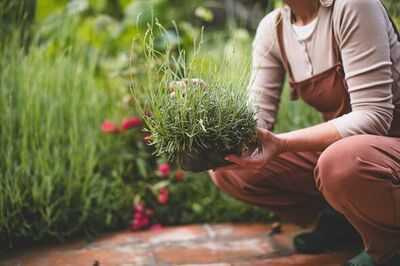
If you want your garden to look like a traditional English cottage, then you need to plant this flower by the end of the month.
Spring is the perfect time to start working on your summer garden. Many flowers will be starting to bloom around this time, so going to a garden centre and finding your ideal mix of spring and summer flowering plants couldn't be easier.
But what do you choose to plant in your pots and borders? The plants you grow will largely come down to personal preference for things like colour and petal shape, but if you want to craft your own picture-perfect English country garden, then you'll need to plant some specific flowers.
One flower in particular that is known as the "quintessentially English" garden flower is lavender, which can be planted at this time of year to create a full hedge of gorgeous purple flowers by the summer.
Adam Kirtland, known online as View From The Potting Bench, encouraged any gardener looking to fill up their flowerbeds or borders to try planting a lavender hedge, as it gives a burst of colour, looks great in the summer, and is a fantastic pollinator plant for insects like bees.
In a TikTok video, he said: "There's something I guarantee that you've seen in other people's gardens that you want in yours, too - and I'm going to show you how to do it. There's nothing that says quintessential English garden [more] than a lavender hedge. It looks fantastic along a path, a raised bed, or a border."
Adam urged gardeners to think about which type of lavender they want to plant, as there are many different varities that look slightly different and may even need different levels of sunlight and water to thrive. He said he always uses Hidcote, also known as English lavender, which is a "bushy evergreen shrub".
At this time of year, you can usually buy established lavender plants from garden centres, which you can simply plant in your own soil at home and wait for them to spread out and fill the space you've put them in. But if you want to save some money and you don't mind waiting until next year for your flowers, then you can try a different method - buying plug plants.
Plug plants are young seedlings or cuttings grown in small cells, which are a halfway house between planting seeds and mature plants. They are often cheaper than buying the full plant, but you do need to be patient and wait for them to grow.
Adam explained: "If you're on a budget and you're happy to wait, use these instead. Plug plants are a great way to save money in your garden and make your money go further.
"When you're planting out your lavender hedge, you want to do it in full sun. Lavender is a Mediterranean plant, and it will sit and bask in that sun happily. Planting out your plugs is no more difficult than making a hole, popping it in, and firming the soil back around it. You'll want to [plant them] around 30cm apart to give them room to grow. It just so happens that most garden hand tools are about 30cm long, so lay them out, lift them up, and you've got the perfect space."
How to take care of lavender1) Plant lavender in the right place
- Choose a full-sun spot (at least 6 hours a day).
- Give plants space and airflow to reduce fungal problems.
2) Use free-draining soil (this matters most)
- Lavender hates wet feet, especially in winter.
- In heavy/clay soil, mix in grit or sharp sand or plant on a slight mound/raised area.
- Mulch with gravel/grit rather than compost to keep the crown dry.
3) Water sparingly
- New plants: water regularly for the first few weeks to help roots establish.
- Established plants: only water during prolonged dry spells.
- In pots: water when the top compost feels dry; never let the pot sit in water.
4) Don't overfeed
- Lavender prefers poor to moderately fertile soil.
- If needed, give a light spring feed; avoid high-nitrogen feeds that cause soft, leggy growth.
5) Prune every year to stop it from going woody
- Best time: after flowering (late summer) or early spring.
- Trim back about a third to keep a neat, rounded shape.
- Don't cut into old brown wood with no green growth - lavender may not regrow.
6) Deadhead for more flowers
- Snip off spent flower stems to encourage repeat blooms and keep plants tidy.
7) Protect from winter wet
- Cold is usually less of a problem than waterlogged soil.
- Improve drainage and, for pots, move to a more sheltered spot during long spells of rain.
-
Adityanath calls for time-bound action to position UP as India's 'deep-tech capital'

-
IPL under Sooryavanshi spell: 15-year-old Vaibhav hits 78 off 26 balls in easy RR victory

-
Child falls into borewell in Ujjain, dies; CM announces Rs 4 lakh aid for family

-
UP boat capsize: Most victims from Punjab; Mann assures Yogi of every possible help

-
Police deployment, traffic management planned ahead of farmers' protest on Apr 11 in Haryana