
At 5:30 p.m. on April 2 Emma Wylie rode from her office in Tay Ho Ward to the class on Hoang Quoc Viet Street in Cau Giay.
This was the 25-year-old kindergarten teacher’s first such class after three months of living in Hanoi.
In a small room in a café, she joined five others from Russia, Germany and the U.K. to learn practical skills such as greetings, self introduction and bargaining at markets.
|
Foreigners attend the Vietnamese communication and cultural etiquette class in Hanoi, April 2, 2026. Photo by Nga Thanh. |
Arriving in Vietnam with no Vietnamese language skills, Wylie says she used to struggle with daily situations.
“In class, I learned that Vietnamese people nap to recharge their energy. I was also taught to raise my hand to signal drivers when crossing the street.”
At the end of the session she quietly repeated a phrase as she wrote it in her notebook, preparing for her market trip the next morning: “This is too expensive, can you lower the price a bit?”
Lukas Weber, a 27-year-old German working at an education company in Ba Dinh Ward, says despite living in Hanoi for nearly three years, he still does not fully understand local social norms.
While in Germany asking a person about their marriage or salary is considered intrusive, while in Vietnam it is often a way to start a conversation, he says.
“I was surprised when neighbors asked if I was married the first time we met, and colleagues even tried to set me up on a date.
“After attending this class, I realize it comes from care and a desire to connect, not to pry.”
He says mastering Vietnamese tones remains his biggest challenge. To improve, he has bought a full set of primary school textbooks to learn and avoid common mispronunciations.
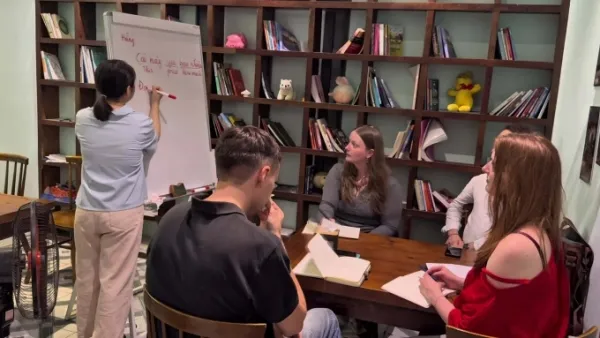
Participants learn to shop, bargain and count numbers during the class on Hoang Quoc Viet Street in Cau Giay District, Hanoi, April 2, 2026. Video by Nga Thanh.
The class is part of Hanoi Exploring, a volunteer-run project founded in 2024 by Le Huy Khanh, who is currently a senior at the University of Languages and International Studies under Vietnam National University
Khanh, who moved to Hanoi from Central Highlands province of Kon Tum, says he got the idea after noticing many foreigners struggling with loneliness and becoming withdrawn due to the language barrier.
Having moved from Kon Tum to Hanoi for his studies, he is himself familiar with the feeling of loneliness.
|
A German student hold his Vietnamese textbook during class. Photo by Huy Khanh. |
The project offers short, six session courses focused on real life communication, including shopping, asking for directions and ordering food.
“Our goal is simple,” Tran The Thanh, a team member and graduate from the Hanoi University of Science and Technology, says. “When students leave, they should be able to order a cup of coffee on their own.”
According to Khanh, the biggest challenge is maintaining team members’ motivation as the workload is heavy with no pay.
The project initially had six members and often had to rent or borrow spaces to keep the classes going. Participation by foreigners was also limited. “But seeing how excited the students are each time they come to class and how eager they are to learn about Vietnamese culture keeps us going,” Khanh says.
In the beginning the team struggled to develop an effective curriculum.
Tran The Thanh, 25, also a graduate from the Hanoi University of Science and Technology, says it took months to refine their teaching approach. Instead of focusing on spelling or academic grammar, which could discourage learners, the team shifted to a simpler and more practical method.
Teaching a tonal language like Vietnamese remains a challenge. Nguyen Minh Hang, 21, another of the volunteers, says many students struggle with vowel pairs such as “ô and ơ” and “u and ư,” and sometimes take weeks to distinguish between the various tones.
|
Le Huy Khanh (left), founder of the Hanoi Exploring project, guides foreigners in learning about Vietnamese culture, 2025. Photo courtesy of the subject. |
The team is getting support from a café owner in Cau Giay Ward, who provides space on weekend evenings.
From an initial six members, the group has grown to 20 volunteers, many with advanced language certifications. The project has helped more than 200 foreigners integrate into Vietnamese society.
Aleksandra Sorokina, 24, a Russian language teacher, has been attending the class since October last year. After completing the course, she continues to return each week to stay connected with the community.
“During Tet (Lunar New Year festival), we gathered to make banh distillation (traditional sticky rice cake), learned about the five-fruit tray and the tradition of first footing. The warmth of everyone here has helped ease my homesickness.
-
Start Your Business Without Collateral: How CGTMSE Scheme Helps You Get Easy Loans

-
PPF Maturity Guide: Withdraw or Extend? These 2 Options Can Grow Your Wealth Further

-
Fulfill Your Dream of an MSc in Physics from Home: These Universities Offer Support via Distance Mode

-
CBSE Updates: How Students' Results Will Be Prepared Without Exams in Gulf Countries—Get Full Details Here
-
Indian Army Recruitment 2026: An Opportunity to Join the Indian Army—Find Out How Veterinary Graduates Can Apply Here