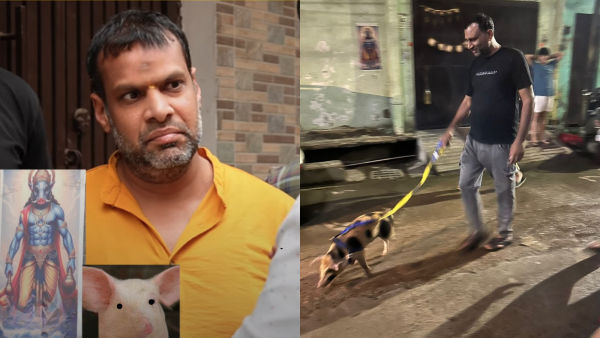
In a narrow lane in Delhi’s Tri Nagar colony, pig cages sit outside the doors of certain houses. On the walls nearby hang posters of a pig-faced deity, adorned with jewellery like other gods. Some Muslim residents claim the animals have been named “Abdul” and “Sultan,” and are only called out when they pass by. During Diwali, the pigs are garlanded with flowers.
Hindu residents say this is devotion. The pigs represent Varaha, Vishnu’s third avatar, they explain. “We have always worshipped them. They are our deity,” one resident told The Print. Another, Prerna, said, “They are used to living in dirt. We are raising them properly. We even decorate them with garlands during Diwali.”
For the more than 70 Muslim families living in Tri Nagar, a residential colony in north Delhi near Ashok Vihar and Shakurpur under the Chandni Chowk constituency, it feels like something else entirely.

Muslims are prohibited from eating pork and consider pigs to be unclean.
“They are trying to push us out of our own homes. We are very troubled. We are insulted again and again, called ‘jihadi’ and ‘Pakistani’ every day,” said Liyakat Ali, a resident who has lived in the area for two decades. He is now considering leaving.
‘Delhi will be purified’
The tensions became visible to the rest of the country when closed circuit television (CCTV) camera footage surfaced on social media on April 6, showing residents placing pig cages outside the doors of specific houses – those belonging to Muslim families. The footage spread quickly. So did the videos that followed.
One video, which accumulated over 3 million views on Instagram, showed a man smiling at the camera. “Pigs will roam in every lane, and there will be a temple in every lane,” he said. “Delhi will be purified. And all these people will leave.”
Other videos showed the animals being fed milk, garlanded with flowers and tended to ceremoniously. Several users shared the clips, urging others to keep pigs as a way to “protect Hindu dharma” and make the neighbourhood “jihadi-mukt (Jihad-free).”
Muslim residents said the practice began only two to three months ago, though Hindu families insist it has been going on for a year. Whatever its origins, the effect on the Muslim community has been the same, that is, a deepening sense of siege.
Tensions escalate as pigs die
The situation took a sharper turn when the pigs began to die.
Ahead of Diwali last year, families in Gali no 3 acquired five pigs and kept them in cages outside their houses. One by one, the animals died. Hindu residents blamed their Muslim neighbours, claiming the pigs had been poisoned, pointing to symptoms like foam at the mouth and blue discolouration of the body, which they said veterinarians had attributed to poisoning.
No medical evidence was produced to support the claim.
Muslim residents offered a different account. The animals, they said, were left exposed to harsh weather, both sun and rain, without adequate care, and the blame was conveniently redirected at them whenever the media arrived.
Abdul Bari, a footwear shop owner in the colony, found himself named as the “mastermind” behind the deaths, who has denied any role. CCTV camera footage from outside his own home showed the animals’ owners injecting them with an unidentified substance before feeding them, he said, sharing the footage with The Print. The pigs visibly cried out after being injected, he pointed out.
Despite filing a complaint with the Municipal Corporation of Delhi about the poor treatment of the animals, Bari continues to be blamed for their deaths. No formal complaint about the deaths has been filed against him.
“My only fault is that I am Muslim,” he told The Print.
‘We just want to live peacefully with our families’
For Bari, the pig episode is only one chapter in a longer story of harassment, with him raising the issue with authorities back in September 2025.
When he bought a plot in the predominantly Hindu colony in 2023, the resident welfare association demanded he pay Rs 1 lakh per square foot. When he refused, residents filed complaints alleging illegal construction. When he remained unfazed, rumours began to circulate that he had links to Pakistan and that his leather business was a front for funding communal unrest.
However, he denied the allegations.
The harassment grew more personal. Residents trespassed into his house, he claims, and he recorded the incidents. Meat and garbage were thrown outside his home. He was then accused of littering.
Ali’s experience is similar. He has spent 20 years in Tri Nagar and the last three in Onkar Nagar B. He says he never once felt uncertain about living there, until now at least. Muslim residents who try to build homes in the area are routinely harassed and extorted, he alleged.
“Every Muslim who comes here is asked for money. You can call it extortion. If they refuse, they are harassed in different ways,” he told The Print.
He and Bari have filed repeated complaints at the local police station as the harassment intensified over two months. A senior police official acknowledged the situation but played down its urgency. “The incident is old. People are giving interviews to the media on what has transpired four to five months back,” the official said.
For Ali, that response does little to ease his fear. He is now considering leaving, with reluctantly and with grief. “We just want to live peacefully with our families,” he said. “I’ve been cut off, even people I once called friends, members of my own community, don’t believe me anymore.”
Resident alleges Muslims come in large numbers to drive out Hindus
Not everyone in Tri Nagar sees it as harassment. Sachin Kumar Sharma, a resident of Onkar Nagar’s Gali no 3, says it is a matter of demographics and self-preservation.
Once predominantly Hindu, areas like Tri Nagar have gradually changed as Muslim families moved in and Hindu families moved out, he said. “They come in large numbers. Slowly, they change the population of the area,” he said.
He alleged that Muslim households have more residents than permitted, and suggested, without evidence, that many may be immigrants from Bangladesh or Pakistan. He claimed that properties were being acquired “through deceit.”
To reinforce control, residents of Gali no 3 have installed a gate on one side of the lane to restrict movement. They allege that Muslim residents use abusive language, film the neighbourhood without permission and cause disturbances. Muslim residents deny these claims.
“These changes are necessary. We won’t give up our lands this time,” said an older woman who visits the local temple daily.
Back in his home, Ali knows what is being said about him and his neighbours. He knows the rumours, the allegations and the suspicion. He has lived through two decades of otherwise ordinary life in this colony, where he built his house, made his friendships and planted his roots.
Now, those roots feel precarious.
“I don’t know how long this house will remain with me,” he told The Print. “We do not want to go. We want to live together.”
-
Vaibhav Sooryavanshi: 266 runs, Vaibhav Sooryavanshi number 1, will do this feat as soon as he hits a six.

-
Is only iodized salt the cause of thyroid, know about these myths and remedies’ – News Himachali News Himachali

-
Your household budget will not deteriorate amid global tension, government gave signal of ‘all is well’

-
Hulikal Ghat Landslide: Major Highway Closed After Three Workers Were Killed in Road Work
-
Mumbai: EVM diagnostic for Chandivali set for April 16 post HC order