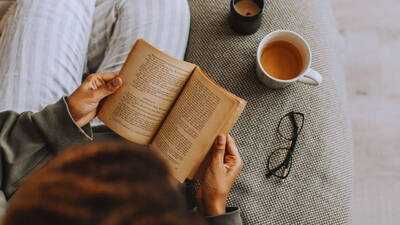
For time immemorial, books have shaped the way people view the world. Not through dramatic aha moments or sudden clarity, but quietly, almost invisibly! A series of small reading habits , built up over the years, can transform the lens through which one perceives everything. A page here, a thought there, and then one day you see things in a way you hadn't noticed before. You are surprised by the newer and finer details with which you observe your surroundings.
What you gain is a fresh perspective rooted in simple, repeatable habits. This demonstrates the power of consistency.
Meera Raman, Co-founder & CEO of BoiPoka, a digital reading community, shares five basic practices that can change how we think by challenging assumptions , expanding biases, and nudging us beyond our comfort zone. None of these require a curated reading list, book club, or productivity app—only a few practices that improve with time.
1. The discipline of showing up
The most overlooked reading habit is also the simplest. Read every day! It doesn't matter if you only read a single page. We tend to make reading into an event. An occasion that requires time out, quiet, and the right frame of mind. But perspective doesn’t come in a single sitting. It builds up over time through consistent practice. Five minutes is enough. Even a page is enough. What’s important is that we return to it every day. A quieter truth here is that when we read what genuinely interests us, the habit sustains itself. We stop negotiating. And on the days when the world feels loud and relentless, that one page or those five minutes with a book become something close to an anchor.
2. Read what you disagree with
We live in an age of curated feeds and personalised recommendations. Our reading lists are also shaped by what we already like. Over time, this "filter bubble" creates an echo chamber of thoughts. Everything begins to sound familiar.
Pick a book that challenges your politics, your philosophy, your assumptions about how the world is supposed to work. You don't have to agree with it. You don't even have to finish it. But staying with an uncomfortable idea, even briefly, has a way of stretching your thinking. That's where genuine expansion happens. You may emerge with the same beliefs. Or you may not. Either way, you understand your own position more clearly.

3. Mark what moves you, not what seems important
Most of us were taught to underline what seems important—key arguments, memorable lines, and quotable insights. But there is another way to read. Mark, what makes you pause? A sentence that feels uncomfortably true, an idea you instinctively resist or a thought that doesn't fit into your existing map of things. Not everything important is memorable. But everything you find memorable tells you something about yourself. Over time, these markings begin to reveal something deeper, not just about the book, but you. Your annotations become a reflection of yourself, showing recurring themes of surfacing, persistent fears, and quietly shifting values. In my experience, it is one of the most honest forms of self-awareness available to anyone.
4. From page to conversation
Reading is often viewed as a solitary act. And it is, to an extent. But its impact multiplies when it enters a conversation.
You do not need a formal setting. No structured discussions or organised groups. Just a casual moment over coffee or a meal. "I read something that's been stuck in my head." That's enough to begin. When you articulate an idea, it undergoes a transformation. The act of translating private reading into conversation forces a kind of precision that silent absorption. You will quickly discover what you actually understood and what you only thought you did. Occasionally, and this is the unexpected part, you'll change someone else's afternoon entirely. The idea you pass on, often without intending to, lingers with them long after the conversation is over.
5. Let the book linger
We approach books as tasks. We complete one, line up the next, and maintain the momentum. But not all books are meant to be consumed this way. Some require space and time to settle in and echo in the mind. The most transformative impact a book has often occurs after the last page is turned, in the days following its closure, during a stray thought that resurfaces. At the same time, you are engaged in completely unrelated activities. Resist the temptation to fill that space right away. Allow the book to linger with you a bit longer.
The making of perspective
Reading, at its best, isn't just an escape from life; it's a gradual journey that teaches us the many ways to be human. It slowly reveals that there are numerous ways to think, feel, and exist – showing that your perspective is just one of many.
These five habits won't transform your life overnight. But when practiced consistently, they subtly shift what you notice, what you question, and what you choose to hold onto.
-
Great Indian Bustard hatches in Gujarat after decade of incubation efforts

-
Four cheetah cubs born in the wild in Kuno for first time since launch of translocation project

-
Who Will Succeed Modi as Prime Minister? Astrological Insights on Top Contenders

-
I make air fryer salmon tastier and richer by adding 1 simple ingredient

-
Trump Highlights U.S. Energy Dominance Amid Diplomatic Talks in Islamabad