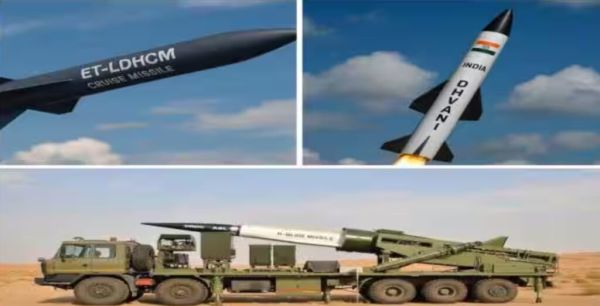
India’s hypersonic weapons programme, led by the Defense Research and Development Organization (DRDO), is now moving beyond technology demonstration to operational development. Three main systems — Dhvani Hypersonic Glide Vehicle (HGV), Long-Range Anti-Ship Missile (LR-AShM), and Extended Trajectory Long Duration Hypersonic Cruise Missile (ET-LDHCM) — are under progress. Their objective is to provide such high speed and maneuverable strike capabilities that can challenge modern air defense systems.
Dhvani is a boost-glide hypersonic vehicle designed primarily for long-range strategic interdiction, and can potentially carry a nuclear payload. It is expected to achieve speeds in excess of Mach 5–6 (approximately 7,400 km/h), and is said to have a range of up to 10,000 km in some configurations. The system uses a ballistic booster to reach altitude before gliding and maneuvering in the upper atmosphere, making it difficult to intercept. DRDO is preparing for its first flight test in early 2026, with special focus on thermal protection (ability to withstand extreme heat), guidance and navigation.
The LR-AShM is a boost-glide hypersonic missile developed for maritime strike roles, particularly to counter naval threats in the Indian Ocean region. It has a confirmed range of over 1,500 km and can engage both moving ships and stationary ground targets. The missile initially reaches speeds of up to Mach 10, and maintains an average speed of Mach 5 through atmospheric lift and maneuvering. It has indigenous sensors for final guidance and was publicly displayed during the Republic Day parade in January 2026. Preference is being given to land-based coastal battery variants, while ship- and aircraft-launched options are also being considered.
The ET-LDHCM, developed under Project Vishnu, is a scramjet-powered hypersonic cruise missile that was successfully test-fired off the east coast of India in July 2025. It is designed for a speed in excess of Mach 8 and a range of more than 1,500 km (potentially up to 2,500 km in some variants), and has the capability to carry conventional or nuclear warheads. Its air-breathing propulsion enables sustained high-speed takeoff and mid-range recovery, giving it the flexibility to launch from land, sea or air platforms. These programs build on earlier achievements, including the test of long-range hypersonic flight from Dr APJ Abdul Kalam Island in November 2024 and significant breakthroughs in scramjet technology. In January 2026, DRDO successfully ground tested a full-scale actively cooled scramjet combustor for more than 12 minutes, an important step towards sustained hypersonic flight.
Dhvani (nuclear deterrence), LR-AShM (maritime dominance) and ET-LDHCM (precision strike) together aim to create a layered hypersonic capability. Although promising, most systems are still in the testing or early development stages, and will likely take several years to become fully operational. India’s efforts represent an important step towards self-reliant deterrence amid changing regional security circumstances.
-
Sonu Nigam Reminisces About Arijit Singh's Heartwarming Visit After 15 Years

-
UAE to introduce administrative roles in schools to ease teacher workload

-
Tried 'looksmaxxing'? UAE doctors warn of health risks related to social media trend
-
Understanding Ear Health: Signs You Shouldn't Ignore

-
Natural Remedies to Improve Vision and Reduce Eyewear Dependency