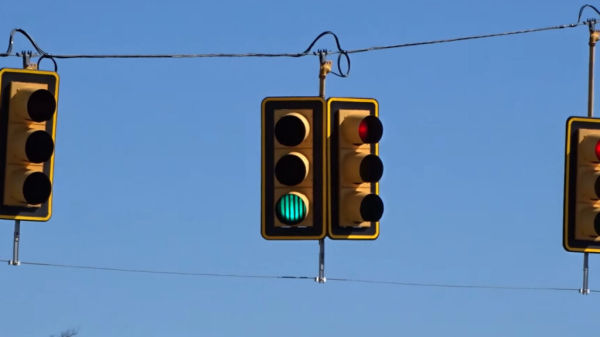
Look closely, and you might find that there are more variations in traffic lights than you realized. Some have white lights that aren’t meant for car drivers, while others have inconspicuous white boxes that gather data on nearby traffic. Others still have lines or slats over the light itself, which are also known as louvres. Like all the other unusual features that can be found adorning traffic lights across the country, there’s a specific reason that they’ve been installed, and in this case, it comes down to visibility.
Specifically, the louvres help control who can see each signal. They’re often used in situations where different lanes are controlled by different signals, and will ensure that only drivers in the corresponding lane are able to see that signal. Meanwhile, adjacent lanes will not be able to see the signal. While these louvres are often applied to green and yellow signals, they’re not as commonly applied to a red signal. Official documentation sometimes refers to the practice of putting louvres over the green and yellow signals as the “Dallas display.”
What does the Dallas display do?
The Dallas display can help drivers avoid running into what’s known as the “yellow trap.” This can affect drivers who end up stranded in an intersection when trying to make a left turn when there’s constant traffic on the opposing side of the road.
If the stranded driver can see the signal for the adjacent straight-ahead lane next to their own left-turn signal, they might assume that a yellow signal for the straight-ahead lane in their direction means drivers in opposing traffic will also be displayed a yellow signal. This isn’t always true, as some intersections feature a delay between the timing signals for opposing directions of traffic. As a result, these drivers can assume that traffic in the opposing direction will be slowing down and then attempt to make their left turn, when in fact the traffic in the opposing direction is still subject to a green signal and is therefore driving at full speed.
By removing the ability for drivers making a left turn to see the signals in adjacent lanes, the Dallas display removes the chance for drivers to make this assumption. They’re then forced to rely solely on their judgement of the speed of the oncoming traffic, and are less likely to turn across that traffic and cause a collision. While modern cars come with all kinds of innovative safety features aimed at preventing collisions, the implementation of simple louvres can make a big difference and can benefit all drivers regardless of the vehicle they drive.