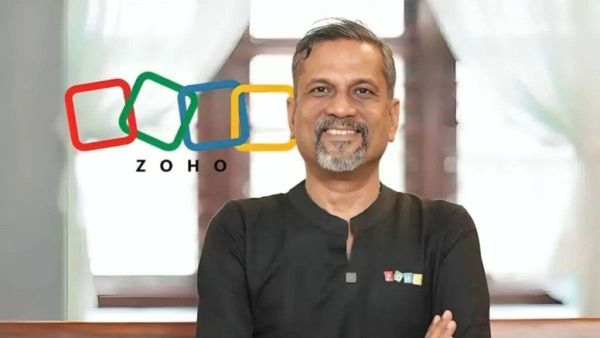
In a startup ecosystem often dominated by venture capital and high-burn growth models, Zoho has carved out a path that is both rare and remarkable. The Chennai-headquartered SaaS company has become India’s first bootstrapped startup to surpass ₹12,000 crore in revenue for fiscal year 2025—an achievement that underscores the power of sustainable, profit-driven growth.
What makes this milestone even more compelling is that Zoho has done it without relying on external funding. In a world where unicorn valuations often grab headlines, Zoho’s steady climb offers a refreshing counter-narrative.
Credits: NewsBytes
Consistent Growth Without External Capital
Zoho’s financial performance reflects disciplined execution over hype. The company recorded a strong 17.8% year-on-year growth, nearly doubling its revenue in just three years. This kind of consistent scaling is rare, especially for a company that has chosen to remain privately held and bootstrapped.
Its approach has always been rooted in long-term thinking—focusing on product innovation, customer retention, and global expansion rather than short-term valuation spikes. This strategy is now paying off in a big way, positioning Zoho as one of India’s most resilient and self-sufficient tech companies.
Profit Dip Signals Strategic Investments
While revenue surged, Zoho’s profits saw a slight dip to ₹3,191 crore. But this isn’t necessarily a red flag—it’s a signal of strategic reinvestment.
The company has ramped up spending on employee benefits and advertising, indicating a clear focus on talent acquisition and brand building. In a competitive SaaS landscape, attracting top-tier talent and maintaining global visibility are crucial for sustaining growth momentum.
Rather than maximizing short-term profits, Zoho appears to be doubling down on future readiness—investing in people, innovation, and market expansion.
Core Products Drive the Engine
A major highlight of Zoho’s growth story is the strength of its core offerings. Its flagship products—including ManageEngine and the Zoho Suite—accounted for a massive 96% of total revenue.
These products cater to a wide range of business needs, from IT management and cybersecurity to CRM, finance, and collaboration tools. Their integrated ecosystem has become a key differentiator, allowing businesses to operate seamlessly without relying on multiple vendors.
This product-led strategy has not only ensured consistent revenue streams but also strengthened customer loyalty across geographies.
North America Leads, Asia Follows
Geographically, Zoho continues to see strong traction in global markets. North America emerged as its largest contributor, accounting for 41% of total revenue. This highlights Zoho’s strong foothold in one of the most competitive SaaS markets in the world.
Asia followed closely, contributing 30% of revenue—a sign of the company’s growing influence in emerging markets. With digital transformation accelerating across regions, Zoho is well-positioned to capitalize on increasing demand for cloud-based business solutions.
Leadership Transition Marks a New Chapter
Amid this growth phase, Zoho also underwent a significant leadership transition. Founder Sridhar Vembu stepped into a new role as Chief Scientist, shifting his focus toward deep tech and R&D initiatives.
Taking over as Group CEO is Shailesh Kumar Daveya long-time leader within the company. This transition reflects Zoho’s maturity as an organization—where leadership evolution is aligned with strategic priorities.
Vembu’s move signals a renewed emphasis on innovation, while Davey’s elevation ensures operational continuity and execution excellence.

A Blueprint for Sustainable Success
Zoho’s journey is more than just a financial milestone—it’s a blueprint for building a global tech company from India without external dependencies.
By prioritizing profitability, investing in its workforce, and staying committed to product excellence, Zoho has demonstrated that scale and sustainability can go hand in hand.
As the SaaS industry continues to evolve, Zoho’s model may well inspire a new generation of founders to rethink growth—not as a race for funding, but as a pursuit of enduring value.
-
LIV Golf star suffers disastrously bad Masters start as his own comments backfire

-
Teenagers who ruled the world — can Sooryavanshi be next?

-
Exciting New Additions to Netflix's Wednesday Season 3 Cast

-
Thalapathy Vijay's Jana Nayagan Faces Release Delays Amid Clip Leak Controversy

-
Who's Who at Anant Ambani's Star-Studded 31st Birthday Bash?