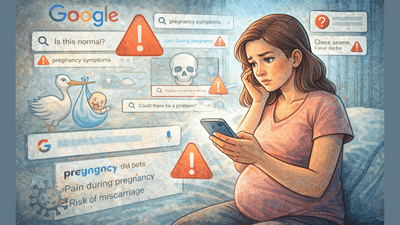
Pregnancy nowadays is not the same as twenty or thirty years ago. Previously, a majority of women were advised by their mothers, grandmothers, and neighbours, and doctors. Today, when someone has a pregnancy test, the last person they want to see is a family member. It’s Google.
And Google has a lot to say.
Type one symptom and suddenly there are ten articles, five YouTube videos, three Reddit discussions, and two Instagram reels telling you what it could mean. Some say it’s normal. Some say call a doctor immediately. Some say it happened to them and everything was fine. Some say it happened to them and it was not fine.
Too much information does not always make people calm. Sometimes it makes people more anxious. Many doctors actually say that one of the biggest problems now is not lack of information but too much information. Earlier, women did not know enough and were scared. Now women know too much and are still scared, just for different reasons.
Every small symptom becomes a search.
Every search becomes five more searches.
Every search leads to a worst-case scenario somewhere on the internet.
Headache? Search.
Back pain? Search.
Baby not moving for some time? Search.
Cramp? Search.
Sleep problem? Search.
And the internet does not know how to calm a person. It only knows how to give more information.
There is actually research showing that excessive internet searching about health symptoms can increase anxiety, especially during pregnancy, because people often read rare complications and start thinking those things will happen to them. Doctors sometimes call this “information anxiety.”
Another interesting thing about pregnancy today is that women are tracking everything. Apps that tell you the baby is the size of a fruit. Apps that tell you what to eat. Apps that count steps. Apps that track sleep. Apps that track baby kicks. Pregnancy has become something that can be tracked, monitored, measured all the time.
But pregnancy is still unpredictable. Bodies are different. Babies are different. Experiences are different. No app or website can fully predict how someone’s pregnancy will go.
Many mothers now say one of the most difficult parts of pregnancy is not the physical discomfort but the constant thinking. Am I eating right? Am I sleeping right? Am I walking enough? Is the baby moving enough? Is it something wrong that I am doing?
Excess information at times makes people feel that they are always in the wrong.
What the doctors say is so simple, almost primitive these days.
“Don’t Google everything. Talk to your doctor.”
But in the age of the internet, that is easier said than done.
For many women today, having a positive pregnancy test means they’ll go to the internet to conduct research and gain knowledge about what to expect as an expecting mama, says Dr. Mannan Gupta, Chairman & HOD - Obstetrics & Gynaecology, Elantis Healthcare New Delhi. While this helps some women feel more knowledgeable about their pregnancy, it’s actually very easy for women to become overwhelmed with the amount of information available to them online. Expectant moms may read and watch multiple articles and videos on the internet, and view forums and receive a lot of different advice regarding their pregnancy. This can lead to more questions than answers and create unnecessary anxiety.
Generally, frequent online searching leads to increased anxiety related to pregnancy. Expectant mamas may begin overthinking their pregnancy symptoms, as well as normal pregnancy symptoms because of what they have read on the internet and confuse them as being something serious. Along with being anxious about pregnancy and overthinking, comparing your pregnancy to that of other women can cause women to experience low self-esteem and panicking. Furthermore, excessive research can cause problems with sleeping, mental health, emotional stability and causing you to doubt your body. And in some cases, possibly due to the increased anxiety, a woman may avoid or delay seeking appropriate medical care.
The best way to manage the amount of information available about pregnancy is to limit random searching, and utilize your medical provider as a trusted source. Utilizing credible sources regarding information about pregnancy and voicing any fears or concerns regarding your pregnancy to your medical provider can help alleviate fears and lessen the probability that anxiety will occur as a result of excessive searching. The focus, during your pregnancy, should remain calm and positive while maintaining your physical, emotional, and mental well-being through medical professional expert direction rather than through excessive searching online.
-
LIV Golf star suffers disastrously bad Masters start as his own comments backfire

-
Teenagers who ruled the world — can Sooryavanshi be next?

-
Exciting New Additions to Netflix's Wednesday Season 3 Cast

-
Thalapathy Vijay's Jana Nayagan Faces Release Delays Amid Clip Leak Controversy

-
Who's Who at Anant Ambani's Star-Studded 31st Birthday Bash?