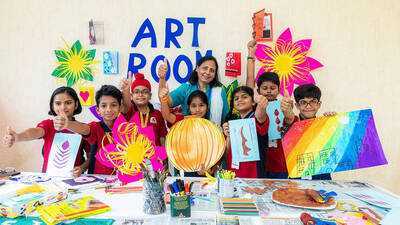
For decades, Indian schooling has leaned heavily on measurable academic output—marks, ranks, and entrance exam results. While this approach has produced strong technical talent, it has also created gaps that are becoming harder to ignore. Teachers, employers, and even parents now point to the same missing links—such as emotional awareness, originality, social confidence, and adaptability—when the rules change. Increasingly, creative disciplines—like art, music, drama, movement, debate, and design—are filling this space. This article is not a philosophical argument for ‘art for art’s sake.' It is a practical one, rooted in how children think, learn, and relate to the world.
Emotional intelligence begins before textbooks end
Emotional intelligence is rarely a priority in Indian classrooms. Yet it is closely linked to long-term outcomes such as resilience, collaboration, and mental health. According to UNICEF India (2023) 1, nearly 1 in 7 adolescents in the country experience some form of mental health challenge, with schools often being the first environment where stress becomes visible. Creative activities give students a non-verbal entry point into understanding emotions, both their own and others’. A child acting out a scene, interpreting a piece of music, or working through a visual art project learns to recognise frustration, patience, empathy, and self-regulation without being lectured about them. These skills develop gradually, but they give them a unique identity.
Imagination is not a distraction from learning Imagination is often misunderstood as the opposite of discipline. In reality, it supports problem-solving. The World Economic Forum’s Future of Jobs Report 2 consistently ranks creativity and cognitive flexibility among the top skills employers look for globally. Indian employers echo this sentiment; NASSCOM’s FutureSkills reports 3 note that adaptability and original thinking are critical gaps in the current talent pipeline. train the mind to explore multiple possibilities rather than search for a single correct answer. In classrooms where drawing, storytelling, theatre, or design thinking is taken seriously, students become more comfortable with ambiguity. That comfort later translates into better performance in science projects, entrepreneurship, and leadership roles.
Empathy is learned through shared experience
Empathy cannot be memorised. It develops through interaction and perspective-taking. Group-based creative work such as choirs, theatre productions, collaborative art, or dance requires students to listen, adjust, and respond to others. For instance, the NCERT National Curriculum Framework (2023) 4 explicitly recognises this, recommending experiential and arts-integrated learning as a way to build social and emotional skills. This is a significant shift from earlier frameworks, which treated creative subjects as optional or peripheral. When students step into roles different from their own or respond to stories from unfamiliar contexts, empathy becomes practice rather than theory.
Adaptability grows when outcomes aren’t fixed
One reason creative disciplines build adaptability is simple: outcomes are rarely predictable. A science experiment may fail, but a drama rehearsal might fail in a dozen unexpected ways,and require quick thinking to recover. A British Council study 5 on arts education in India reports that students exposed to regular creative learning environments exhibit greater comfort with change and feedback. These students are less likely to shut down when plans shift or instructions evolve - an ability that matters in higher education and modern workplaces alike.
Confidence that isn’t tied to marks
Academic confidence in India is often fragile, closely tied to examination scores. Creative disciplines offer an alternative path. A student who struggles with written tests may still shine on stage, in a studio, or during a presentation. Over time, these experiences build a sense of capability that carries into other subjects.
This is especially important during the middle school years, when dropout risk and disengagement begin to rise. UDISE+ data 6 shows that student retention becomes a concern from upper primary onwards, particularly where learning feels rigid or impersonal.
Where schools are beginning to respond
Some private school networks are beginning to treat creative education as a core element rather than an add-on. Orchids The International School, for instance, integrates arts, performance, and activity-based learning into the regular school day instead of isolating them as occasional periods. Parents often note that students become more articulate, socially aware, and confident over time changes that are difficult to capture in report cards but visible in daily behaviour.
At , the visual arts programme is structured to give students sustained exposure to multiple forms of artistic expression rather than limiting them to a single medium. Students develop observation and representation skills through drawing and sketching before moving into painting with watercolours, acrylics, and oil-based techniques. The curriculum also includes sculpture and clay modelling, allowing learners to explore form and texture through hands-on, three-dimensional work. Alongside traditional methods, students are introduced to digital art and graphic design, where technology becomes a creative tool rather than a distraction. Printmaking and mixed-media projects further encourage experimentation by combining materials and techniques. Together, these experiences help students think visually, approach problems creatively, and develop a well-rounded understanding of how ideas can be expressed through art.
By linking creative exposure with structured reflection and age-appropriate guidance, such models attempt to balance academic expectations with emotional and social growth. For families who worry that creativity might dilute academic focus, this integration offers reassurance rather than trade-offs.
A newer approach for education
The conversation around Indian education is slowly shifting. Board results and entrance exams will continue to matter, but they are no longer enough on their own. Schools are being asked to prepare students not just for tests, but for uncertainty, collaboration, and self-direction. Creative disciplines are not a shortcut to these outcomes, nor are they a luxury. They are one of the few proven ways to help children understand themselves, relate to others, and adapt when the world refuses to follow a syllabus.
As Indian schools reassess what success really looks like, creativity may turn out to be less about talent and more about readiness for life beyond the classroom.
References:
1. https://varthana.com/student/prioritizing-student-mental-health-and-well-being-before-its-too-late
2. https://reports.weforum.org/docs/WEF_Future_of_Jobs_Report_2025.pdf
3. https://www.futureskillsprime.in/about-us/
4. https://www.education.gov.in/sites/upload_files/mhrd/files/infocus_slider/NCF-School-Education-Pre-Draft.pdf
5. https://www.britishcouncil.org/sites/default/files/arts_and_technologies_in_india.pdf
6. https://dsel.education.gov.in/sites/default/files/update/PIB2161543.pdf
Disclaimer: This article has been produced on behalf of Orchids The International School by Times Internet’s Spotlight team.
-
Armed police race to Wiltshire village after dogs attack 14-year-old boy

-
Milk or 'poison' in the river: Religious extremism and assault on ecology

-
Start Your Business Without Collateral: How CGTMSE Scheme Helps You Get Easy Loans

-
Maha CM Fadnavis directs robust system for affordable rental housing in Mumbai
-
India Prepares for a Spectacular Commonwealth Games 2030