
The ceasefire between the US and Iran after 39 days of war, which includes the reopening of the Strait of Hormuz waterway, led to markets rallying sharply, with benchmark indices surging 3.8% on Wednesday.
New Delhi | Mumbai: Chief executives across sectors said they expect the two-week US-Iran ceasefire announced early Wednesday to lead to pick-up in consumer sentiment after a month, but cautioned that supply disruptions, LPG shortages in factories and migration of labour would take time to normalise, and added that inflationary pressures would continue, given the massive scale of disruptions in recent weeks.
"We remain cautiously optimistic with the ceasefire providing a necessary window for recovery, while at the same time making sure that we continue to be agile in this dynamic operating environment," said Sunil D' Souza, chief executive, Tata Consumer Products. He said the announcement of the ceasefire would provide a much-needed boost to consumer confidence after several weeks of geopolitical uncertainty. "The disruptions seen in recent weeks across industries, specifically around LPG shortages and labour migration alongside second order effects like freight costs and packaging material costs would have had sharper operating implications in the coming months," he added.

The ceasefire between the US and Iran after 39 days of war, which includes the reopening of the Strait of Hormuz waterway, led to markets rallying sharply, with benchmark indices surging 3.8% on Wednesday.
Energy Infra Needs to be Rebuilt
Raw material prices have risen by 10-15%, Bajaj said, while cautioning that damaged gas supply infrastructure in West Asia would take a considerable time to rebuild.
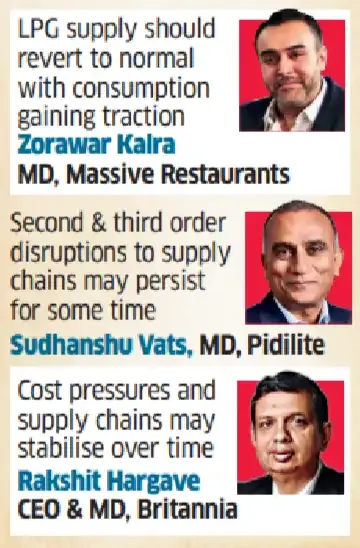
The US-Iran ceasefire, which includes reopening of the Strait of Hormuz, led to stock markets rallying Wednesday. Global oil prices slumped, with the benchmark Brent crude falling 13% to $94.80 a barrel. While Pidilite Industries managing director Sudhanshu Vats said there is still uncertainty around a ceasefire “with Israel not fully aligned”, most executives and analysts said they hoped the de-escalation is not temporary.
“Today’s development is a positive sign for the industry at large,” said Sunil Kataria, managing director and chief executive at Godrej Agrovet. “While the supply chains would take one-two months to normalise, we expect the inflationary swing on raw material and packaging material to come down, and this would help in ensuring that demand remains steady over the coming months,” he said.
The war has led to a near blockage of the Strait of Hormuz, choking supply chains for commodities such as crude oil, glass, PET, plastics and copper. This has affected the availability and increased the prices of inputs for consumer goods firms, from key raw materials like copper for AC makers to packing products for foods companies.
“The ceasefire is definitely a breather and consumer sentiment should look up,” said Arup Chauhan of Parle Products, India’s largest biscuit maker. “We hope global natural resources are protected and sovereign borders respected.”
Britannia Industries managing director Rakshit Hargave said the war has had a neutral impact on consumer sentiment. But it will take a while for supply chains to return to normal after the war ends, he said.
"We remain cautiously optimistic with the ceasefire providing a necessary window for recovery, while at the same time making sure that we continue to be agile in this dynamic operating environment," said Sunil D' Souza, chief executive, Tata Consumer Products. He said the announcement of the ceasefire would provide a much-needed boost to consumer confidence after several weeks of geopolitical uncertainty. "The disruptions seen in recent weeks across industries, specifically around LPG shortages and labour migration alongside second order effects like freight costs and packaging material costs would have had sharper operating implications in the coming months," he added.
The ceasefire between the US and Iran after 39 days of war, which includes the reopening of the Strait of Hormuz waterway, led to markets rallying sharply, with benchmark indices surging 3.8% on Wednesday.
Energy Infra Needs to be Rebuilt
Raw material prices have risen by 10-15%, Bajaj said, while cautioning that damaged gas supply infrastructure in West Asia would take a considerable time to rebuild.
The US-Iran ceasefire, which includes reopening of the Strait of Hormuz, led to stock markets rallying Wednesday. Global oil prices slumped, with the benchmark Brent crude falling 13% to $94.80 a barrel. While Pidilite Industries managing director Sudhanshu Vats said there is still uncertainty around a ceasefire “with Israel not fully aligned”, most executives and analysts said they hoped the de-escalation is not temporary.
“Today’s development is a positive sign for the industry at large,” said Sunil Kataria, managing director and chief executive at Godrej Agrovet. “While the supply chains would take one-two months to normalise, we expect the inflationary swing on raw material and packaging material to come down, and this would help in ensuring that demand remains steady over the coming months,” he said.
The war has led to a near blockage of the Strait of Hormuz, choking supply chains for commodities such as crude oil, glass, PET, plastics and copper. This has affected the availability and increased the prices of inputs for consumer goods firms, from key raw materials like copper for AC makers to packing products for foods companies.
“The ceasefire is definitely a breather and consumer sentiment should look up,” said Arup Chauhan of Parle Products, India’s largest biscuit maker. “We hope global natural resources are protected and sovereign borders respected.”
Britannia Industries managing director Rakshit Hargave said the war has had a neutral impact on consumer sentiment. But it will take a while for supply chains to return to normal after the war ends, he said.