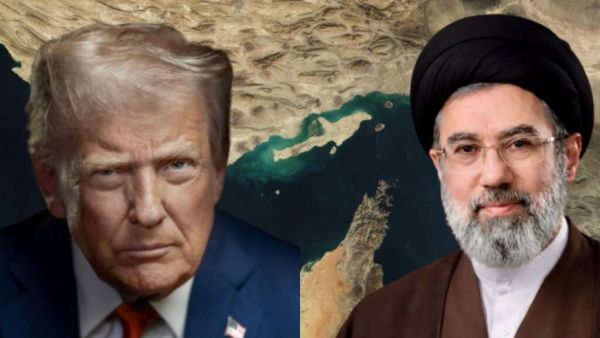
Amidst the ongoing tension in the Middle East, Iran has made a strategy to further strengthen its hold on the world’s most important oil supply line, the Strait of Hormuz. During the two-week fragile ceasefire, Tehran has presented a plan that has created a stir in the global shipping industry and oil market. Under this scheme, oil tankers will now have to pay toll in cryptocurrency to pass through Hormuz and will have to go through a stringent inspection process.
This step is being seen not just as an economic decision but as an attempt to create strategic pressure. Iran has made it clear that it wants to keep an eye on every ship passing through this important waterway, so that any kind of weapons transfer can be prevented during the ceasefire. But this strictness has made the situation more explosive.
What is Iran’s new toll system and why is there a stir?
Iran has proposed that every oil tanker passing through Hormuz will first have to provide information about its cargo through email. After this, a transit fee of about $1 per barrel will be fixed, which will have to be paid in digital currency like Bitcoin.
Hamed Hosseini, spokesman for Iran’s Oil, Gas and Petrochemical Export Union, said, ‘Iran will have to monitor what is coming in and what is going out of this Strait of Hormuz, so that these two weeks cannot be used for weapons transfer.’ He further said that ‘everything can pass, but the process for each ship will take time and Iran is in no hurry.’
He also said that ‘as soon as the email arrives and Iran completes its investigation, the ships are given just a few seconds to make the payment in Bitcoin, so that they can neither be traced nor seized due to sanctions.’
Is it now dangerous to pass through Hormuz?
The situation has become so tense that ships are being warned openly. A radio message said that ‘if any ship tries to pass without permission, it will be destroyed.’ After this threat, most of the shipping companies have stopped their ships. At present only a few ships, which are connected to Iran, are trying to pass through this route.
Why is tension increasing despite ceasefire?
Although there has been a temporary ceasefire between America and Iran, there is still conflict between the two over Hormuz. US President Donald Trump has clearly said that the ceasefire will last only if Iran ensures ‘COMPLETE, IMMEDIATE, and SAFE OPENING of the Strait of Hormuz’. Iran has indicated that instead of completely opening Hormuz, it will implement the “Safe Passage Protocol”, in which its military will have a direct role.
Why are hundreds of ships stranded and what is the ‘car park’ like situation?
Due to this uncertainty, a huge traffic jam like situation has arisen in the Gulf region. According to reports, 300 to 400 ships are waiting to come out. A shipping expert has described it as a “car park” like situation. Big companies like Maersk are also adopting the strategy of waiting for now. He says that despite the ceasefire, safe passage is still not certain.
Can global oil supply be affected?
According to analysts, if the situation remains like this, only 10 to 15 ships will be able to pass daily, whereas in normal times this figure is around 135. This could have a major impact on the oil supply chain and could lead to a rise in prices.
Why is there a ‘red line’ for Gulf countries?
Iran’s control over Hormuz is considered a big threat for countries like Saudi Arabia, Qatar and UAE. Ali Shihabi, an analyst close to Saudi, said that giving Iran any kind of control over Hormuz would be a ‘red line’.
-
DC Vs GT, IPL 2026: Washington Sundar Cracks Maiden League Fifty To Take Gujarat Past 200

-
How Much Tax Does the Government Levy on LPG Gas Cylinders? What Would the Price Be If This Tax Were Removed?
-
UPSSSC VDO: Major Update for Candidates Who Cleared the Mains Exam—Learn the Complete Document Submission Process..

-
Pension: A Reliable Support for Old Age! PPF Can Help Arrange a Monthly Pension of ₹61,000; Here Is the Full Calculation

-
Admissions Open at CSJM University, Kanpur: Check Every Detail—From Application to Courses—Here..