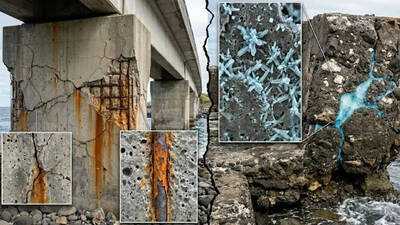
Although modern-day skyscraper and bridge constructions could begin deteriorating within 50 years, the Pantheon and coastal sea wall constructions are still standing after 2,000 years. For many years, engineers thought the white mineral pieces in Roman mortar were due to improper mixing. Recent research conducted by MIT and Harvard has shown that lime clasts were used in the making of hybrid cements, and they served to allow for self-healing properties. When a crack occurs in the cement structures, water rich in minerals will dissolve some of the lime clasts, and the resulting minerals will subsequently recrystallise, thus glueing back the ancient structures together between 3 and 6 months. This intentional engineering brilliance allows ancient monuments to endure environmental stressors that would normally compromise the integrity of modern steel-reinforced concrete.
Modern concrete is dying, Roman walls are still standing strong
Modern concrete structures do not have as flexible chemicals, which is one reason they fail. Structural integrity is usually achieved through the use of steel rebar. While this does provide tensile strength, it creates a major issue for modern concrete structures in the event that water penetrates through hairline fissures or cracks. Once water reaches the steel rebar, oxide develops, and the volume of the iron expands, causing internal stress and spalling (cracking) of the concrete due to rebound from within.
According to the research published by MIT, the primary ingredient used to make Roman concrete was volcanic ash (pozzolan) and quicklime. Due in large part to this combination, Roman concrete has remained chemically active for thousands of years, allowing for continual evolution and an increase in strength over long periods of time.
Why Roman temples outlast modern skyscrapers
Research published in Science Advances identifies ‘lime clasts’ as the defining feature of Roman longevity. When a crack occurs in a Roman wall, it inevitably travels through these brittle lime clasts.
Therefore, each time a crack forms in the wall of a Roman building, water from rain or the ocean will flow into the crack and react with the chemical formula of calcium hydroxide, the result is a calcium-saturated solution. This dissolved calcium then recrystallises into calcium carbonate, effectively sealing the crack from further development. This self-healing capacity allows Roman piers and temples to endure seismic activity and to exist in very inhospitable conditions; therefore, they will last indefinitely compared to current concrete buildings.
The rare mineral that grows more solid over centuries
For maritime construction, the Romans took advantage of the reaction that occurred between seawater and volcanic ash. Seawater today would normally degrade concrete, but in Roman structures, it actually promotes a pozzolanic reaction.
According to the study published on Lawrence Berkeley National Laboratory, this pozzolanic reaction produces a rare mineral called aluminous-tobermorite , which forms plate-like crystals similar to those found in concrete's matrix, giving concrete its strength. In the case of seawalls, as seawater continues to pass through the concrete for centuries, the plate-like crystals continue to grow, thus making the seawalls much stronger than they were when originally constructed.
Why modern concrete breaks down faster
According to MIT, modern concrete is susceptible to failure due in part to its use of embedded steel reinforcement that is prone to rust and eventual expansion, creating a ‘cancer-like’ condition (structural degradation). Compared with Roman cement mixtures created more than 2000 years ago, which contained reactive ‘lime clasts’ coupled with volcanic ash that enabled cracked surfaces to autonomously heal and gain strength from long-term mineral crystallisation, current mixtures of cement do not have these properties.
-
ODI and T20 series will be played between IPL 2026, timing of matches changed to save electricity

-
5 consecutive wickets in 5 balls… 9 victims taken in the match, this happened for the first time in cricket history

-
Anant Ambani Birthday Bash: Jamnagar Turns Starry as Bollywood Celebs Arrive for Grand Celebration

-
5 Clear Reasons Triple H’s WrestleMania 42 Booking Failed To Excite the WWE Audience

-
Give a new look to old sarees: Earn money sitting at home by making cushions and curtains, know the complete process. Business Idea Reuse Old Saree To Make Handmade Cushions And Curtains For Earn Money