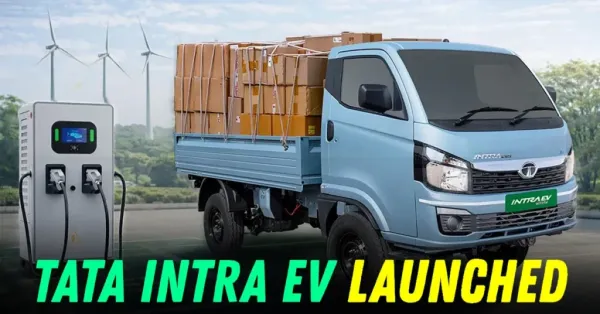
Tata Motors has launched the Intra EV pickup truck at Rs 11.95 lakh ex-showroom, making it the first electric pickup in the light commercial vehicle segment priced below Rs 12 lakh. The Intra EV is positioned as a direct electric alternative to small diesel and CNG pickups used for last-mile goods delivery, farm produce transport, and inter-city small cargo runs.
The Intra EV is built on the same platform as the existing Intra V20 diesel pickup but uses a fully electric drivetrain. The motor produces 70 bhp and 190 Nm, drawing from a 21.3 kWh LFP battery. Claimed range is 225 km on a single charge under standard load conditions. Fast charging via a 25 kW DC charger can bring the battery from 20 to 80 percent in approximately 55 minutes. Standard AC charging at 3.3 kW takes around seven hours for a full charge.
The numbers are closely matched to actual daily duty patterns in the small commercial vehicle space. A 225 km claimed range is not aimed at long-haul freight. It is aimed at predictable urban and semi-urban loops where the vehicle returns to base or a charging point at the end of the day. That includes courier work, milk and food distribution, kirana restocking, municipal supply runs, and short agricultural transport. In these use cases, the value of an EV is not top speed or highway flexibility. It is lower operating cost, quieter operation, and easier daily scheduling when routes are fixed.
The Intra EV’s most commercially significant number is its payload rating: 1,000 kg. For a pickup in this price bracket, a tonne of rated payload capacity is the baseline requirement for most commercial uses. The loading deck measures 2,040 mm long and 1,530 mm wide, giving it usable floor space for standard cargo formats including crates, boxes, and sacks without needing custom lashing. Ground clearance is 180 mm, adequate for mixed-road use but not off-road or heavy rutted terrain.
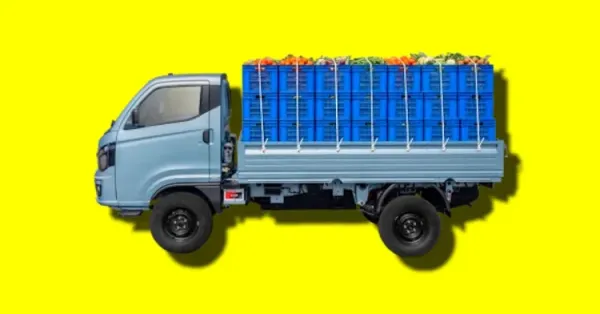
The cab is a single-row setup with seating for driver and one passenger. Tata has included a touchscreen with navigation, reverse camera, and Bluetooth connectivity even on the base spec, which is not standard practice in commercial vehicles at this price. Fleet operators who run connected tracking systems can use the OBD port and the optional Tata Fleet Edge telematics package, which provides real-time location, battery status, and driving behaviour data.
That equipment list matters more than it may first appear. Commercial vehicle operators increasingly track route efficiency, idling time, driver behaviour, and uptime. Features like a reverse camera and telematics are not only comfort additions. They can reduce minor damage, improve route discipline, and help operators monitor whether the vehicle is being used as planned. For a small fleet owner running three to ten vehicles, those details can directly affect operating cost and vehicle availability over a year.
The diesel Intra V20, which is the direct equivalent in terms of payload and body size, is priced from approximately Rs 7.50 lakh. The Intra EV at Rs 11.95 lakh carries a premium of roughly Rs 4.45 lakh over the diesel. For a commercial buyer running 150 to 200 km a day, the running cost difference between diesel at current prices and electricity at commercial tariff rates works out to approximately Rs 2.50 to Rs 3 per km in favour of the electric vehicle. At 200 km a day and 300 working days a year, that is a saving of Rs 1.50 lakh to Rs 1.80 lakh annually, which means the premium pays back in approximately 2.5 to 3 years.
That payback window is central to the product’s business case. Commercial buyers generally do not move to new technology because it is new. They move when the numbers are visible and the recovery period is reasonable. A 2.5-to-3-year payback is meaningful because many small pickups remain in active commercial use well beyond that period. Once the price premium is recovered, the operator effectively benefits from lower running costs for the rest of the vehicle’s working life. That makes the Intra EV easier to justify for businesses that maintain fixed routes and high annual utilisation.
The Intra EV is currently available with a three-year or 1.25 lakh km warranty on the vehicle and an eight-year or 1.60 lakh km warranty on the battery pack. Tata Motors has an established service network for commercial vehicles across tier-2 and tier-3 towns, which reduces the downtime risk that makes fleet operators cautious about adopting new technology.
That network strength could prove as important as the product itself. Many first-time EV buyers in the commercial segment worry less about the motor or battery and more about downtime, parts support, and who will fix the vehicle in smaller towns. Tata already has credibility in commercial vehicles, and that gives the Intra EV a stronger starting position than a newcomer would have.
No other mainstream LCV manufacturer has a directly comparable electric pickup at this price point right now. Mahindra’s electric commercial vehicle lineup under the Treo and Zor brands covers three-wheelers and smaller platforms. Ashok Leyland’s Switch division operates further up the weight range. For small fleet operators and individual commercial buyers looking at a sub-12 lakh electric pickup with a tonne of payload and a 225 km range, the Intra EV enters without a direct competitor.
That gives Tata a first-mover advantage in a segment that could grow steadily rather than explosively. The initial buyers are likely to be fleets, institutional users, and route-based operators who can calculate savings clearly. But if the product proves dependable and the charging ecosystem around depots and local business hubs improves, the Intra EV could end up shaping a new sub-segment in light commercial transport before rivals arrive.
-
Iran suspends US talks over Israeli strikes in Lebanon

-
ISRO successfully conducts 2nd integrated air drop test for Gaganyaan mission
-
Fire breaks out on a Prabhas film set in Hyderabad: Reports

-
Telangana HC Grants Pawan Khera One-Week Relief In FIR Linked To Assam CM’s Wife

-
'Our destiny still in our hands': Rovman Powell after KKRs third defeat in IPL 2026