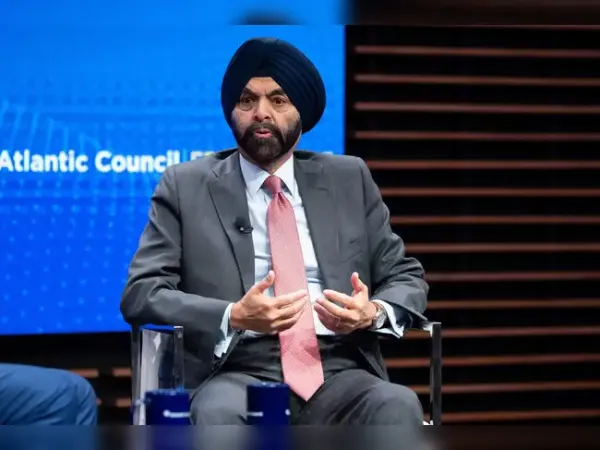
Washington: World Bank President Ajay Banga said on Tuesday the war in the Middle East would result in some degree of slower growth in the global economy and higher inflation, regardless of how quickly it ended.
Banga, speaking at an event hosted by the Atlantic Council ahead of next week's meetings of the World Bank and International Monetary Fund, said the World Bank was able to quickly disburse billions of dollars in funding to countries affected by the war using its crisis windows, as it did during the height of the COVID-19 crisis.
The World Bank chief said the impact of the war would depend on the severity and duration of the disruption to energy markets. A rapid end to the conflict would allow some kind of normalization in the next few months, while a longer stretch would extend the impact for six to eight months.
Also Read: Iran cuts direct US contact after Donald Trump threat to wipe out 'civilization'; talks via mediators continue, WSJ reports
"Either way, if you look at the world having a probable GDP growth of 2.83% before this recent conflict, you're probably impacting that between 0.3%, 0.4% in the baseline scenario, all the way to 1 plus percent in the more challenging longer timespan," he said.
Inflation could be affected by up to 0.9 percentage points, he said.
He said he expected finance officials gathering in Washington to discuss how the two institutions could help countries hit hard by rising energy prices and supply chain disruptions as a result of the war.
"We as an institution can help because we've got certain kinds of response windows that we call crisis response windows," Banga said, referencing World Bank rules that allow countries to request quick access to 10% of undisbursed funds from previously approved programs.
Also Read: 'A whole civilization will die tonight,' Trump issues chilling warning on Iran
Banga said countries reeling from the war could potentially access around $30 billion through these "crisis windows" over the next two to three months, with up to $70 billion available over the course of six months.
But he cautioned that countries should beware of increasing their fiscal challenges by providing subsidies that they could not afford, or which could trigger even bigger problems in future years.
Banga, speaking at an event hosted by the Atlantic Council ahead of next week's meetings of the World Bank and International Monetary Fund, said the World Bank was able to quickly disburse billions of dollars in funding to countries affected by the war using its crisis windows, as it did during the height of the COVID-19 crisis.
The World Bank chief said the impact of the war would depend on the severity and duration of the disruption to energy markets. A rapid end to the conflict would allow some kind of normalization in the next few months, while a longer stretch would extend the impact for six to eight months.
Also Read: Iran cuts direct US contact after Donald Trump threat to wipe out 'civilization'; talks via mediators continue, WSJ reports
"Either way, if you look at the world having a probable GDP growth of 2.83% before this recent conflict, you're probably impacting that between 0.3%, 0.4% in the baseline scenario, all the way to 1 plus percent in the more challenging longer timespan," he said.
Inflation could be affected by up to 0.9 percentage points, he said.
He said he expected finance officials gathering in Washington to discuss how the two institutions could help countries hit hard by rising energy prices and supply chain disruptions as a result of the war.
"We as an institution can help because we've got certain kinds of response windows that we call crisis response windows," Banga said, referencing World Bank rules that allow countries to request quick access to 10% of undisbursed funds from previously approved programs.
Also Read: 'A whole civilization will die tonight,' Trump issues chilling warning on Iran
Banga said countries reeling from the war could potentially access around $30 billion through these "crisis windows" over the next two to three months, with up to $70 billion available over the course of six months.
But he cautioned that countries should beware of increasing their fiscal challenges by providing subsidies that they could not afford, or which could trigger even bigger problems in future years.