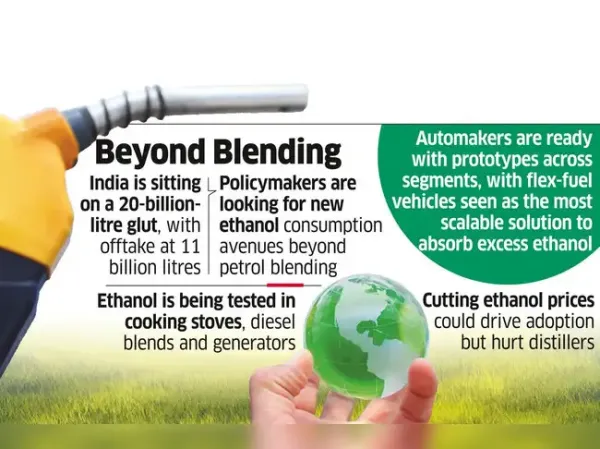
Mumbai: A swelling supply glut of ethanol is forcing policymakers and industry to look beyond car and two-wheelers to spur consumption of the renewable fuel. This includes ethanol-powered cooking stoves and diesel blends to generators and flex-fuel vehicles.
Pilot projects are already starting to unfold. Ethanol-based cooking stoves are being tested as a cleaner household alternative, while blending the biofuel with diesel and using it in backup generators is under discussion.
Early trials are also being run of ethanol-blended diesel buses of Karnataka State Road Transport Corporation to ascertain technical feasibility.
The mounting inventory underscores the urgency. India is sitting on an estimated surplus of nearly 20 billion litres of ethanol, while oil marketing companies have contracted only about 11 billion litres.
The mismatch has left distillery capacity grossly underutilised, raising concerns of financial strain across the supply chain, said Deepak Ballani, director general of the Indian Sugar & Bio Energy Manufacturers Association.
Industry bodies including the Indian Sugar & Bio Energy Manufacturers Association, and the Indian Distillers Association are pushing for rapid demand creation, especially in light of ongoing geopolitical uncertainties that could disrupt conventional fuel supply lines.
Notably, the most scalable outlet may lie on the roads. Flex-fuel vehicles-capable of running on varying blends of petrol and ethanol-are technically ready, with prototypes spanning two-wheelers to passenger cars developed by Maruti Suzuki, Toyota, and Bajaj Auto, among others.
Yet mass adoption hinges on economics. Unlike electric vehicles, which attract a concessional goods and services tax (GST) of 5%, flex-fuel vehicles are taxed between 18% and 40% depending on engine configuration and blend capability. The higher upfront cost, combined with the absence of widespread ethanol fuel availability, may dampen consumer interest.
Also Read: India doubles 5-kg LPG cylinder quota to ease supply concerns amid Hormuz tensions
"Vehicle readiness is not the issue, fuel availability and pricing are," said an official familiar with the discussions. "For flex-fuel to work, ethanol must be priced lower, and the entire fuel-vehicle equation needs policy alignment."
Industry stakeholders are calling for tax rationalisation, long-term policy visibility for automakers, and a pricing framework to make ethanol blends economically attractive. "Without cheaper ethanol, flex-fuel vehicles will struggle to find buyers," said an executive at a car maker that has a ready flex-fuel prototype.
Some states are starting to respond. Sikkim has waived road tax on flex-fuel vehicles, the first such move in the country, raising hopes of similar incentives elsewhere.
Automakers, on their part, are preparing at least one flex-fuel model each, but are seeking a clearer roadmap before scaling production. Executives say with the right policy push, adoption could accelerate.
Also Read: Govt steps up LPG supply, urges calm amid Hormuz concerns
The government's ethanol blending programme has currently reached E20-a mixture of 80% petrol and 20% ethanol-but the next stage remains uncertain. Proposals for E25 and E30 blends are under consideration, though no firm policy direction has emerged.
Meanwhile, the government appears reluctant to cut ethanol prices, "a move that could stimulate demand but hurt producer margins," said an official familiar with the matter. "This policy tension lies at the heart of the current impasse."
Pilot projects are already starting to unfold. Ethanol-based cooking stoves are being tested as a cleaner household alternative, while blending the biofuel with diesel and using it in backup generators is under discussion.
Early trials are also being run of ethanol-blended diesel buses of Karnataka State Road Transport Corporation to ascertain technical feasibility.
The mounting inventory underscores the urgency. India is sitting on an estimated surplus of nearly 20 billion litres of ethanol, while oil marketing companies have contracted only about 11 billion litres.
The mismatch has left distillery capacity grossly underutilised, raising concerns of financial strain across the supply chain, said Deepak Ballani, director general of the Indian Sugar & Bio Energy Manufacturers Association.
Stoves to Cars: India Widens Ethanol Play Amid Supply Glut
Industry bodies including the Indian Sugar & Bio Energy Manufacturers Association, and the Indian Distillers Association are pushing for rapid demand creation, especially in light of ongoing geopolitical uncertainties that could disrupt conventional fuel supply lines.
Notably, the most scalable outlet may lie on the roads. Flex-fuel vehicles-capable of running on varying blends of petrol and ethanol-are technically ready, with prototypes spanning two-wheelers to passenger cars developed by Maruti Suzuki, Toyota, and Bajaj Auto, among others.
Yet mass adoption hinges on economics. Unlike electric vehicles, which attract a concessional goods and services tax (GST) of 5%, flex-fuel vehicles are taxed between 18% and 40% depending on engine configuration and blend capability. The higher upfront cost, combined with the absence of widespread ethanol fuel availability, may dampen consumer interest.
Also Read: India doubles 5-kg LPG cylinder quota to ease supply concerns amid Hormuz tensions
"Vehicle readiness is not the issue, fuel availability and pricing are," said an official familiar with the discussions. "For flex-fuel to work, ethanol must be priced lower, and the entire fuel-vehicle equation needs policy alignment."
Industry stakeholders are calling for tax rationalisation, long-term policy visibility for automakers, and a pricing framework to make ethanol blends economically attractive. "Without cheaper ethanol, flex-fuel vehicles will struggle to find buyers," said an executive at a car maker that has a ready flex-fuel prototype.
Some states are starting to respond. Sikkim has waived road tax on flex-fuel vehicles, the first such move in the country, raising hopes of similar incentives elsewhere.
Automakers, on their part, are preparing at least one flex-fuel model each, but are seeking a clearer roadmap before scaling production. Executives say with the right policy push, adoption could accelerate.
Also Read: Govt steps up LPG supply, urges calm amid Hormuz concerns
The government's ethanol blending programme has currently reached E20-a mixture of 80% petrol and 20% ethanol-but the next stage remains uncertain. Proposals for E25 and E30 blends are under consideration, though no firm policy direction has emerged.
Meanwhile, the government appears reluctant to cut ethanol prices, "a move that could stimulate demand but hurt producer margins," said an official familiar with the matter. "This policy tension lies at the heart of the current impasse."