
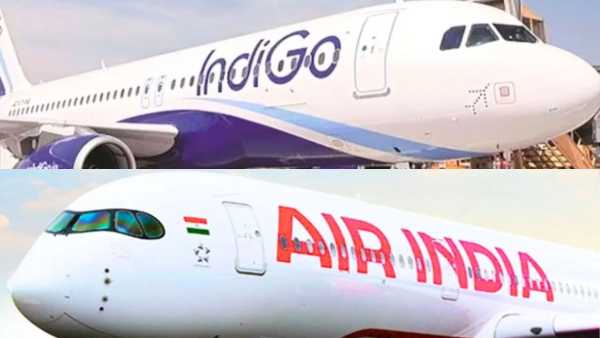
Three Indian airlines, which carry more than 90 percent of domestic passengers, are going through a transition due to the departure of their CEOs. On Tuesday, Air India officially announced the departure of its Chief Executive Officer and Managing Director Campbell Wilson. With this, he joins the list of two other airline leaders who have already stepped down from their posts. Aloke Singh, managing director of Air India Express, the low-cost arm of Air India, left the airline on March 19 after completing his five-year tenure, while IndiGo announced the sudden departure of Dutch national Pieter Elbers on March 10. IndiGo has appointed former British Airways CEO William Walsh as the new CEO, although regulatory approval is still pending.
On the other hand, the board of Air India has formed a committee to find a replacement for Wilson in the coming months. Until someone else replaces him, he will remain on both these posts. Air India Express has also not yet announced anyone to replace Singh. Singh is now working as Chief Strategy Officer in IndiGo. In the rapidly growing Indian domestic aviation market, where duopoly fears are a reality, the way Air India Group and IndiGo work is important – whether in terms of choice available to customers or in terms of future growth. Let us try to understand this entire issue in detail.
Air India: From crash to strict investigation
For Air India, the chain of events started with the crash of a Boeing 787 near Ahmedabad in June 2025, which took the lives of 260 people. Following this incident, regulators began a strict investigation and the airline's operations were closely monitored. In the months that followed, regulatory concerns were not limited to the crash.
According to media reports, Air India was reprimanded for security lapses. These lapses included flying the aircraft several times without a valid airworthiness certificate and operating the aircraft without checking emergency equipment. Later the airline admitted that it needed to comply with the rules and improve internal processes.
Additionally, the airline's reform efforts were also hampered by external factors. Due to Pakistan closing its airspace to Indian aircraft, aircraft on major international routes had to take longer routes, which increased fuel consumption and operating costs.
The ongoing conflict in West Asia also increased this disruption. In a note sent to employees in March, Wilson reported that Air India had canceled about 2,500 flights to the region over the course of three weeks. Due to airspace restrictions and airport closures, the airline was able to operate on only 30 per cent of its normal Middle East schedule, and they warned of serious financial consequences. These disruptions also affected routes to Europe and North America, resulting in rerouting of flights and increase in costs.
Financial pressure continued to increase. Air India and its low-cost subsidiary posted a combined loss of Rs 98.08 billion in 2024-25, while the airline continued to invest in fleet expansion and renewal.
IndiGo: December's disruptions and their consequences
While Air India was struggling with security checks and external disruptions, IndiGo faced its own problems at the end of the year. In December 2025, the airline faced massive disruptions. In the first weeks of the month itself, it canceled about 4,500 flights. The airline later said that it was not able to update the crew roster in time to comply with strict rules related to pilot fatigue.
The government's response to Parliament pointed to some internal problems, including over-optimization of operations, deficiencies in regulatory preparedness, and deficiencies in system support and operational controls. Due to these results, monitoring became even more strict. Authorities increased monitoring of the airline's operations and intensified checks on crew availability, roster reliability and system robustness. These disruptions had an impact at the top level as well. According to a regulatory filing by the airline, Elbers resigned from his post in March and managing director Rahul Bhatia took over the reins in the interim.
A series of pressures, two resignations
These pressures on both airlines came to the fore in an environment of rising costs, regulatory changes and geopolitical uncertainty. Airlines faced operational challenges due to rising fuel prices, rising insurance costs associated with conflict areas, and restricted airspace. IndiGo's operations were also impacted by these conditions, despite it continuing its expansion work while managing the fallout from the December disruptions. For Air India, this change in leadership comes at a time when the airline is pursuing its turnaround process under the ownership of Tata Group.
-
Jailer 2: Potential Hindi Market Hit After BIG Cameo Is Shelved?

-
'Cheap, Lethal, Everywhere': Indian Army’s Drone Doctrine Signals a New Era of Warfare
-
Can Iran Charge Fees for Ships to Transit the Strait of Hormuz?
-
Salads For Weight Loss: From Breakfast To Dinner, Salad Recipes That Go With Every Meal

-
Here's How To Store Tomatoes So That They Stay Fresh Longer