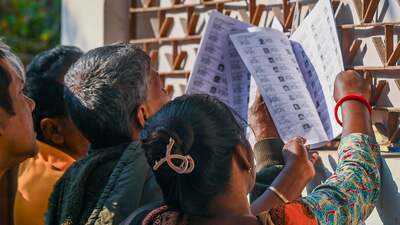
The voter verification drive in West Bengal has sparked fresh controversy after the Election Commission of India’s (ECI) judicial adjudication process led to the deletion of an estimated over 90 lakh names from the electoral rolls — raising serious concerns over transparency and potential disenfranchisement ahead of the assembly elections.
With the adjudication process concluding late Monday night, officials indicated that the total number of deleted voters has reached around 90.83 lakh, and could rise further once pending formalities are completed. Critics argue that such a massive purge, carried out under the Special Intensive Revision (SIR), risks excluding legitimate voters on a large scale.
According to data from the chief electoral officer’s office, out of 60,06,675 cases sent for judicial scrutiny, decisions have been finalised in 59,84,512 cases so far. Of these, 27,16,393 voters have been marked as “excludable” and subsequently removed. The process of adding e-signatures by judicial officers remains pending in over 22,000 cases, leaving room for further deletions.
The scale of the exercise has drawn criticism, especially when viewed against earlier revisions. Before the SIR began in November, West Bengal had over 7.66 crore registered voters. The draft rolls published in December saw 58.2 lakh deletions, which rose to 63.66 lakh in the final list released on 28 February. The latest adjudication has now pushed the figure close to the one-crore mark, intensifying fears of voter suppression.
Bengal polls: ECI’s repeated reshuffles continue unabatedParticularly alarming for critics is the regional pattern of deletions. Minority-dominated districts appear to be disproportionately affected, with Murshidabad recording the highest number of exclusions at 4.55 lakh, followed by North 24-Parganas (3.25 lakh) and Malda (2.39 lakh). Opposition voices and civil society groups have flagged this trend as deeply problematic, questioning whether the exercise has unfairly targeted specific communities.
While the ECI has maintained that affected individuals can appeal before one of the 19 Appellate Tribunals, detractors argue that the burden of proof has been shifted onto voters, many of whom may lack the resources or awareness to navigate the legal process within a limited timeframe.
The controversy comes just weeks before the state heads to polls, scheduled in two phases on 23 April and 29 April, with results due on 4 May. With such a significant portion of the electorate now struck off the rolls, questions are mounting over the fairness and inclusiveness of the electoral process in one of India’s most politically crucial states.
With IANS inputs
-
Super Mario Galaxy 2 Headlines Nintendo Switch 2 Limited Time Bundle Offer

-
Special discounts on smartphones and smart TV

-
All you need to know about the 2026 Archery World Cup Stage-1 in Mexico

-
The viral drawing that changed everything: Read-born Payal Nag’s tryst with archery
-
DK backs Padikkal for Team India return – Tezzbuzz