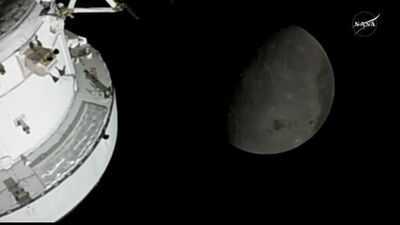
Four astronauts vanished behind the Moon - cut off from Earth and beyond the reach of Mission Control for the first time in more than half a century, as the Artemis II mission reached its most dramatic moment.
The blackout descended at the end of a six-hour flyby during which the crew made history simply by looking out of the window - becoming the first humans ever to set eyes on the lunar far side in person before they re-established communication after a nail-biting 40 minutes of radio silence. Just before this histroy-making moment, what they saw clearly surprised them.
What the astronauts witnessedGeometric patterns etched into the surface, sinuous formations the crew took to calling "squiggles", and an unexpected palette of greens and browns were among the features that greeted NASA astronauts Reid Wiseman, Victor Glover and Christina Koch and Canadian Space Agency astronaut Jeremy Hansen as their Orion capsule swept across terrain no human had previously seen at close range.
Koch described newly formed craters that punctuated the ancient surface in a way that stuck with her.
"All the really bright, new craters, some of them are super tiny, most of them are pretty small, there's a couple that really stand out, obviously, and what it really looks like is a lampshade with tiny pinprick holes and the light shining through," she told Mission Control.
Glover offered his own account of what lay beyond the windows.
"Up to the north, there is a very nice double crater. It looks like a snowman just sitting there," he said. "On the southern edge, there is a hole. Just blackness and a wall of brightness. It looks like there is a gigantic hole right there.2
The wider view, he added, felt like looking at "an island of terrain completely surrounded by darkness."
The terrain the crew crossed is fundamentally unlike the Moon most people know. Where the near side - the face permanently visible from Earth - is characterised by wide dark volcanic plains, the far side is ancient, heavily scarred and structurally thicker, its crust bearing the marks of billions of years of undisturbed bombardment, reports the Daily Mail.
Into the silenceRadio contact between Orion and Earth's ground stations depends on an unobstructed line of sight. The moment the Moon itself slid between the spacecraft and every antenna on the planet, that line was broken. Mission specialists refer to this as a loss of signal - a phrase that understates the isolation it represents.
With no live link to Houston, the four crew members navigated this phase on autopilot, guided by systems programmed before the blackout began. Ground teams were left watching the clock, calculating the moment - roughly 40 minutes after contact was lost - until Orion eventually emerged from behind the Moon and transmissions resumed.
Before the silence fell, Glover offered what turned out to be a fitting farewell - invoking the teachings of Jesus, including the instruction to love your neighbour as yourself, before signing off with words that carried a double meaning.
"We will see you on the other side," he said.
The blackout caps a mission that has already rewritten the history books. At 1.57pm ET, Orion carried its crew to 252,757 miles from Earth - a distance no human being had previously reached. The record that fell belonged to Apollo 13, whose crew was pushed to 248,655 miles from home during their desperate emergency return in 1970 - a record that had stood for 55 years.
As Orion emerged from behind the Moon on schedule and radio contact snapped back - ending a 40-minute blackout that had left Mission Control waiting in silence.
Mission specialist Christina Koch was first to speak.
"Houston, Integrity, comm check," she said. "It is so great to hear from Earth again."
-
Shivraj Singh Chouhan Says ‘Crackers Will Burst In Pakistan’ If Cong Wins Kerala Polls

-
'Murderous Corruption': Rahul Gandhi Hits Out At AINRC-BJP Govt Over 'Fake Drugs' In Puducherry

-
School Assembly News Headlines Today April 7, Top National, International, Sports, Business News

-
Delhi EWS Admission 2026: Draw Today; Full Timeline For Verification, Admission & Appeals Released

-
New Zealand flags concern over US threats towards Iran