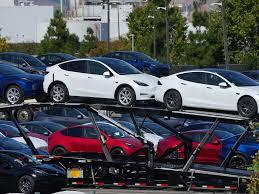
The number of vehicles manufactured by Tesla has been higher than the number of cars delivered to clients in Q1 2026. As a result, there has been an unprecedented backlog of cars with the carmaker holding as many as 50,363 automobiles in inventory, which is the highest ever for the brand.
The calculations are straightforward. Tesla manufactured 408,386 automobiles in Q1 2026 while delivering 358,023 units. This difference results in almost 50,000 units of inventory.
What makes this ratio striking is that it is not common for Tesla to produce more cars than it delivers. Historically, Tesla has always ensured that its production equals or is close to its deliveries. In fact, one of the brand’s strengths is being able to deliver the cars as soon as they have been manufactured.
The last time the same situation happened with Tesla was in early 2024. Back then, the difference between production and deliveries was 46,500 units. Now, the difference is even bigger.
Nevertheless, the figures aren’t poor either. The company delivered over 358,000 cars. This amount is relatively high for comparison with other competitors. However, it did not meet the expected outcomes. Specialists estimated around 372,000 sales on average. This is important to keep in mind, considering that Tesla is being closely watched.
The EV Slowdown: Is Tesla Outpacing Demand?
There are several reasons why sales are growing slow. In America, the new policy negatively impacted car demand. The discontinuation of the $7,500 government tax credit on the purchase of an EV is one of them. The change requires some readjustments on the part of most manufacturers.
Some have even abandoned their projects already. For instance, Ford suspended production on the F-150 Lightning EV model. Honda is planning to cancel its new car models. Finally, Stellantis has decided to stop producing its hybrid vehicles in America.
Not Tesla, either. The automaker has pared down its product range. It recently announced that it would cease manufacturing the Model S and Model X at the end of March. Those two models have been instrumental in shaping the brand, although their significance is no longer as great in terms of sales.
At present, Tesla’s key revenue drivers are the Model 3 and Model Y cars. They generate most of the company’s income and operate in the most competitive niche of the electric vehicle industry. In addition, the Cybertruck model offers something new, although its significance is marginal for the time being.
The number of units produced by the Cybertruck in the first quarter was under 16,000. This number is insignificant in comparison with the Model 3 and Model Y figures.
This begs the question – does Tesla produce too many vehicles, or is the demand decreasing quicker than anticipated? Probably somewhere in between.
Tesla’s Production Surge Meets a Cooling Market: Navigating the 2026 EV Slowdown
On the production side, the company is ramping up its manufacturing capabilities at a stable rate. Over the past year, it grew its output by almost 13%. However, the demand did not match these numbers, which could be explained by various factors.
There is market pressure on all sides. In Q1 2026, the sale of electric vehicles in the United States dropped by 28%, according to Cox Automotive. This means that the initial adoption phase ended. Now, the average consumer seems reluctant to buy one of those green vehicles.
However, there are competitors emerging in the industry. For instance, Rivian will release its R2 vehicle soon. Meanwhile, BMW is going to launch its lineup of the iX3 and i3 cars. Moreover, Volvo plans to make deliveries of its EX60 model by the end of the year.
The Inventory Paradox of Tesla Scaling Beyond the Speed of Demand
In this context, Tesla is confronted with a well-known dilemma: how to balance supply and demand while maintaining profit margins. Cutting prices can help sell products, yet it reduces margins. Holding onto inventory can be a sign of strength, but it locks in capital.
The role of management cannot be overlooked. Elon Musk has always been known for his appetite for expansion, even amid uncertainty. This has enabled Tesla to scale much faster than its competitors. However, it has also led to the company operating ahead of demand at times.
At present, the inventory figure does not indicate any crisis. Tesla remains one of the leading EV brands in the world, with its production capacity, charging infrastructure, and brand awareness setting it apart from others.
But the data indicates a clear change. The market is no longer dominated by pioneers alone. Today’s consumers consider factors such as pricing, driving range, and value when making decisions.
The next move from Tesla will determine the outcome of the situation. Tesla may either increase its prices, decrease production levels, or introduce additional features to drive demand.
As things stand, the high level of inventory clearly sends the message that Tesla has the ability to manufacture vehicles in large volumes. The only challenge remains in selling them.
-
Delhi Assembly Security Breach: Car Rams Gate, Masked Driver Places Flower Bouquet & Escapes

-
DLTA President Celebrates Billie Jean King Cup as a Milestone for Indian Tennis

-
Tottenham 'ban Kanye West from performing' as Pepsi festival row erupts

-
Princess Beatrice 'destroyed' by Andrew scandal after major royal 'snub'

-
Drivers with Sainsbury's Nectar cards handed 5p a litre off petrol