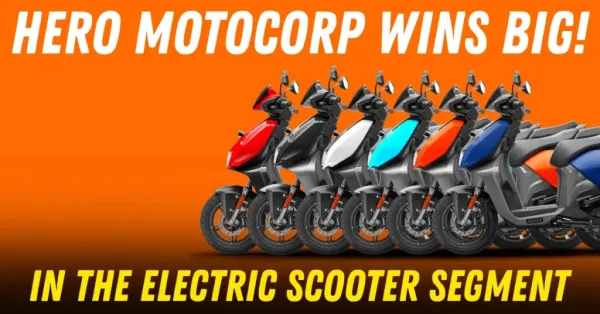
Hero MotoCorp’s electric two-wheeler brand Vida ended FY26 with a market share of 10.3 percent, making it the single largest year-on-year market share gainer in the electric two-wheeler segment. At the start of FY26, Vida’s share was around 2 to 3 percent. The 10.3 percent figure by March 2026 represents a near-fourfold increase in share within a single financial year, the biggest swing of any brand in the segment.
In March 2026 specifically, TVS Motor led the electric two-wheeler market with 31,107 units, followed by Bajaj’s Chetak at 21,263 units. Ather came in third, Vida fourth, and Ola Electric fell to fifth with 10,117 units, down from its earlier position of market leader. Hero Vida’s March volume of approximately 18,000 units placed it firmly in the top five and within striking distance of the podium.
The numbers show how dramatic that shift has been. If Vida began the year at roughly 2.5 percent share and ended at 10.3 percent, that is an increase of 7.8 percentage points within one financial year. In relative terms, that works out to more than a fourfold expansion. In a segment where even a 1 or 2 percentage point change can alter rankings, a jump of that scale is not a small improvement. It is a structural gain. Vida’s March volume of around 18,000 units also puts it just 3,263 units behind Bajaj Chetak. That is not a distant fourth place. It is a narrow enough gap to suggest the podium is now realistic, not theoretical.
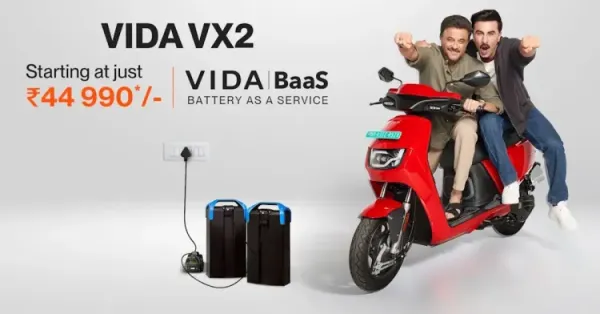
The volume behind Vida’s share gain came primarily from the Vida V2 and the more affordable Vida Z series, which Hero launched at sub-Rs 1 lakh price points to compete directly in the mass market segment. The Vida Z starts at Rs 84,490, making it one of the cheapest electric scooters from a mainstream OEM in the market. This price positioning opened a buyer segment that was previously going to either Ola or TVS iQube, both of which had been the dominant players below Rs 1 lakh.
That starting price matters because mass-market electric scooters have become a pricing game as much as a technology game. Once a product drops below the Rs 1 lakh threshold, it enters a much larger consideration set. Vida Z at Rs 84,490 sits more than Rs 15,000 below that line, and that is a meaningful difference in this category. For many buyers, that gap can cover registration, accessories, insurance differences, or part of the financing cost. This is especially important in smaller cities where total ownership cost tends to matter more than app features or brand image. Hero understood that the next wave of EV growth was unlikely to come only from early adopters in larger cities.
Hero’s pre-existing dealer network of over 10,000 touchpoints has also been a structural advantage. Unlike Ola, which built a direct-to-consumer channel, or Ather, which operates its own retail stores, Hero’s Vida can tap into Hero MotoCorp’s existing service and sales infrastructure. In smaller cities and towns where Ola and Ather have limited physical presence, Vida’s dealer access has been a genuine differentiator.
That reach is difficult to replicate quickly. A network of more than 10,000 touchpoints means Hero already has physical visibility, workshop familiarity, and service confidence in places where newer EV-only brands are still building trust. In practical terms, that gives Vida access to a far wider buyer base without having to build each retail point from scratch. It also reduces one of the biggest worries in electric two-wheelers: where the scooter will be serviced if something goes wrong. In categories where technology is still new for many buyers, service reassurance can be as important as price.
FY26 effectively reshuffled the top of the electric two-wheeler segment. Ola Electric, which once commanded a 35 percent market share, ended FY26 with a significantly lower share as TVS, Bajaj, Ather, and now Hero closed in. TVS’s iQube has been the most consistent performer through the year. Bajaj’s Chetak surged significantly in the second half of FY26 after the launch of more affordable variants.
Hero’s rise matters specifically because it signals that the legacy two-wheeler manufacturers, those with established manufacturing scale, widespread dealer networks, and strong rural and semi-urban reach, have now fully engaged with the electric segment. The first phase of EV two-wheeler growth was dominated by new-age brands. FY26 looks like the year the incumbents started taking back ground.
The March ranking makes that trend even clearer. TVS at 31,107 units sold nearly three times what Ola managed at 10,117 units. Bajaj at 21,263 stayed well ahead too. Vida’s roughly 18,000-unit tally means Hero was much closer to Bajaj than Ola was to Hero. That would have sounded unlikely a year earlier. The market is no longer being led by one standout EV-first company. It is becoming a tightly contested field where scale, distribution, pricing, and execution matter more than early-mover advantage. FY26 may be remembered as the year electric two-wheelers stopped being a startup-led race and became a mainstream two-wheeler battle.
-
‘Attempt to divert attention’: BJP on Pak Minister Khwaja Asif’s remark
-
Bengal SIR: Tribunal orders Congress candidate reinstated in supplementary roll

-
OPEC+ nations to ramp up oil output in May amid global energy crisis

-
Iran says Strait of Hormuz will ‘never return to former state’ for US, Israel

-
School Assembly News Headlines Today April 6, Top National, International, Sports, Business News