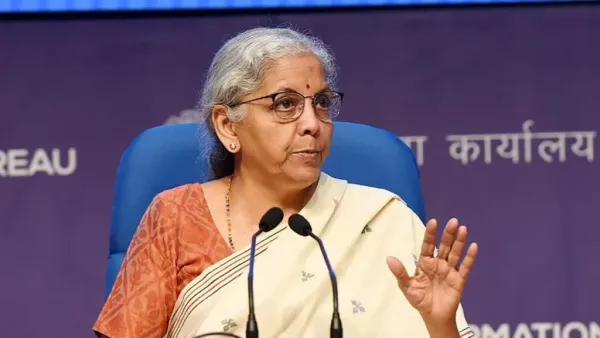
Union Finance Minister Nirmala Sitharaman and Union Minister of Petroleum and Natural Gas Hardeep Singh Puri jointly addressed the nation on Friday to dismiss lockdown rumours circulating across social media and WhatsApp and to explain the full scope of the government’s fiscal intervention to protect Indian consumers from the worst fuel price shock in a generation.
The joint statement from two of the government’s most senior economic ministers is the most authoritative and comprehensive official response yet to both the misinformation crisis and the genuine economic challenge that the West Asia conflict has created for India’s energy security and household finances.
No Lockdown. Full Stop.
Sitharaman was unambiguous. “There shall not be any lockdown. I want to reassure people that there will be no such lockdown as we saw during COVID,” she said, describing rumours of a lockdown as baseless and expressing concern over misinformation circulating in political discourse.
Puri was equally direct, going further by posting formally on X: “Rumours of a lockdown in India are completely false. There is no such proposal under consideration by the Government of India.” He termed the rumours irresponsible and harmful and urged the public to remain calm and not fall prey to panic-driven narratives.
The joint intervention by the Finance Minister and Petroleum Minister simultaneously signals how seriously the government is taking the spread of these rumours. When two cabinet ministers hold a joint briefing specifically to address a piece of misinformation, it reflects both the scale of public anxiety the rumours have generated and the political urgency of containing that anxiety before it translates into panic buying, supply disruption, or unnecessary economic damage.
What the Government Is Actually Doing — The Full Fiscal Picture
The more substantive part of the joint statement is the detailed disclosure of exactly how much the Indian government is absorbing on behalf of its citizens to prevent the global fuel price shock from reaching Indian petrol pumps and kitchen cylinders.
Sitharaman announced that excise duties on petrol and diesel have been significantly reduced, bringing them down to Rs 3 per litre for petrol and nil for diesel. This is a dramatic reduction in the excise component that represents one of the largest single excise duty cuts on petroleum products in recent years. Additionally, the government has imposed export duties on fuel including Rs 21.5 per litre on diesel exports to ensure that domestically refined diesel is not exported at a profit while Indian consumers face a shortage. The combination of excise cuts and export duties is designed to keep domestic fuel prices stable and domestic fuel supply abundant simultaneously.
The OMC Loss Picture
Puri disclosed the specific loss figures that OMCs are absorbing per litre of fuel sold in India. Oil companies are facing losses of approximately Rs 24 per litre for petrol and Rs 30 per litre for diesel. These losses exist because the global crude oil price surge, from approximately $70 per barrel before the Iran war to over $120 per barrel at current levels, has raised the input cost of refining fuel significantly above the controlled retail price at which it is sold to Indian consumers.
The government is helping offset these losses through the excise duty reduction, export duty revenues, and direct fiscal support to OMCs, ensuring that the companies can continue operating without being driven into financial distress by the gap between their input costs and their controlled selling prices.
“The government will bear the burden so that the public does not face any difficulty or shortage of petrol, diesel, and LPG,” Sitharaman said, in the clearest single statement of the government’s policy priority during the current crisis.
India vs the World — The Price Comparison That Explains the Policy
Puri provided the global context that makes the scale of India’s consumer protection policy immediately apparent. Global crude prices have surged from around $70 per barrel to over $120 per barrel in the past month. That increase has fed through to retail fuel prices across the world with no government absorbing the full shock on behalf of consumers. Fuel prices have increased by approximately 30 to 50 percent in Southeast Asian countries, 30 percent in North American countries, 20 percent in Europe, and 50 percent in African countries.
India’s retail petrol and diesel prices have not moved by anything approaching these percentages. The gap between what global markets have done to fuel prices and what Indian consumers are paying at the pump is the direct financial cost of the government’s chosen policy approach, a cost being absorbed across excise revenue foregone, export duty mechanisms, and OMC balance sheet support.
“The government chose to take a hit on its own finances rather than increase prices drastically for citizens,” Puri said.
No Shortage of Fuel or Essential Supplies
Both ministers were equally emphatic on supply security. India has adequate fuel reserves, monitoring of global supply chains is happening in real time, and the export duty and OMC support mechanisms are specifically designed to ensure continuous fuel imports and stable domestic supply. There will be no shortage of petrol, diesel, or LPG regardless of how the West Asia situation develops in the near term, they said.
The government’s preparedness statement addresses the second most significant anxiety driving the lockdown rumours, which is not just the price shock but the fear that India could face a genuine supply disruption if the Strait of Hormuz closure continues. PM Modi had addressed Parliament to note that India has 60 days of oil cover and 30 days of LPG reserves, and the Sitharaman-Puri statement reinforces that supply security message with the additional context of the specific policy tools being used to maintain it.
The Warning on Misinformation
Both ministers closed with a strong warning against the spread of rumours during sensitive geopolitical situations. Sitharaman described the lockdown claims as baseless and expressed concern over misinformation in political discourse, a pointed observation that suggests the rumours are being amplified deliberately in some quarters for political purposes rather than spreading purely organically.
Puri’s characterisation of the rumours as irresponsible and harmful reflects the government’s assessment that false emergency information during a genuine crisis has real economic consequences. Panic buying triggered by a fake lockdown notice can cause the very supply disruptions that the government’s policies are designed to prevent.
The message from Friday’s joint briefing is comprehensive and clear. There is no lockdown. Fuel prices are being held below market levels at significant fiscal cost to the government. Supply is secure. And the people spreading lockdown rumours are doing so without basis and with harmful effect.
This article is based on statements made by Union Finance Minister Nirmala Sitharaman and Union Minister of Petroleum and Natural Gas Hardeep Singh Puri on April 1, 2026. All financial figures are sourced from official ministerial statements. This article is for informational purposes only and does not constitute financial or investment advice.
-
Chelsea Premier League winner tears up contract and retires after collapsing in training

-
Two main perpetrators of blast outside BJP office in Chandigarh arrested: Punjab DGP

-
A Retired Postman's Journey Back Home

-
'Dennis the Menace' turns 75: Why rule‑breaking kids never go out of style

-
Zameer joins campaign in Davanagere South bypoll, dismisses rift rumours