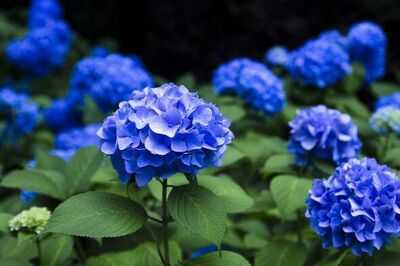
Gardeners keen to add a burst of colour to their outdoor space need look no further than hydrangeas.
The impressive flowers typically bloom from mid-spring until late summer, but this can depend on the variety you plant and the growing conditions in your garden. Hydrangeas are particularly eye-catching thanks to their striking ball and cone-shaped flowerheads, and they come in a variety of shades, including blue, pink, purple and white. But the colour of flowers hydrangeas bloom can be influenced by the type of soil they are planted in. The Royal Horticultural Society (RHS) says if the soil in your garden is acidic (with a pH of 5.5 or lower) this should produce striking blue flowers thanks to the availability of aluminium, whereas alkaline soils (with a pH of 6.5 or higher) encourage more pink blooms.
So if you're particularly keen to add a burst of vibrant blue to your garden, it is possible to influence the colour of hydrangeas with the help of a common kitchen scrap: coffee grounds.
Coffee grounds are acidic and so when added to soil, they help to naturally lower the pH level to make it more acidic, which is key to producing blue flowers.
The coffee grounds help to make aluminium more available for hydrangeas to absorb which, in turn, helps promote vibrant blue blooms.
Gardeners should note that the process won't happen overnight and will require some time and patience to produce the blue colour, so if you want to give the plant an extra helping hand, adding aluminium sulfate to your soil in combination with coffee grounds can really help.
In its online advice for achieving blue blooms, Planting Tree explains: "Some people report success using coffee grounds to change the colour of their hydrangeas. Coffee grounds, in theory, carry enough acid to increase the acid in your soil to change your hydrangeas to blue hydrangeas.
"This method may work, and coffee grounds break down into the soil well, so there's no harm in trying it. However, if you want to give yourself better odds of results, you might consider a product specifically designed to increase the acidic balance of your soil."
Gardening experts advise sprinkling coffee grounds around the base of hydrangeas, but make sure they aren't directly in contact with the stems of the plant. Then gently work the coffee grounds into the soil using your hands or a trowel to help them break down.
Coffee grounds can also be composted before being applied to the base of hydrangea plants as this can help provide a wider range of nutrients and improve the health of your soil.
In its online advice on using coffee grounds for plants, Gardener's World said: "The moist, small particles of coffee grounds are certainly an excellent compost ingredient because of their texture, to mix with dry and woody waste to speed the composting process.
"Ensuring a balanced mix of 'wet' and 'dry' materials is the best way to achieve good compost. The nutrients contained in coffee grounds will be recycled back into the soil when finished compost is used as a mulch or dug into the soil. Also, add any un-drunk coffee to dry material in a compost bin.
"Coffee tends to be slightly acidic and is therefore good for acid-loving plants such as hydrangeas, as well as nutrient-hungry plants like roses, but again, use it only in moderation on any one plant."
-
Maa Ka Sum Out On OTT: Where To Watch Mona Singh And Mihir Ahuja's Drama Series

-
From Pilot to Plant Floor: Industrial AI Moves from Boardroom to Assembly Line

-
A Breakthrough Kitchen Device Is Being Hailed as the Invention That Could Finally Replace the Microwave for Good

-
Delhi bans sale of LPG directly from godowns; govt warns of action

-
Dhurandhar 2 box office collection: Ranveer Singh film becomes 1st Bollywood movie to cross Rs 1,000 cr; joins Pushpa 2 & Baahubali 2 league