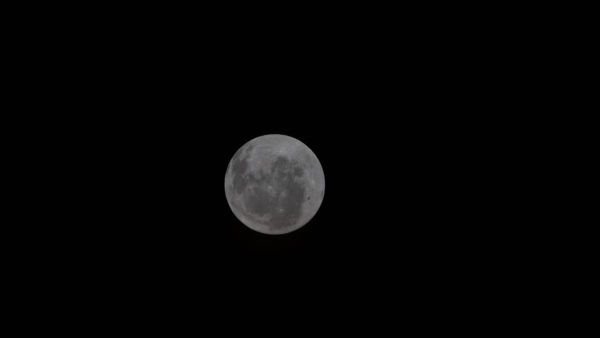
Washington D.C.: NASA has released a breathtaking full-view image of the Moon’s Orientale Basin, captured by the crew of the Artemis II mission.
The agency confirmed that this marks the first time the entire basin, a massive, multi-ringed impact structure, has been witnessed directly by human eyes, signalling a new era of lunar discovery.
The image was downlinked on Sunday as the Orion spacecraft, named Integrity, continued its historic journey toward the lunar far side.
Launched on April 1, 2026, from the Kennedy Space Centre, Artemis II is the first crewed mission to travel to the vicinity of the Moon in over 50 years, following the conclusion of the Apollo program in 1972.
History in the making
— NASA (@NASA) April 5, 2026
In this new image from our @NASAArtemis II crew, you can see Orientale basin on the right edge of the lunar disk. This mission marks the first time the entire basin has been seen with human eyes. pic.twitter.com/iqjod6gqgz
Rare Glimpse of the Lunar
The Orientale Basin is located on the extreme western edge of the Moon’s near side, making it notoriously difficult to view from Earth.
The four-member Artemis II crew, NASA astronauts Reid Wiseman, Victor Glover, Christina Koch, and CSA astronaut Jeremy Hansen, are the first humans to see the feature in its entirety from their vantage point in deep space.
Measuring roughly 950 kilometres (about 590 miles) across, the Orientale Basin is considered the youngest and best-preserved of the Moon's large impact basins.
Its striking appearance, created by concentric rings of mountain ranges, offers scientists critical data on how massive impacts shaped the early solar system.
History in the making
— NASA (@NASA) April 5, 2026
In this new image from our @NASAArtemis II crew, you can see Orientale basin on the right edge of the lunar disk. This mission marks the first time the entire basin has been seen with human eyes. pic.twitter.com/iqjod6gqgz
The Journey Continues
NASA reported that the crew has already crossed the halfway mark of their journey. As of Sunday, the Orion spacecraft is travelling on a free-return trajectory that will see the crew swing around the Moon’s far side on Monday.
During this flyby, the astronauts will reach a distance of more than 400,000 kilometres from Earth, breaking the record for the furthest humans have ever travelled into space, a title previously held by the Apollo 13 mission.
The 10-day mission is a final test of the Orion spacecraft’s life-support and navigation systems before NASA moves forward with Artemis III, which aims to land the first woman and the first person of colour on the lunar surface.
Artemis II just hit the "two thirds" mark of the journey to the Moon.
— NASA Artemis (@NASAArtemis) April 5, 2026
During Flight Day 4, the astronauts aboard Orion went over plans to study the Moon during their upcoming lunar flyby and are currently practicing manually controlling the spacecraft. pic.twitter.com/TU0ftZAekT
The Artemis II mission is scheduled to conclude with a splashdown in the Pacific Ocean on April 10, 2026.
-
Eye Care: How should women take care of their eyes during pregnancy? What to change in diet, know the advice of experts

-
IMD expressed possibility of hailstorm and heavy rain – Obnews

-
Luxury bag made from dinosaur protein displayed

-
The luck of these 5 zodiac signs can shine from April 6, Mars will change its course, will transit in the constellation of Saturn.

-
Photography will be more powerful! 200MP camera in Vivo’s new smartphone, users are happy