
Despite an overall slowdown in entry-level IT/ITeS hiring, the class of 2026 at several of the country’s Tier 2/3 engineering colleges is seeing a better-than-expected placement season with more offers than last year.
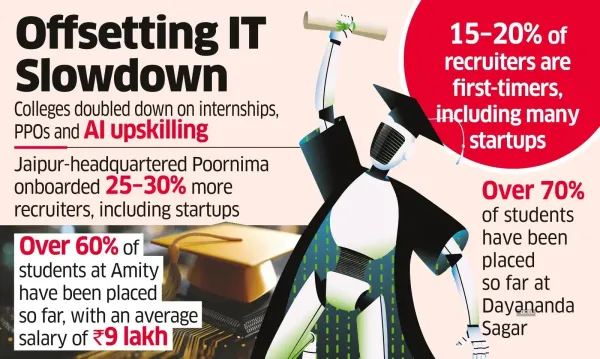
Institutes that diversified beyond regular recruiters and doubled down on internships, pre-placement offers, and targeted upskilling in domains like AI are reaping the benefits. Maharaja Agrasen Institute of Technology (MAIT), Dayananda Sagar College of Engineering, Amity University and Poornima Group said the strategy kept placement momentum intact, even as traditional hiring slows.
Most of these colleges widened their nets well ahead of the placement cycle.
Delhi-based MAIT, for instance, stepped up its focus on analytics, consulting, and diversified technology roles to offset reduced entry-level hiring by IT/ITeS companies. Jaipur-headquartered Poornima Group, which runs engineering colleges and one university, onboarded around 25-30% more recruiters, including startups, to reduce dependence on the big companies.
 “While IT/ITeS organisations continue to constitute a significant portion of our recruiter base, we proactively anticipated the slowdown in entry-level hiring and diversified our placement strategy. Our focus has expanded to include core engineering roles, consulting, analytics, BFSI, international opportunities, and emerging startups,” said Dr. Anjani Kumar Bhatnagar, head, Amity Technical Placement Centre.
Over 60% of engineering students at Amity have been placed so far, a 10%-plus increase in placement numbers over last year. For the 2025–26 placement cycle, the average salary so far stands at around Rs 9 lakh, compared to last year’s Rs 8.5 lakh.
At Dayananda Sagar, over 70% of the students have been placed so far, though individual hiring numbers per recruiter, especially at the large IT/ITeS players, have dropped. “At least 15-20% of the 400-odd companies that have visited so far are first-timers, including many startups,” said MN Guruvenkatesh, senior vice-president, placements and skill development, Dayananda Sagar Institutions, Bengaluru.
A focus on skilling the students in areas such as AI has also helped, he said, adding the institute has even set up an AI lab to facilitate this.
Dr Amit Gautam, director (Addl.), CDC at MAIT said campus offers were comparatively higher than in the same stage of the 2024-25 placement cycle. More than 140 companies have participated so far.
First-time recruiters at MAIT include Orange Business, Nucleus Software, and Escorts Kubota; regulars include Infosys, ZS Associates, Amazon, DE Shaw and Accenture, said Gautam.
The top salary offer has jumped from Rs 32 lakh in 2024-25 to Rs 53 lakh in the 2025-26 cycle, while the average salary remains similar, said Dipti Lodha, director, corporate relations of Poornima group. “TCS and Infosys have recruited in good numbers, but mostly for AI roles where students will be deployed after initial training,” she said.
Lodha said about 85% of their students have been placed so far compared to around 80% at the same time last year.
“While mass entry-level IT/ITeS hiring is softer in the broader market, our outcomes are not heavily dependent on that segment,” said Srabani Ghosh, Head, Office of Corporate Partnerships and Careers, Plaksha University. “Instead, demand remains robust in specialised technology, analytics, consulting, and high-impact corporate roles. Companies focused on volume hiring have reduced engagement, but that hasn’t materially affected placements for specialised functions,” she added.
Institutes that diversified beyond regular recruiters and doubled down on internships, pre-placement offers, and targeted upskilling in domains like AI are reaping the benefits. Maharaja Agrasen Institute of Technology (MAIT), Dayananda Sagar College of Engineering, Amity University and Poornima Group said the strategy kept placement momentum intact, even as traditional hiring slows.
Most of these colleges widened their nets well ahead of the placement cycle.
Delhi-based MAIT, for instance, stepped up its focus on analytics, consulting, and diversified technology roles to offset reduced entry-level hiring by IT/ITeS companies. Jaipur-headquartered Poornima Group, which runs engineering colleges and one university, onboarded around 25-30% more recruiters, including startups, to reduce dependence on the big companies.
Over 60% of engineering students at Amity have been placed so far, a 10%-plus increase in placement numbers over last year. For the 2025–26 placement cycle, the average salary so far stands at around Rs 9 lakh, compared to last year’s Rs 8.5 lakh.
At Dayananda Sagar, over 70% of the students have been placed so far, though individual hiring numbers per recruiter, especially at the large IT/ITeS players, have dropped. “At least 15-20% of the 400-odd companies that have visited so far are first-timers, including many startups,” said MN Guruvenkatesh, senior vice-president, placements and skill development, Dayananda Sagar Institutions, Bengaluru.
A focus on skilling the students in areas such as AI has also helped, he said, adding the institute has even set up an AI lab to facilitate this.
Dr Amit Gautam, director (Addl.), CDC at MAIT said campus offers were comparatively higher than in the same stage of the 2024-25 placement cycle. More than 140 companies have participated so far.
First-time recruiters at MAIT include Orange Business, Nucleus Software, and Escorts Kubota; regulars include Infosys, ZS Associates, Amazon, DE Shaw and Accenture, said Gautam.
The top salary offer has jumped from Rs 32 lakh in 2024-25 to Rs 53 lakh in the 2025-26 cycle, while the average salary remains similar, said Dipti Lodha, director, corporate relations of Poornima group. “TCS and Infosys have recruited in good numbers, but mostly for AI roles where students will be deployed after initial training,” she said.
Lodha said about 85% of their students have been placed so far compared to around 80% at the same time last year.
“While mass entry-level IT/ITeS hiring is softer in the broader market, our outcomes are not heavily dependent on that segment,” said Srabani Ghosh, Head, Office of Corporate Partnerships and Careers, Plaksha University. “Instead, demand remains robust in specialised technology, analytics, consulting, and high-impact corporate roles. Companies focused on volume hiring have reduced engagement, but that hasn’t materially affected placements for specialised functions,” she added.
( Originally published on Apr 04, 2026 )