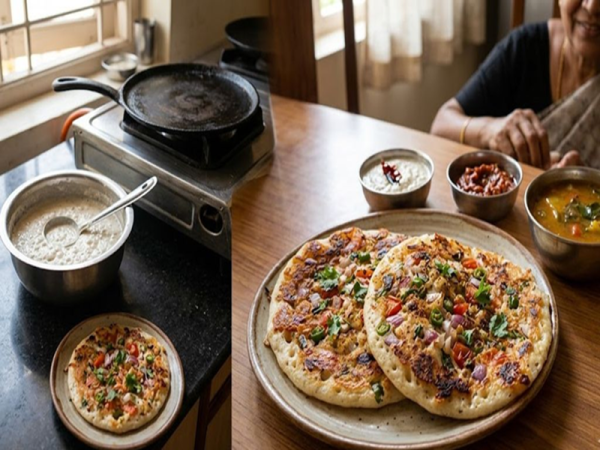
We all love South Indian food—especially when it comes to *Uttapam*. Just the sight of a restaurant-style Uttapam—crispy on the outside, soft as cotton on the inside, and topped with crunchy vegetables—is enough to make your mouth water. However, when we try to recreate it at home, it often either sticks to the griddle (*tava*) or remains undercooked in the center.

Why, exactly, is it so difficult to achieve that restaurant-quality taste and texture at home? The truth is, we often make a few small mistakes—sometimes unknowingly. Let's explore these four common errors and discover the right way to correct them.
**4 Mistakes People Make When Preparing Uttapam**
**1. The Batter is Too Thin**
The biggest mistake people make is assuming that the batter for *Dosa* and *Uttapam* should be the same consistency. Dosa batter is typically thinner so that it spreads easily; however, Uttapam batter needs to be slightly thicker. If the batter is too thin, the Uttapam will not turn out spongy, nor will it develop that characteristic porous, net-like texture.
**2. Neglecting the Griddle's Temperature**
In restaurants, chefs meticulously control the temperature of the griddle. If you pour the batter onto a griddle that is too hot, the Uttapam will burn on the bottom while remaining raw on the inside. Conversely, if the griddle is too cool, the Uttapam will stick to the surface and turn tough and rubbery.
**3. Spreading it Too Thinly (Like a Dosa)**
Many people, as soon as they pour the Uttapam batter onto the griddle, begin spreading it out in a thin, circular motion—just as they would for a Dosa. However, the defining characteristic of an Uttapam is its thickness. It needs to be kept slightly thicker—much like a pancake—to allow that porous, spongy structure to form within.
**4. Not Incorporating the Vegetables Correctly**
People often scatter onions, tomatoes, and bell peppers over the Uttapam, but they frequently neglect to press them down firmly into the batter. The result is that when you flip the Uttapam, all the vegetables scatter onto the griddle and burn.
**The Right Way to Make Restaurant-Style Uttapam**
If you want your Uttapam to turn out absolutely perfect, follow these simple steps next time:
**Prepare the Right Batter:** The Uttapam batter should be thick, similar in consistency to Idli batter. Allow it to ferment thoroughly. It is this fermentation process that creates the characteristic porous texture in the Uttapam.
**Prepare the Griddle:** First, heat the griddle (Tawa) over high heat. Then, sprinkle a few drops of water onto it and wipe it clean with a cloth or a tissue paper. This will bring the griddle's temperature down to a normal level and prevent the Uttapam from sticking.
**Spread it Thick:** Reduce the flame to medium. Now, pour one or two spoonfuls of batter into the center of the griddle and spread it out only slightly. Allow it to remain thick.
**Gently Press the Vegetables:** Immediately after pouring the batter—while the top surface is still slightly wet—add your choice of finely chopped vegetables (onions, tomatoes, green chilies, coriander). Now, using a spoon, gently press the vegetables into the batter.

**Cover and Cook:** Drizzle a little oil or butter around the edges of the Uttapam. Now, cover it with a lid for 1–2 minutes. The steam generated inside will ensure the Uttapam cooks thoroughly from the inside out, and the vegetables will also soften.
**Flip and Cook:** Once the top layer appears slightly dry and the bottom side has turned golden brown, carefully flip the Uttapam and cook it lightly on the other side as well.
PC Social Media
-
Artemis II crew heading for Moon releases Blue Marble photo

-
'Ranveer's conviction and commitment towards both the script and Jai has enabled 'Pralay,' says Hansal Mehta

-
Khanna wins Best Supporting Actor for 'Dhurandhar' at Chetak Awards

-
At 83, Amitabh Bachchan says it's disturbing for him to not work each day: 'Living in anxiety is harmful for the mind'

-
Director Anurag Kashyap's cult hit 'Dev D' to re-release on April 24