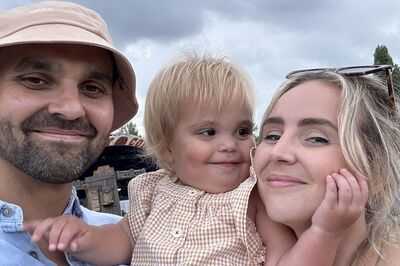
It's hard to imagine a brighter smile - but this adorable toddler will end up not being able to walk, talk or eat unless she gets help.
Two-year-old Leni Forrester has Sanfilippo Syndrome, a rare genetic disorder otherwise known as childhood dementia. Her parents, Gus, 35, and Emily, 33, from Kent, had no idea that anything was wrong with their daughter until Emily's sister flagged that she was a carrier for the gene that causes the condition.
Heartbreakingly, Sanfilippo comes with a hugely reduced life expectancy, with children affected usually living until only their early to mid teens. This means that little Leni is currently fighting for her life.
When Gus and Emily found out that the gene is in the family, they raised the issue with their doctor and began a lengthy process to find out if Leni was affected - they would both have to be carriers for this to be the case. One week before Leni's second birthday they got terrible news: she did have the condition, and there was "no treatment, no cure".
• Jesy Nelson's devastation for girl, 2, with dementia after second baby tragedy
• Sanfilippo syndrome - tragedy of ‘childhood dementia’ and its early warning signs
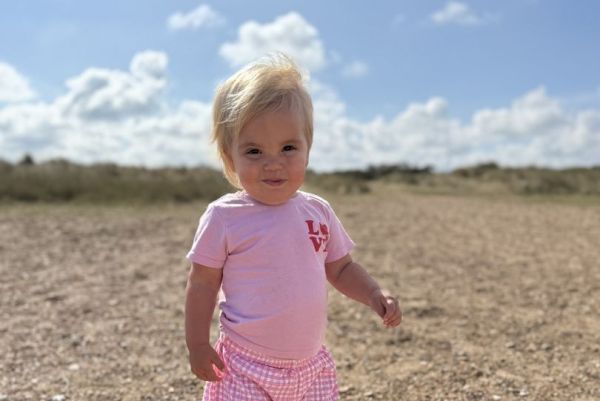
The couple were sent home after receiving this terrifying diagnosis, told that they would be provided with palliative care, which was "obviously horrific," Emily tells the Mirror. But determined to fight, Leni's parents started their own research, and found two promising experimental treatment options - but they come at a high cost and it's a "race against time" to save Leni. The inspiring couple have begun campaigning to get their daughter the life-saving treatment she needs, and they've just hit a major landmark.
They've surpassed their £300,000 fundraising milestone, which will enable them to help fund the "pre-clinical costs" to get a gene replacement therapy to trial. However, the entire trial will cost £5.5 million - so there is still some way to go to ensure Leni gets the crucial, life-saving treatment she needs. With this in mind, the family have increased their fundraising goal to £5,000. Emily says: "When it's your child's life, it's like, how can we possibly put a price on this?"
Support the fight to save Leni's life by donating to the GoFundMe, and you can follow the family's journey on TikTok.
The mum explains that Leni's condition is caused by "a fault in a single gene that produces a specific enzyme. That enzyme is responsible for breaking down a sugar molecule in her body called heparan sulphate. Essentially that sugar molecule is toxic waste and without it being broken down it builds up on various organs, but most importantly on the brain and causes irreversible brain damage.
Children as young as Leni are not normally diagnosed with Sanfilippo, Emily says. In part, this is because the "they don't show symptoms until they're usually about two, three years old is because it's obviously incremental build up, it just hasn't built up to a point to cause any kind of symptoms yet."
Equally, many of the signs of the condition can be easily misdiagnosed as more common conditions, Emily tells us, and this means that tragically, many children with the genetic disorder don't get diagnosed until they are around eight years old, when they start to lose their motor functions. Before this, the regression of cognitive function is often misdiagnosed as some kind of neurodivergence, like Autism, or ADHD.
Because the disorder has been caught so young, Leni is an excellent candidate for clinical trials, and Emily tells us a bit about the life-saving treatment they are hoping to facilitate for their daughter. "Since launching the campaign a different treatment has just been announced as ready for patients, pending funding. And again, it would be in a clinical trial setting," she explains.
"Children that receive it have gone on to develop as normal children, again, if they receive it young enough, that's the key and why it's so urgent. They replace the gene completely so that the child's body produces the enzyme by itself. I think it's amazing. If Lenny could receive it tomorrow, the likelihood is she would develop as a normal child. But we have to beat any kind of regression, and that is what makes it so urgent."
Even bringing forward the trial by a few weeks before Leni slips into regression could make a huge difference to her future - once a child with Sanfilippo loses function, the damage cannot be undone. "It is such a race against time because the damage can never be reversed once it's been done, so early treatment is key and the youngest children that receive this treatment went on to develop pretty typically," Emily says.
Two weeks after finding out Leni had Sanfilippo, the family were faced with more heartache: Emily learned that she was pregnant and they would have to wait three months to find out if the baby was affected by the disorder too. The couple had initially paused trying for another baby when they learned Emily's sister was a carrier, but after getting a private genetic test for Gus, they were told he had the all clear. Emily tells us when they got the private test back their reaction was "Great amazing, whatever is going on, worst case scenario is not possible because you're not a carrier," and they resumed trying for another child.
In a cruel twist of fate - Gus' test result was actually incorrect. "It since transpires that he is a carrier but for what they call a variant of unknown significance which means that never before in the global database has the gene that he carries been known to cause a child affected with Sanfilippo. So he just carries a very, very rare variant. So it wasn't logged, which is why it came back as negative," Emily explains.
The brave mum endured three months of "horrific" morning sickness - something that in her pregnancies is so severe it has to be medicated - before going through a painful and intense screening test to find out if the baby had the condition too. "There's only 25% chance that our children are affected and unfortunately the baby was also diagnosed with Sanfilippo so we felt we had no choice but to terminate the pregnancy," she says.
The couple, who are "desperate" for Leni to know her siblings, have begun the lengthy process of growing their family through IVF, and have to undergo bespoke genetic testing as part of this. Because of their unique circumstances, another addition to to their family is a long way off, so they felt they had to get the process started, unwilling to "roll the dice" and try naturally knowing that their child could suffer from the condition. Emily explains it's been a harrowing time filled with "emotional turmoil" and that " I just can't mentally go through that again."
-
Effective tips for summer skin care

-
Before Nitish Kumar went to Rajya Sabha, Nishant Kumar became emotional, said- ‘Bihar will not forget his father’s 20 years of work’

-
Billionaire wife of Journey to the West actor Chi Zhongrui dies at 85

-
Zahid Ahmed reveals why he chose marriage over dating

-
If you want to drink cold water from a pot in summer, then take care of cleaning the pot also.