
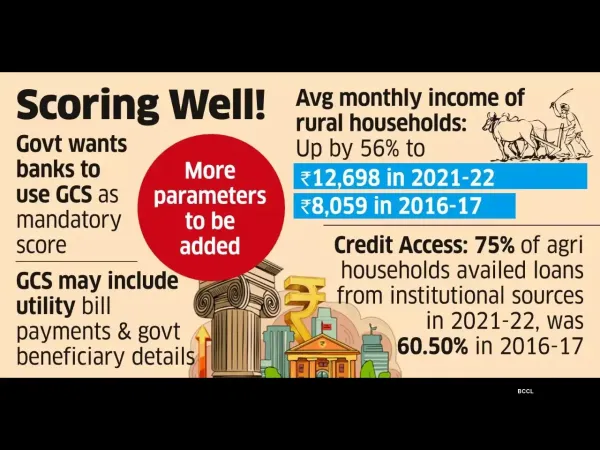
The government has asked banks to consider using the Grameen Credit Score (GCS) as the default measure to assess rural borrowers, in a push to widen access to formal credit, people familiar with the matter said.
The government wants banks to devise low-interest loan schemes for self-help groups (SHGs), farmers and marginalised communities besides micro and small enterprises in rural areas, and GCS is expected to help in faster credit assessment and loan disbursement.
"Banks have been asked to ensure smooth adoption of GCS in coordination with credit information companies and ensure that the unbanked population is assessed largely on these parameters," a government official said.
Maximum benefit should be passed on to first-time borrowers as they have no credit history, the official added.
Under Phase I, GCS has been developed using existing data attributes such as rural and agriculture-related borrowings available with credit information companies (CICs).
"Discussions are on to expand this criterion and map more parameters like utility bills and enrolment status in government beneficiary schemes," a bank executive said, requesting anonymity.
These discussions have been going on for the last two months.
Announced in the FY26 budget, GCS was to incorporate wider credit information into the assessment of creditworthiness while considering the fact that rural borrowers' spending and financial profiles may differ from urban borrowers.
In December 2025, minister of state for finance Pankaj Chaudhary informed the Rajya Sabha that the development of Grameen Credit Score is expected to help in improving access to formal credit for the rural population, including small farmers.
All CICs have since launched GCS and, as per TransUnion Cibil, it provides a overview of rural borrower behaviour across key Grameen lending products like Kisan credit card, priority sector loans, tractor loans.
The government wants banks to devise low-interest loan schemes for self-help groups (SHGs), farmers and marginalised communities besides micro and small enterprises in rural areas, and GCS is expected to help in faster credit assessment and loan disbursement.
"Banks have been asked to ensure smooth adoption of GCS in coordination with credit information companies and ensure that the unbanked population is assessed largely on these parameters," a government official said.
Move to help SHGs, farmers, marginalised communities
Maximum benefit should be passed on to first-time borrowers as they have no credit history, the official added.
Under Phase I, GCS has been developed using existing data attributes such as rural and agriculture-related borrowings available with credit information companies (CICs).
"Discussions are on to expand this criterion and map more parameters like utility bills and enrolment status in government beneficiary schemes," a bank executive said, requesting anonymity.
These discussions have been going on for the last two months.
Announced in the FY26 budget, GCS was to incorporate wider credit information into the assessment of creditworthiness while considering the fact that rural borrowers' spending and financial profiles may differ from urban borrowers.
In December 2025, minister of state for finance Pankaj Chaudhary informed the Rajya Sabha that the development of Grameen Credit Score is expected to help in improving access to formal credit for the rural population, including small farmers.
All CICs have since launched GCS and, as per TransUnion Cibil, it provides a overview of rural borrower behaviour across key Grameen lending products like Kisan credit card, priority sector loans, tractor loans.