
A clear resurgence of new-age, digital-first companies defined the year 2025 for India’s primary markets, with at least 18 companies collectively mopping up more than INR 41,283 Cr from public listings, significantly exceeding the INR 29,070 Cr garnered the year before.
Unlike the listing frenzy of 2021, last year’s wave was more selective, with investors homing in on startups that crossed the critical scale thresholds and showed improving unit economics, even if they were making losses at the net level.
Public markets rewarded companies that showed tighter unit economics, clearer profitability roadmap and wider market share, while those struggling with deeper losses, eroding market share and leadership shakeups saw their market cap decline considerably.
From consumer internet and ecommerce platforms to tech-enabled services, companies hitting the IPO market turf in 2025 were largely mature businesses seeking growth capital, rather than survival funding. This helped rebuild investor confidence, with valuation discussions being increasingly anchored to the sustainability of margins, capital efficiency, and the ability to convert scale into long-term profitability.
“The emphasis has moved decisively away from the growth-at-any-cost narratives to more disciplined, execution-led stories,” Sunny Agrawal, who heads fundamental equity research at SBI Securities, told Inc42. “The momentum is expected to carry into 2026, as a strong group of large digital businesses prepares to tap the markets.”
New-age companies that are expected to go public this year include OYO, Zepto, boAt, Fractal Analytics, Curefoods, Flipkart and PhonePe, with the cumulative fund-raise exceeding INR 50,000 Cr.
With internet users in the country projected to breach the 1.2 Bn mark by 2030, growing from 886 Mn+ in 2024, 46 out of every 100 people in rural India being connected online, the opportunity for scaled platforms continues to expand. Market analysts believe this creates room for another phase of listings, provided the companies can clearly articulate their path to profitability and defend their competitive position.
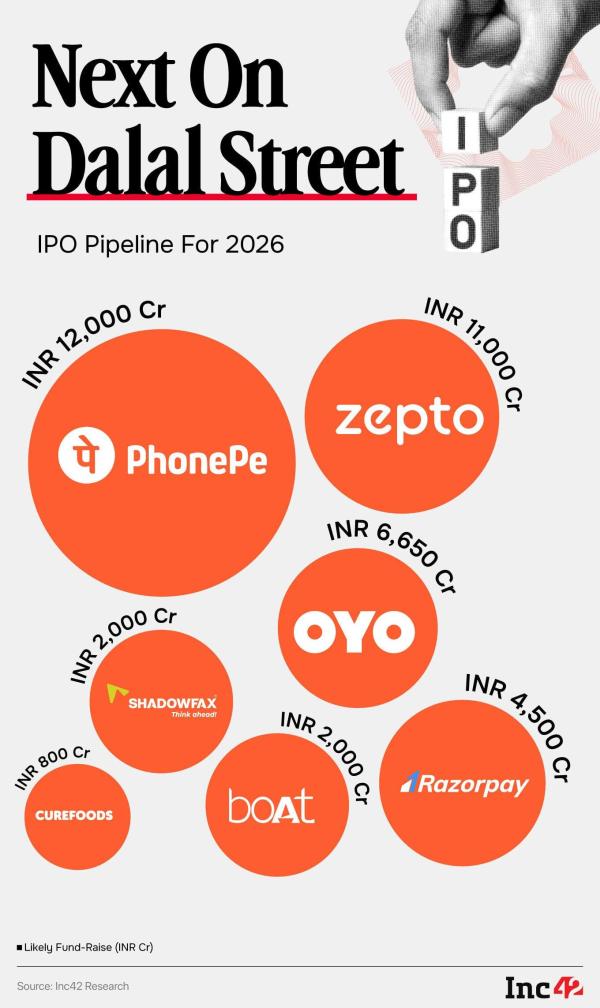
“The momentum for new-age IPOs remains strong. We anticipate a robust pipeline as large-scale digital businesses such as OYO and Zepto are expected to tap the primary market to mobilise growth capital,” Agarwal said.
As the market matured to the digital-era dynamics, it has learned to differentiate startups from traditional legacy businesses. Shifting their focus from historical earnings and cash flow that are traditionally used to evaluate a legacy business, market participants now zero in on the growth potential of new-age tech businesses and their ability to scale into sustainable, profitable enterprises.
The key metrics that analysts track include unit economics that is the most critical parameter for assessing the health of a business model, path to profitability that gives investors an estimate of how consistent has been the reduction in cash burn, inflexion point that gives an idea of how a company will follow the trajectory seen in the US and China and when the businesses would reach that point after a certain scale is achieved, and the total addressable market (TAM) that justifies the valuation of the company.
In step with the market, the perspective of bankers, too, has changed for the market-bound startups. “The engagement with startups hinges on price discovery among institutional investors,” Agarwal said. When meeting fund managers to determine a fair price band, the conversation revolves around a few points, he explained. These include the following:
Sustainability of unit economics: Can the margins hold at scale?
Competitive moats: How will the company fare against ‘deep-pocket’ competitors who might trigger price wars to disrupt the market?
Deployment of capital: How effectively will the mobilised funds be used to fuel non-linear growth?
A look at the startup IPO landscape throws up an intriguing fact. Many new-age companies are listed on the bourses but continue to grapple with losses. “While current losses are certainly a cause for concern, the market operates on the expectation of future consolidation. As digital and ecommerce penetration expands into tier III and tier IV cities, the opportunity grows exponentially,” he said.
The ‘challenge’ is mitigated if the company shows that it is becoming a cash-generating machine over time. Investors are willing to overlook short-term losses if the unit economics improve and the company moves towards a dominant market position where it can eventually exercise the pricing power.
Some 21 startups have so far filed their draft IPO papers with SEBI, while 25 more are in various stages of finalising their IPO plans for 2026. Out of these, unicorns like Flipkart, Zepto, OYO, InMobi, Fractal and Zetwerk alone could raise over INR 50,000 Cr, making it one of the largest years for startup IPO.
[Edited By Kumar Chatterjee]
The post SBI Securities Sees India’s New-Age IPO Cycle Entering A More Disciplined Phase In 2026 appeared first on Inc42 Media.
-
Recipe : A taste that everyone will like from kids to adults… Make Crispy ‘Paneer Bread Roll’ at home

-
NASA’s shocking prediction! Will the heat of the sun end life on earth? Find out what the scientists said

-
YouTube Income- Company pays this much money for getting 1000 views on YouTube, know complete details

-
Redmi K90 Max launched with 8550mAh battery, no more charging tension in powerful phones

-
LSG vs RR, IPL 2026: Ekana Cricket Stadium Pitch Report and Lucknow Weather Forecast | Read